|
|

|
National Wildlife Humane Society |
| Wildlife Conservation News |
|
|
|
| NWHS Intro |
| Tristan Oil Spill |
| Researching Wolverines |
| Right Whales |
| Disney's African Cats |

National Wildlife Humane Society
A wildlife conservation organization working to preserve and protect threatened and endangered species.
|

| |
|

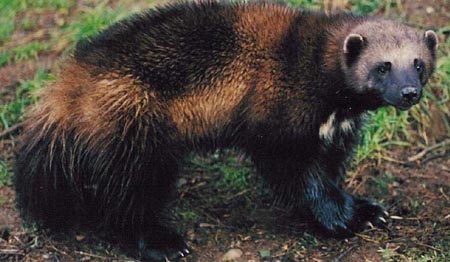
Researchers struggle to study and protect wolverines
Source:The Daily News Online BY:Rich Landers
Perhaps the only critter at the top of the food chain that's rarer and more set apart than a wolverine is the wolverine researcher. "Worldwide, maybe a dozen people are working on wolverine projects or pursuing research," said Jeff Copeland, who's been among that rare breed for 20 years.
"The fact that wolverines don't mess with human property, get in our garbage cans or prey on our livestock contributes to our lack of knowledge about them - there's no economic incentive for studying them," he said. Pound for pound, the wolverine is perhaps the toughest North American carnivore, legendary for cowing wolves, challenging grizzlies and for chewing its way out of traps. But unlike the others, it's a predator that shies from human habitats. Wolverines have been in the headlines in recent years as conservation groups have worked toward getting them listed as endangered species since the mid-1990s. In the past year, U.S. Fish and Wildlife Service evaluated wolverines for endangered status, but essentially put them on a waiting list... Click To View The Entire Article |
|
Endangered whales gathering off Cape Cod in record numbers
Source:Boston dot Com BY:Vivian Ho
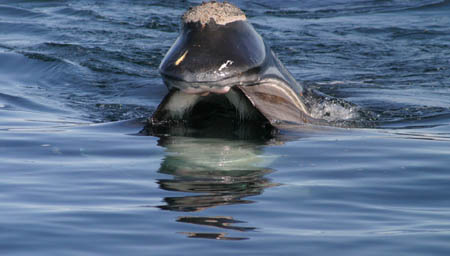
Whale watchers won’t even have to leave land to see a spectacular sight. A record number of the critically endangered North Atlantic right whales have gathered close off the beaches of Provincetown and Truro and is expected to stay there for at least another week, said Charles "Stormy" Mayo, senior scientist at the Center for Coastal Studies in Provincetown. Researchers counted more than 100 whales during an aerial survey Tuesday, with a preliminary count of more than 200 total, a little less than half of the known population. At some points the whales can be seen just a few yards offshore, to a quarter-mile out.
The whales are drawn to the area this time of year by the stores of zooplankton. Mayo said he thinks there are a large number of the whales there now because the area is particularly rich in zooplankton this year. "We don’t understand that particularly well, but it's clearly a combination of oceanographic processes and a lot of marine biology," Mayo said... Click To View Article In Full |
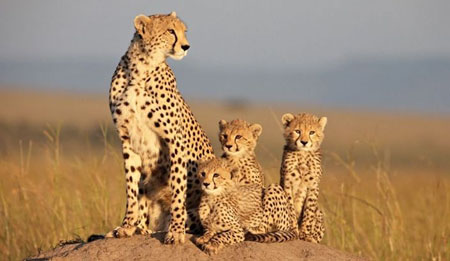
'African Cats' Disney brings African savannah alive
Source:The Weekly Herald BY:Robert Horton
The life of an antelope is a precarious one, especially in a nature documentary about big African cats. Not only will you be chased and devoured, you won't even get a cute name like the ones given to the lions and cheetahs. Truly, this is a walk-on role, until Disney decides to make "African Antelopes." But this film is called "African Cats," and the felines are the stars.
Narrator Samuel L. Jackson, who sounds like he relishes his role, introduces us to an area of savannah divided by a river. On one side of the river, a lion pride roams, led by an aging male (with an indecorous broken tooth hanging from his mouth). The focus is on a cub named Mara and her protective mother. On the other side, a lone cheetah raises her five tiny cubs. Although the emphasis is on cats, there are plenty of cameo appearances by other animals, including crocodiles, elephants, and hippopotami... Click To View The Article NWHS NOTE: Normally we wouldn't plug a movie, but the cinematic value, location and content should be worthy of the Earth Day (April 22) Disney release. This is an excellent way for parents and kids to share a movie concerning African big cats on the big screen. Parents take note, although rated G, there are some scenes of big cats attacking and devouring prey. It is real and it might be somewhat disturbing to children of a very young age. No more violent than today's video games though, which show far more gratuitous violence than this nature film. |
|
National Wildlife Humane Society Thank-you for allowing us into your email inbox. You are a valued member of NWHS and we look forward to providing you with current news concerning NWHS, other matters concerning wildlife, wildlife habitats and our wildlife rescue/sanctuary facility, "Top Of The Rock". Please invite other concerned humans to join our organization. It is our members that allow us to exist, expand and assist wildlife and precious wild habitat.
Humane is the responsibility of Humanity
FAIR USE NOTICE: This mailing may contain images and excerpts the use of which have not been pre-authorized. This material is made available for the purpose of analysis and critique, as well as to advance the understanding of political, media and cultural issues. All articles and commentary are provided as non-commercial, public educational and outreach content. The 'fair use' of such material is provided for under U.S. Copyright Law. In accordance with U.S. Code Title 17, Section 107, material on this mailing (along with credit links and attributions to original sources) is viewable for educational and intellectual purposes. If you are interested in using any copyrighted material from this mail for any reason that goes beyond 'fair use,' you must first obtain permission from the copyright owner.
Note: NWHS provides hyperlinks from email to third party sites as a convenience to users. NWHS does not endorse such third parties or the contents of any such sites. NWHS has no control over, makes no representation or warranty and disclaims all liability with respect to such sites. To use articles originated by NWHS, please use unaltered and provide a link back to NWHS. http://www.humanewildlife.org/ |
|
To Contact National Wildlife Humane Society
info@humanewildlife.org "A world without wildlife is a world not fit for humans"
Click Here To Visit NWHS Newsletter Archive
| | ||