Your support will make a difference! National Wildlife Humane Society has created this fundraising page in response to the MS Oliva shipwreck and the damage to endangered and threatened wildlife at the Tristan Islands. Please consider helping.
Tristan Wildlife Supporters
Your donations have been processed and forwarded.
(Thank-you!)
Tristan da Cunha Oil Spill Disaster
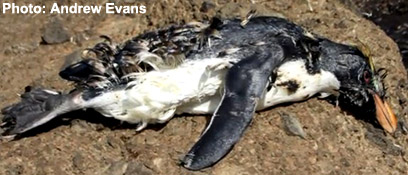
TRISTAN OIL SPILL MS Oliva ran aground on Nightingale Island on 16th March 2011. All 22 crew were rescued by March 17th before the ship broke up and now Nightingale Island is facing an environmental catastrophe.
This major oil spill off the coast of Nightingale Island in the South Atlantic, has potentially impacted 200,000 endangered Rockhopper Penguins. The combination of harsh conditions, remote location and external factors has combined to put the largest population of Northern Rockhoppers on the verge of extinction.
The Tristan da Cunha island group represents the second largest concentration of sea birds in the world. Half of the world’s endangered Northern Rockhopper Penguin population is found here. Nightingale Island holds more than 100,000 pairs of Northern Rockhopper Penguins, 20,000 pairs of Albatrosses including the Yellow Nose Albatross, and 2,000,000 pairs of Broadbill Prions. The island is also home to the highly-endangered Tristan Bunting. Only 50 pairs remain in the world, all of which are found on Nightingale Island.
You can help impacted wildlife by donating to our Tristan da Cunha Oil Spill Project. Your donations will be used to assist and support follow-up monitoring and to assess the full impact of this disaster.
NWHS NOTE:
The immediate crisis of oiled rockhopper penguins has been resolved. The Tristan islanders, with the assistance of representatives of SANCCOB and a representative of The Royal Society for the Protection of Birds, did everything possible to save as many rockhopper penguins as possible. Many penguins were saved, but sadly many also died. The vast majority of rockhopper penguins were vacating the islands after molting and it is unknown how many became oiled in this process. The penguins will return in August/September to breed, lay and hatch eggs, and biologists will then better know the extent of rockhopper losses.
The clean-up of oil on the islands shores and rocks continues on. There is a possibility of more toxins being released from the freighter Oliva as the salvage process begins (hydraulic fluids, crankcase oils, coolant fluids, battery acid, etc.) which would also pose further problems. Obviously there is a great deal of work ahead for the islanders and involved conservation organizations. Your support will also be used to fund follow-up monitoring and to assess the full impact of this disaster. Public assistance is greatly needed and appreciated.
Due to conclusion of the initial crisis and clean-up of wildlife, NWHS has removed the direct donation box.
We wish to express gratitude to those who donated through NWHS. Your donations have been forwarded, in full, to The Foundation for Antarctic Research as previously stated on this page.
We encourage those who would be so kind to continue to assist, to explore the donation link provided below.