|
|

|
National Wildlife Humane Society |
| Wildlife Conservation News |
|
|
|
| NWHS Intro |
| Catching Cougars |
| Tigers In Kazakhstan |
| Thailand Seizes Lizards |
| Gray Wolves Delisted |

National Wildlife Humane Society
A wildlife conservation organization working to preserve and protect threatened and endangered species.
|

| |
|



Tiger to return to Central Asia
Source:Telegraph UK BY:Richard Orange, Almaty
World Wildlife Fund announced on Thursday that it had secured the agreement of Kazakhstan, a former Soviet republic the size of Western Europe, to reintroduce Amur Tigers from the Russian Far East. A recent study demonstrated that Amur tigers are genetically very close to the extinct Caspian Tiger, and the Ily River delta, just south of Kazakhstan's Balkhash Lake, has been selected as an ideal habitat for reintroduction.
The Caspian Tiger once populated a swathe of Eurasia stretching from eastern Turkey to north-west China, but died out forty years ago due to habitat destruction and hunting. No tiger has been recorded in the Ily River Delta since 1948. "This will be the first time that the tiger has returned to an area where it's become completely extinct," said Olga Pereladova, the head of WWF in Kazakhstan. "The tiger is a flagship species on top of the ecosystem, and to be able to introduce the tiger, we need to restore all the other species which used to be there." The program requires Kazakhstan to establish its first national park across 400,000 hectares of the Ily River basin, and try to build up a sufficient population of prey species such as wild boar and deer before tigers to be reintroduced in five to ten years' time. Tigers have been successfully reintroduced in parts of India where they've become extinct. WWF has also looked into reintroducing tigers to the Amu Darya river basin in neighbouring Uzbekistan... Click To View The Source Article |
|
Thailand seizes 1,800 monitor lizards from trucks
Source:Emirates 24/7
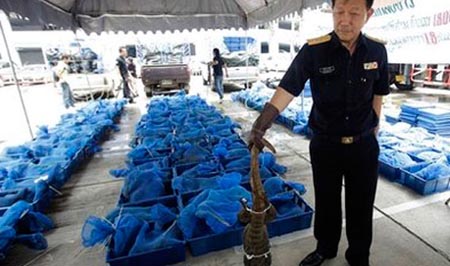
Authorities in Thailand have seized 1,800 monitor lizards being smuggled on pickup trucks to the capital. Customs officials say the Bengal monitor lizards were hidden in mesh bags and stashed in open containers behind boxes of fruit in three pickup trucks. They were seized Thursday at a checkpoint in southern Thailand.
Customs Department chief Prasong Poontaneat said Friday he suspects the lizards were destined to be eaten. He said their meat sells for $7.50-$15 per pound ($16-$33 per kilogram) in China, making them worth more than $60,000. International trade in the reptiles is banned. In Thailand, illegal sale of wildlife carries a penalty of up to four years in prison and a fine of $1,300... Click To View Article At Source |

Micromanaging the gray wolf
Source:Washington Post via Tampa Bay Online
Among the policy riders added to this year's budget deal was a measure removing the gray wolf in Idaho and Montana from the endangered species list, ending a years long battle between environmentalists and ranchers in those states. The measure has bipartisan support, and neither party's base is going to war over it. Still, there is reason to worry about this one, too.
Defenders of Congress' move to delist the gray wolf insist that lawmakers aren't substituting political decisions for scientific ones. The Interior Department tried to do the same thing in 2009 after concluding that Idaho and Montana had adequate state-level management plans for their wolf populations, which had stabilized and were harassing herds of livestock. Environmentalists challenged that determination in court, arguing that Interior couldn't delist part of the northern Rockies' gray wolf population and not the rest, which resides in Wyoming and nearby states. A district court judge agreed. The parties tried to settle, but not all the plaintiffs signed on to a proposed settlement, and the judge continued to object. Congress' rider short-circuits these judicial proceedings by simply reissuing Interior's 2009 determination, mooting any legal questions about how the Endangered Species Act can be applied in this case. But that does nothing to clarify how the act should operate in other cases, and whether the law more broadly needs improvement. Instead, it sets a precedent of congressional micromanagement. In this instance, the science doesn't seem to suggest a different practical outcome for the gray wolf. But will that be so the next time a member of Congress wants his or her own exception written into endangered species law? Click To View The Article |
|
National Wildlife Humane Society Thank-you for allowing us into your email inbox. You are a valued member of NWHS and we look forward to providing you with current news concerning NWHS, other matters concerning wildlife, wildlife habitats and our wildlife rescue/sanctuary facility, "Top Of The Rock". Please invite other concerned humans to join our organization. It is our members that allow us to exist, expand and assist wildlife and precious wild habitat.
Humane is the responsibility of Humanity
FAIR USE NOTICE: This mailing may contain images and excerpts the use of which have not been pre-authorized. This material is made available for the purpose of analysis and critique, as well as to advance the understanding of political, media and cultural issues. All articles and commentary are provided as non-commercial, public educational and outreach content. The 'fair use' of such material is provided for under U.S. Copyright Law. In accordance with U.S. Code Title 17, Section 107, material on this mailing (along with credit links and attributions to original sources) is viewable for educational and intellectual purposes. If you are interested in using any copyrighted material from this mail for any reason that goes beyond 'fair use,' you must first obtain permission from the copyright owner.
Note: NWHS provides hyperlinks from email to third party sites as a convenience to users. NWHS does not endorse such third parties or the contents of any such sites. NWHS has no control over, makes no representation or warranty and disclaims all liability with respect to such sites. To use articles originated by NWHS, please use unaltered and provide a link back to NWHS. http://www.humanewildlife.org/ |
|
To Contact National Wildlife Humane Society
info@humanewildlife.org "A world without wildlife is a world not fit for humans"
Click Here To Visit NWHS Newsletter Archive
| | ||