|
|

|
National Wildlife Humane Society |
| Wildlife Conservation News |
|
|
|
| NWHS Intro |
| China's Ivory Demand |
| Tristan Oil Spill |
| Water At The Milgis |
| Arabian Leopards |

National Wildlife Humane Society
A wildlife conservation organization working to preserve and protect threatened and endangered species.
|

| |
|
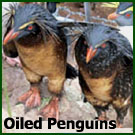

Tristan da Cunha Oil Spill Project
Source:National Wildlife Humane Society WebNews
National Wildlife Humane Society and The Foundation for Antarctic Research (FAR) have teamed up to heighten public awareness of this ecological disaster and generate much needed funding to provide assistance.
MS Oliva ran aground on Nightingale Island on 16th March 2011. All 22 crew were rescued by March 17th before the ship broke up and now Nightingale and surrounding islands are facing an environmental catastrophe. This major oil spill off the coast of Nightingale Island, in the South Atlantic, has affected more than 20,000 endangered Northern Rockhopper Penguins. The combination of harsh conditions, remote location and external factors has combined to put the largest population of Northern Rockhoppers in grave danger. The Tristan da Cunha island group represents the second largest concentration of sea birds in the world. Half of the world’s endangered Northern Rockhopper Penguin population is found here. Nightingale Island holds more than 100,000 pairs of Northern Rockhopper Penguins, 20,000 pairs of Albatrosses including the Yellow Nose Albatross, and 2,000,000 pairs of Broadbill Prions. The island is also home to the highly endangered Tristan Bunting. Only 50 pairs remain in the world, all of which are found on Nightingale Island... Click To View The Entire Article At NWHS WebNews Learn more about this oil spill and how you can Help Click To View The Special NWHS/FAR Tristan Oil Spill Web Page At NWHS NWHS NOTE: NWHS has created a special Tristan Oil Spill YouTube Presentation. Click To View The NWHS/FAR Tristan Presentation At YouTube |
|
What a wonderful show of GRATITUDE!
Source:Dr. Richard Leakey's WildlifeDirect BY:Helen Douglas-Dufresne, Northern Kenya
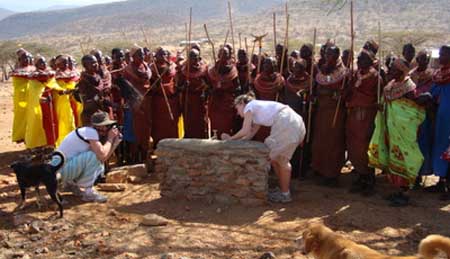
YES, and this THANKS is to VOSS FOUNDATION, from every one who lives at Ndonyo Nasipa! A very special occasion for the Samburu people, THANK YOU FOR DRINKING WATER.
100s and 100s of Samburu women, dressed in FULL celebration gear, came from far and wide to witness this special day. Kara, from VOSS FOUNDATION came all the way from America to turn on the tap, to the sounds of the beautiful voices of the women. The music all day was absolutely fabulous. To open the water project we walked, with 8 women from Norway and America, from the Milgis (for 2 days) with camels carrying our camp, to witness this special day with the Samburu people of Ndonyo Nasipa. At the top of the hill we were met by the chief, councillor, and many Elders, who accompanied us down to where some women were waiting for us to officially 'TURN ON THE WATER'... Click To View Article And Very Cool Photos at WildlifeDirect NWHS NOTE: Milgis Trust is a conservation ally of NWHS. Their conservation work covers 8,000 sq. km of very remote northern Kenya. Visit their NWHS Ally page to learn more about their incredible work and view their video. Click To View The Milgis Trust At NWHS |

Ghost safari: spotting leopards in Oman
Source:Guardian UK News BY:Kevin Rushby
In the mountains of Oman, visitors can join the only conservation project in the world trying to save the endangered, and elusive, Arabian leopard.
Khalid stopped the pick-up truck and inspected the ground ahead in the light of the headlamps. There were a few tiny greyish plants on a gently convex plateau of jagged loose rocks. It felt like we had landed on a small and rather inhospitable planet. There was no track, and hadn't been for the past few miles, not since we had stopped to look at a wolf track in the dust. "This is it," he said, "our campsite." He grinned. "It's not as bad as it looks, there'll be enough firewood to boil a kettle, and in the morning, you'll see, it's a good view." The rest of the team were coming up in two cars. "And leopards?" I asked, "Are they here?" Khalid made a face. "Insha'Allah [God willing]. There's a trail camera near here which we'll check tomorrow." He jumped out of the car and started unloading, a man used to this life of remote camps in the Dhofar mountains of Oman. As a wildlife protection officer with Oman's Arabian leopard project, Khalid is on the front line when it comes to saving one of the world's rarest creatures. There are probably fewer than 200 individual Arabian leopards left in the wild, mostly in Oman, Yemen and Saudi Arabia... Click To View The Full Article And Photos |
|
National Wildlife Humane Society Thank-you for allowing us into your email inbox. You are a valued member of NWHS and we look forward to providing you with current news concerning NWHS, other matters concerning wildlife, wildlife habitats and our wildlife rescue/sanctuary facility, "Top Of The Rock". Please invite other concerned humans to join our organization. It is our members that allow us to exist, expand and assist wildlife and precious wild habitat.
Humane is the responsibility of Humanity
FAIR USE NOTICE: This mailing may contain images and excerpts the use of which have not been pre-authorized. This material is made available for the purpose of analysis and critique, as well as to advance the understanding of political, media and cultural issues. All articles and commentary are provided as non-commercial, public educational and outreach content. The 'fair use' of such material is provided for under U.S. Copyright Law. In accordance with U.S. Code Title 17, Section 107, material on this mailing (along with credit links and attributions to original sources) is viewable for educational and intellectual purposes. If you are interested in using any copyrighted material from this mail for any reason that goes beyond 'fair use,' you must first obtain permission from the copyright owner.
Note: NWHS provides hyperlinks from email to third party sites as a convenience to users. NWHS does not endorse such third parties or the contents of any such sites. NWHS has no control over, makes no representation or warranty and disclaims all liability with respect to such sites. To use articles originated by NWHS, please use unaltered and provide a link back to NWHS. http://www.humanewildlife.org/ |
|
To Contact National Wildlife Humane Society
info@humanewildlife.org "A world without wildlife is a world not fit for humans"
Click Here To Visit NWHS Newsletter Archive
| | ||