|
|

|
National Wildlife Humane Society |
| Wildlife Conservation News |
|
|
|
| NWHS Intro- |
| Korean Zoo Tigers- |
| Lioness Injured- |
| Western Tragopan- |
| Africa Wildlife Losses- |
|
NWHS 
National Wildlife Humane Society
A wildlife conservation organization working to preserve and protect threatened and endangered species.
|
Quick Links |

| |
|



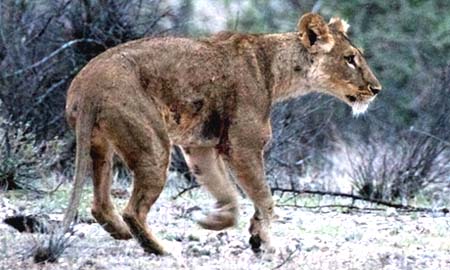
Ambassador Lioness Severely Wounded
Source:Ewaso Lions Blog at WildlifeDirect
Our favorite local lion, Magilani, has been critically injured. We don't yet know how she was injured or what her outlook is. But she is alive and she is with her two cubs, and she can move around. We are doing everything we can to find her and assess the situation and her status. Here's what has happened so far. On Monday, we drove to Arusha, Tanzania for the ATBC-SCB Conference (Assoc. for Tropical Biology and Conservation & Society for Conservation Biology Conservation Africa Section). Just as we were settling in we got a call that a severely wounded lion had been spotted in the Conservation Area just next to our camp. Trying to get all the facts and coordinate everyone involved from Tanzania was next to impossible, so we decided to pack up, cancel our participation in the conference and rush back to Samburu.
At the time, we didn't know which lion was injured. Based on photos taken by a guest at Sasaab Lodge, we couldn't ID the lion or decide with certainty how she was injured, but we could see bloody wounds on her right chest and right foreleg. However, it was hard to really assess her status from photos alone and we really needed to see her. On Friday our hearts sank when we found the lion and confirmed it was Magilani, the lioness who lives with her two adolescent cubs in the Conservation Area in Westgate Community Conservancy. We were the first people to see and ID her and have been monitoring her for the past 2+ years. She serves as an ambassador lion and has become famous among the community... Click To View The Ewaso Lions' Entire Blog Post At WildlifeDirect |
|
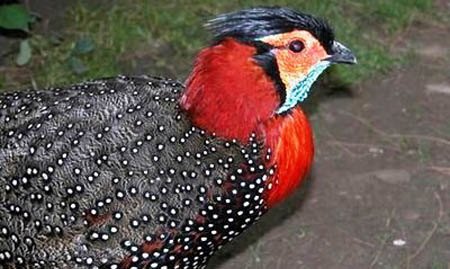
Two new populations of Endangered Western Tragopan discovered
Source:Wildlife Extra News
INDIA: The extremely rare western tragopan has been recorded at two new sites along the Pir Panjal range in Jammu and Kashmir. Sightings and calls of the pheasant were validated at the Kalamund-Tatakuti and Khara Rakh areas of the range. A Schedule I species on the Indian Wildlife (Protection) Act and listed as 'Vulnerable' by the IUCN Red List, the western tragopan is a medium-sized, brightly coloured pheasant endemic to the western Himalayas and inhabits coniferous forests. Locals had talked about seeing the bird in April - but its presence was confirmed the following month.
"The bird is extremely shy and silent. But knowing that the best way to locate the species would be during its breeding season, when it becomes highly vocal, we returned in May," said Riyaz Ahmad, the team leader and assistant manager, species division of WTI (Wildlife Trust of India). A victim of rampant poaching for its meat and plumage and habitat degradation and fragmentation, the western tragopan has previously been reported only from Kazinag range and Kishtawar National Park in the state. A few scattered records occur from Sud Mahadeo area of Jammu province... Click To View Article In Full |
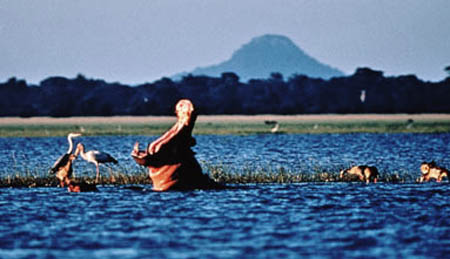
Africa's declining wildlife
Source:Guardian UK BY: John Vidal
Major national parks and wildlife reserves across Africa lost up to 60% of their lions, giraffes, buffalo and other large wild animals between 1970 and 2005, raising the spectre of wildlife on the continent soon being confined to isolated pockets dependent on international money for protection.
Researchers at the Zoological Society of London (ZSL) and the University of Cambridge studied animal population changes at 78 protected areas across Africa and found the steepest falls in west Africa, where up to 85% of wildlife had been lost in the last 35 years, and in east Africa, where nearly half of all wildlife has disappeared. The research, which was collated from parks including popular tourist safari destinations such as the Masai Mara in Kenya and the Serengeti in Tanzania, and published last year, found increases only in southern Africa. The cause of the continent-wide decline has been attributed mainly to the lack of money and people needed to police parks, as well as the encroachment of humans on animal habitats. In addition, war and the growing bushmeat trade is said to have decimated populations... Click To View The Entire Article |
|
National Wildlife Humane Society Thank-you for allowing us into your email inbox. You are a valued member of NWHS and we look forward to providing you with current news concerning NWHS, other matters concerning wildlife, wildlife habitats and our wildlife rescue/sanctuary facility, "Top Of The Rock". Please invite other concerned humans to join our organization. It is our members that allow us to exist, expand and assist wildlife and precious wild habitat.
Humane is the responsibility of Humanity
FAIR USE NOTICE: This mailing may contain images and excerpts the use of which have not been pre-authorized. This material is made available for the purpose of analysis and critique, as well as to advance the understanding of political, media and cultural issues. All articles and commentary are provided as non-commercial, public educational and outreach content. The 'fair use' of such material is provided for under U.S. Copyright Law. In accordance with U.S. Code Title 17, Section 107, material on this mailing (along with credit links and attributions to original sources) is viewable for educational and intellectual purposes. If you are interested in using any copyrighted material from this mail for any reason that goes beyond 'fair use,' you must first obtain permission from the copyright owner.
Note: NWHS provides hyperlinks from email to third party sites as a convenience to users. NWHS does not endorse such third parties or the contents of any such sites. NWHS has no control over, makes no representation or warranty and disclaims all liability with respect to such sites. To use articles originated by NWHS, please use unaltered and provide a link back to NWHS. http://www.humanewildlife.org/ |
|
To Contact National Wildlife Humane Society
info@humanewildlife.org "A world without wildlife is a world not fit for humans"
Click Here To Visit NWHS Newsletter Archive
| | ||