|
|

|
National Wildlife Humane Society |
| Wildlife Conservation News |
|
|
|
| NWHS Intro- |
| Gray Wolf Hysteria- |
| Baby Elephant Rescue- |
| Black Rhinos Increase- |
| Unicorn Returns- |

National Wildlife Humane Society
A wildlife conservation organization working to preserve and protect threatened and endangered species.
|
Quick Links |

| |
|



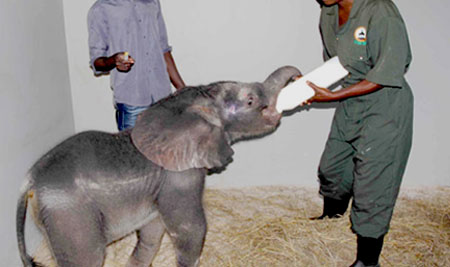
Baby elephant rescued from island
Source:Daily Monitor BY:Martin Ssebuyira
The Uganda Wildlife Authority (UWA) has rescued a two month old male baby elephant abandoned at Hamukungu Island on Lake George, near Katunguru trading centre in Kasese District. The elephant named Charles Hamukungu after the fisherman who picked it and the island it was rescued from, was left behind by an elephant family from Queen Elizabeth National Park after fracturing its leg. "He carried it in the boat to Hamukungu landing site and we called UWA rangers who carried it to UWA ranger post at Katunguru where they have been looking after it for two months," Mr Alex Egawu, an animal caretaker, who has looked after the elephant at Katunguru, said.
He said the baby elephant received treatment from Dr Margaret Driciru, a veterinary doctor, while at Katunguru, adding that UWA officials resolved to take it to the Uganda Wildlife Educational Centre (UWEC) in Entebbe. UWEC spokesperson Belinda Atim said the animal is in a healthy condition. The centre's boss, Mr James Musinguzi, said the animal takes about two litres of milk per meal. "It has four meals a day as its still under the quarantine for one month," Mr Musinguzi said, adding that they will prepare it a new home in a natural environment where people can get education about elephants. Mr Musinguzi said: "We recently rescued 220 parrots and feeding them costs Shs300,000 a day. This is quite expensive. We call upon stakeholders to join the struggle to conserve the endangered species"... Click To View The Source Article |
|
Black rhino population increasing
Source:New Era BY:Albertina Nakale
WINDHOEK – The Ministry of Environment and Tourism (MET) is set to increase the number of endangered black rhino in the country to 1500 beasts by the end of 2011. In 2002, the black rhino population was estimated at 750 when Namibia's rhino management plan was developed. Based on MET surveys conducted in 2009, Namibia's black rhino population already exceeds 1500.
This information is contained in a report of the MET tabled by its Minister Netumbo Nandi-Ndaitwah in parliament on Tuesday. A comprehensive document on the status of Namibia's rhino was developed in 2009. "This will guide the development of an updated rhino strategy," the report states. Etosha National Park's rhino are considered a key population, according to the report. The report says most animals have been trans-located to private farms and conservancies, under the successful rhino custodianship programme. Other rhino sub-populations are found in three other national protected areas and conservancies in the Western Kunene Region... Click To View Article In Full |

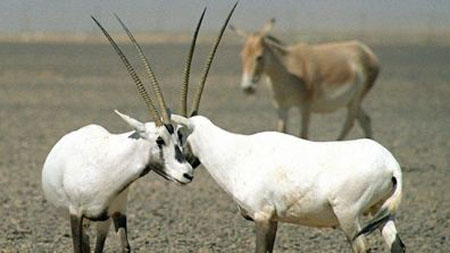
Arabian 'unicorn' no longer extinct
Source:Guardian UK
An antelope species, widely believed to be the source of the unicorn legend and hunted to extinction in the wild, has been brought back from the brink, conservationists said today as they unveiled the latest update on threatened species. It is thought the last wild Arabian oryx was shot in 1972, but a successful captive breeding programme and reintroduction efforts mean its population now stands at 1,000 in its wild home of the Arabian peninsula.
It has moved from "endangered" to the less-serious category of "vulnerable" in the latest red list of threatened species, the International Union for Conservation of Nature (IUCN) said. It is the first time a species that was once classified as extinct in the wild has improved its fortunes to such an extent, the IUCN said. Razan Khalifa Al Mubarak, director general of the Environment Agency Abu Dhabi, said: "To have brought the Arabian oryx back from the brink of extinction is a major feat and a true conservation success story, one which we hope will be repeated many times over for other threatened species. "It is a classic example of how data from the IUCN red list can feed into on-the-ground conservation action to deliver tangible and successful results." Despite the conservation victory, the latest update of the red list reveals that of the 19 species of frogs, toads and salamanders added to the the list this year, eight are critically endangered... Click To View The Entire Article |
|
National Wildlife Humane Society Thank-you for allowing us into your email inbox. You are a valued member of NWHS and we look forward to providing you with current news concerning NWHS, other matters concerning wildlife, wildlife habitats and our wildlife rescue/sanctuary facility, "Top Of The Rock". Please invite other concerned humans to join our organization. It is our members that allow us to exist, expand and assist wildlife and precious wild habitat.
Humane is the responsibility of Humanity
FAIR USE NOTICE: This mailing may contain images and excerpts the use of which have not been pre-authorized. This material is made available for the purpose of analysis and critique, as well as to advance the understanding of political, media and cultural issues. All articles and commentary are provided as non-commercial, public educational and outreach content. The 'fair use' of such material is provided for under U.S. Copyright Law. In accordance with U.S. Code Title 17, Section 107, material on this mailing (along with credit links and attributions to original sources) is viewable for educational and intellectual purposes. If you are interested in using any copyrighted material from this mail for any reason that goes beyond 'fair use,' you must first obtain permission from the copyright owner.
Note: NWHS provides hyperlinks from email to third party sites as a convenience to users. NWHS does not endorse such third parties or the contents of any such sites. NWHS has no control over, makes no representation or warranty and disclaims all liability with respect to such sites. To use articles originated by NWHS, please use unaltered and provide a link back to NWHS. http://www.humanewildlife.org/ |
|
To Contact National Wildlife Humane Society
info@humanewildlife.org "A world without wildlife is a world not fit for humans"
Click Here To Visit NWHS Newsletter Archive
| | ||