|
|

|
National Wildlife Humane Society |
| Wildlife Conservation News |
|
|
|
| NWHS Intro |
| Sharks At Beach |
| Orphan Tiger Moved |
| Penguin Shuffle |
| Smuggled Turtles Seized |

National Wildlife Humane Society
A wildlife conservation organization working to preserve and protect threatened and endangered species.
|

| |
|



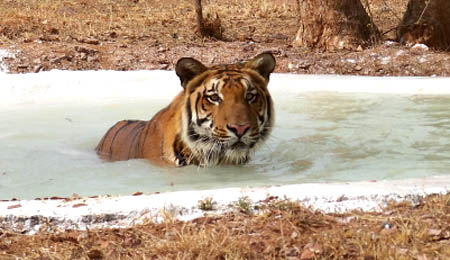
Orphaned tiger gets a new home at Van Vihar
Source:Wildlife Trust of India
Bhopal, May 23, 2011: After a five-day journey covering 2012 kms, the male tiger on its way from the Centre for Wildlife Rehabilitation and Conservation (CWRC) in Assam safely reached its destination, the Van Vihar National Park, on Friday evening. The four year old animal was accompanied by two veterinarians and two animal keepers. "Our prime focus through the journey was to ensure the animal's safety and to minimise the stress on it. The weather was favourable for the most part of the journey and we’re glad that it is now in a safe environment," said Dr Anthony Nokso Phangcho, who looked after the tiger along with Dr Anil Deka and animal keepers Lakhiram Das and Tarun Gogoi.
"With the arrival of this animal, the count of Royal Bengal tigers here has reached 10 and breeding among the big cats is likely to get a boost," said SS Rajput, Acting Director of the Zoo. "This being a wild tiger will benefit the gene pool of tigers at Van Vihar." The tiger, Vivek, was rescued from a tea estate by the Assam Forest Department and IFAW-WTI veterinarians in December 2007. "Of the 12 tigers handled so far by WTI, Vivek has stayed the longest in captivity," said Dr NVK Ashraf, Chief Veterinarian, WTI. "While other tigers spent less than a year with WTI, Vivek had to wait for three and half years to get his placement right. He will now contribute to the National Tiger Conservation Breeding program at Van Vihar Zoo in Bhopal"... Click To View The Source Article NWHS NOTE: While not involved with this Wildlife Trust of India (WTI) captive tiger project, NWHS and WTI are allies in the Wild Tiger Conservation Program. To learn more about the projects involved in conserving and protecting wild tigers in India, please visit the NWHS-WTI Alliance web page, at the NWHS web site. Learn how you can assist wild tigers! Click - Wildlife Trust of India's Ally Page & Video At NWHS |
|
Emperor Penguins Rotate Through Giant Huddle for Warmth
Source:Wired Science BY:Jane J. Lee
Massive huddles of male Emperor penguins are crucial to keeping warm during Antarctica's brutal winter while they incubate their eggs. These tightly packed penguins shuffle en mass every 30 to 60 seconds, reordering themselves so every individual gets to cycle through the warm, central part of the huddle. The trick with these groups is to get the packing just right. If the penguins are too loosely arranged, they won't stay warm enough, said Daniel Zitterbart, Barbara Wienecke, James Butler and Ben Fabry in a June 1 study in PloS One. But if they're too tightly jammed together, they can't rearrange themselves, and animals on the edge of the huddle won't get a chance to warm up.
By taking small, 2 to 4 inch steps every minute or so, the penguins achieve maximum packing density. It's like tapping on a can of flour to jiggle everything into the bottom. But the shuffling also results in a wave of movement that rolls through the group and rotates every bird through the warmest parts of the huddle. Penguins can join the group on one end, cycle through the huddle and exit on the other end. This creeping movement also means that different groups can merge into larger huddles. The international team of researchers kept track of emperor penguin groups near a German research station in Antarctica using time-lapse photography. While charting the path of individuals over a four hour period, the authors found that when the huddles remained still, they were tightly jammed. But once the shuffling wave started through the group, individuals ended up creeping their way through the huddle... Click To View Article In Full |

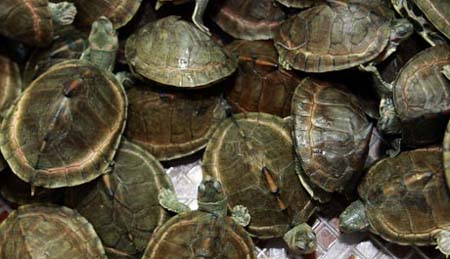
Thai Customs seize hundreds of smuggled turtles
Source:Guardian UK
Thai Customs have found 451 turtles worth 1 million baht (£20,000) stashed in suitcases offloaded from a passenger flight from Bangladesh, in the latest seizure of live animals at Bangkok's Suvarnabhumi airport. Turtles of varying sizes worth around 2,000 baht apiece in Thai markets, and seven false gavials, a type of freshwater crocodile worth 10,000 baht each, were found on Thursday in small bags packed into cases after authorities received a tip-off that a known trafficker was travelling to Thailand. The alleged trafficker, a Bangladeshi national, did not collect the luggage and fled on arrival in Bangkok, customs officials said.
The discovery was the biggest since September last year, when 1,140 turtles were found by Customs in a single day. A further 218 were seized a month later. Customs officials at Suvarnabhumi often seize reptiles and small animals in luggage. They found a two-month old tiger cub in a bag last August, which was concealed by stuffed tiger toys and bound for Iran. Prasong Poontaneat, director-general of Thailand's Customs department, said it was likely the turtles were destined for Bangkok's Chatujak market, a sprawling mass of 11,000 stalls and shops that has a dedicated pet section where endangered species are sometimes sold. Although Thailand has been at the forefront of a regional effort to combat wildlife trafficking, the country's multiple airports, sea ports and road network make it a major transit point for other destinations... Click To View The Article At Source |
|
National Wildlife Humane Society Thank-you for allowing us into your email inbox. You are a valued member of NWHS and we look forward to providing you with current news concerning NWHS, other matters concerning wildlife, wildlife habitats and our wildlife rescue/sanctuary facility, "Top Of The Rock". Please invite other concerned humans to join our organization. It is our members that allow us to exist, expand and assist wildlife and precious wild habitat.
Humane is the responsibility of Humanity
FAIR USE NOTICE: This mailing may contain images and excerpts the use of which have not been pre-authorized. This material is made available for the purpose of analysis and critique, as well as to advance the understanding of political, media and cultural issues. All articles and commentary are provided as non-commercial, public educational and outreach content. The 'fair use' of such material is provided for under U.S. Copyright Law. In accordance with U.S. Code Title 17, Section 107, material on this mailing (along with credit links and attributions to original sources) is viewable for educational and intellectual purposes. If you are interested in using any copyrighted material from this mail for any reason that goes beyond 'fair use,' you must first obtain permission from the copyright owner.
Note: NWHS provides hyperlinks from email to third party sites as a convenience to users. NWHS does not endorse such third parties or the contents of any such sites. NWHS has no control over, makes no representation or warranty and disclaims all liability with respect to such sites. To use articles originated by NWHS, please use unaltered and provide a link back to NWHS. http://www.humanewildlife.org/ |
|
To Contact National Wildlife Humane Society
info@humanewildlife.org "A world without wildlife is a world not fit for humans"
Click Here To Visit NWHS Newsletter Archive
| | ||