|
|

|
National Wildlife Humane Society |
| Wildlife Conservation News |
|
|
|
| NWHS Intro |
| Mtn. Lion In Garage |
| Baby Musk Oxens Saved |
| Top 10 New Species |
| Lion Steals Camera |

National Wildlife Humane Society
A wildlife conservation organization working to preserve and protect threatened and endangered species.
|

| |
|



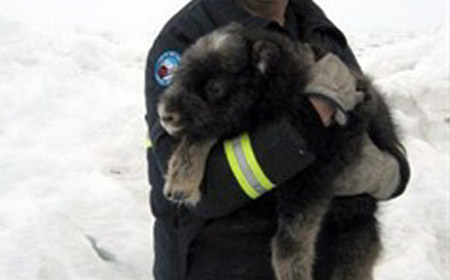
2 newborn musk oxen rescued days apart on Alaska's North Slope
Source:Seattle Times BY:Rachel D'Oro
Two newborn musk oxen were rescued days apart on Alaska's North Slope after they became separated from the same wild herd, likely scattered by a grizzly bear. One of the female calves was rescued earlier this month by trans-Alaska oil pipeline workers and the other by a state field biologist conducting research on musk oxen populations. The calves, believed to have been born around May 9, 2011 were faltering when they were rescued but are now rebounding at the University of Alaska Fairbanks' Large Animal Research Center.
"Both of them are gaining weight and doing really well," UAF attending veterinarian John Blake said Friday of the 28-pound animals, which look somewhat like stuffed toys. The calves were just days old when they were found in the same vicinity about 70 miles south of the Prudhoe Bay oil field, according to Alaska Fish and Game Department spokeswoman Cathie Harms. The calf rescued by workers of Alyeska Pipeline Service Co. was to be transferred to the Alaska Zoo in Anchorage Friday, Harms said. The other calf will remain with the UAF center herd. "It's very, very rare for wild musk ox calves to get brought to other homes," Harms said. "This is a real unique situation." Musk oxen were once native to Alaska but were hunted to extinction several hundred years ago. The animals were reintroduced, starting with a small herd from Greenland in the 1930s... Click To Read The Article In Entirety |
|
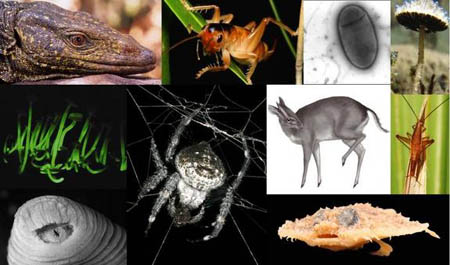
Top 10 New Species List Of 2010 Announced
Source:Live Science BY:Jennifer Walsh
This year's top 10 come from around the world, including Brazil, the Gulf of Mexico, the Mascarene Islands in the Indian Ocean, Madagascar, the North Atlantic Ocean, Oregon, Peru, the Philippines, South Africa and West Africa. [See a Gallery of Top 10 New Species]
The top 10, in no specific order, include: * T.-rex leech: The Tyrannobdella rex leech, which sports gigantic teeth, was found in the nostril of a 9-year-old girl by Peruvian physician Renzo Arauco-Brown. * Titanic bacterium: Found at the bottom of the ocean, at the site of the RMS Titanic shipwreck, this iron-eating bacterium named Halomonas titanicae. The bacterium sticks to steel surfaces, creating knob-like mounds of corrosion products, called "rusticles." * Pancake batfish: The odd fish seems to hop on its thick, arm-like fins as it moves awkwardly in the water, resembling a walking bat. It was discovered in the Gulf of Mexico. * Glowing fungus: Lighting up the top 10 is a luminescent fungus collected in Sao Paulo, Brazil, which have gel-coated stems that emit a bright, yellowish-green light constantly. * Jumping cockroaches: As if cockroaches weren't creepy enough on the ground, one discovered last year has legs that are highly modified for jumping, putting its ability on par with grasshoppers. Named Saltoblattella montistabularis, the cockroach was discovered in the Mountain National Park in South Africa. * Monitor lizard: At more than 6 feet (1.8 meters) in length, a fruit-eating monitor lizard discovered in the Philippines is the lengthiest species to make this year's top 10. The blue, black, green and gold lizard, named Varanus bitatawa, weighs in at 22 pounds and spends most of its time in trees. * Dead antelope: A new antelope, named Philantomba walteri, was discovered in West Africa, but sadly it was already dead: it was discovered at a bushmeat market. * Raspy cricket: Glomeremus orchidophilus made the list for its distinction of being the only pollinator of the rare and endangered orchid Angraecum cadetii in the Mascarene Archipelago in the Indian Ocean. * Gilled mushroom: Called Psathyrella aquatica, this gilled mushroom was found in the northwestern United States submerged in the clear, cold, flowing waters of the upper Rogue River in Oregon. * Giant orb-weaver: A giant orb-weaving spider discovered in Madagascar makes webs that can span rivers, streams and lakes. Its silk is more than two times stronger than any other known spider silk. "We can only realistically aspire to sustainable biodiversity if we first learn what species exist to begin with. Our best guess is that all species discovered since 1758 represent less than 20 percent of the kinds of plants and animals inhabiting planet Earth," Quentin Wheeler, an entomologist who directs the International Institute for Species Exploration, said in a statement. "A reasonable estimate is that 10 million species remain to be described, named, and classified before the diversity and complexity of the biosphere is understood," he said... Click To View Article In Full |
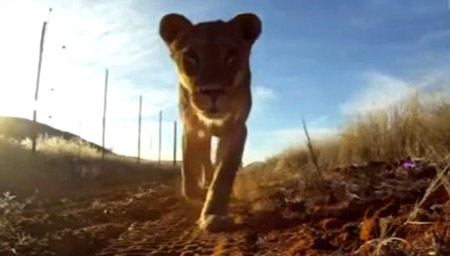
Lion steals photographer's camera
Source:The Telegraph
A wildlife photographer captures an unusual view of the South African savannah when his video camera is picked up and carried off by an inquisitive lioness. Photographer Roger de la Harpe was in South Africa's Tswalu Kalahari Game Reserve taking pictures for a book about the endangered African lion, when he spotted three lionesses on the path ahead. Placing a small digital video camera on the ground, he retreated to a safe distance.
As planned, the lions approached the camera. However, instead of walking by, an inquisitive lioness gave the device a thorough examination, sniffing and licking the casing before picking it up her mouth and padding off with her trophy. After 30 years working in South Africa's national parks, the 57-year-old, was stunned by the behaviour. "It was the last thing I expected her to do," he said. Incredibly, the camera lens remains unobstructed recording a prey's view of the grasslands from the lioness's mouth. After five minutes though, bored with her inedible find, she drops it into the long grass by the side of the track. As the lions moved away, the photographer's wife and niece stood watch from the landrover roof while Mr de la Harpe crept back to retrieve the camera... Click To View The Entire Article And Video (Lion-Mouth Cam?) |
|
National Wildlife Humane Society Thank-you for allowing us into your email inbox. You are a valued member of NWHS and we look forward to providing you with current news concerning NWHS, other matters concerning wildlife, wildlife habitats and our wildlife rescue/sanctuary facility, "Top Of The Rock". Please invite other concerned humans to join our organization. It is our members that allow us to exist, expand and assist wildlife and precious wild habitat.
Humane is the responsibility of Humanity
FAIR USE NOTICE: This mailing may contain images and excerpts the use of which have not been pre-authorized. This material is made available for the purpose of analysis and critique, as well as to advance the understanding of political, media and cultural issues. All articles and commentary are provided as non-commercial, public educational and outreach content. The 'fair use' of such material is provided for under U.S. Copyright Law. In accordance with U.S. Code Title 17, Section 107, material on this mailing (along with credit links and attributions to original sources) is viewable for educational and intellectual purposes. If you are interested in using any copyrighted material from this mail for any reason that goes beyond 'fair use,' you must first obtain permission from the copyright owner.
Note: NWHS provides hyperlinks from email to third party sites as a convenience to users. NWHS does not endorse such third parties or the contents of any such sites. NWHS has no control over, makes no representation or warranty and disclaims all liability with respect to such sites. To use articles originated by NWHS, please use unaltered and provide a link back to NWHS. http://www.humanewildlife.org/ |
|
To Contact National Wildlife Humane Society
info@humanewildlife.org "A world without wildlife is a world not fit for humans"
Click Here To Visit NWHS Newsletter Archive
| | ||