|
|

|
National Wildlife Humane Society |
| Wildlife Conservation News |
|
|
|
| NWHS Intro |
| Milgis Trust Vehicle |
| Cheetahs Released |
| Polar Bear Cub |
| Rhinos In Nepal |

National Wildlife Humane Society
A wildlife conservation organization working to preserve and protect threatened and endangered species.
|

| |
|



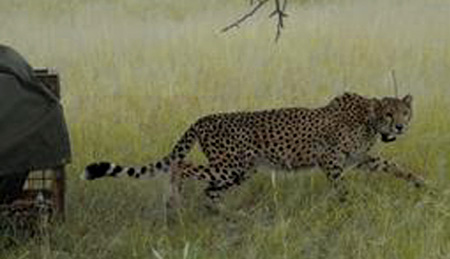
Smuggled cheetahs released into the wild
Source:Wildlife Extra
Three adult cheetahs confiscated from a wildlife trader in Tanzania are now free after being released back into the wild recently. The big cats were seized at a house in Arusha, Tanzania's safari capital, where they were being held in cramped cages barely high enough for the animals to stand. Conservationists from the Zoological Society of London (ZSL), Frankfurt Zoological Society (FZS) and the Wildlife Conservation Society (WCS) worked with the Tanzania Wildlife Research Institute (TAWIRI) and the Tanzania Wildlife Division to urgently secure the release of the cheetahs.
Conservationists and staff from Tanzania National Parks (TANAPA) carefully selected the release site to ensure there was a sufficient abundance of prey in the area, and a number of vantage points from where the cheetahs could familiarise themselves with their surroundings. The male and one female cheetah were fitted with satellite collars before they were released. They will now be tracked by a team in Arusha who will monitor their movements over the forthcoming months to ensure they settle in well to their new home. This is the first known case of cheetah trafficking in Tanzania and it worryingly suggests that the illegal trade of this protected species is increasing. The Tanzania Wildlife Division are now appealing for information from the local community to determine whether the wildlife trader was working alone, or was part of a wider network... Click To View The Entire Article |
|
Polar Bear Cub Rescued In Alaska Oil Field
Source:NPR
Wanted: A zoo for an orphaned polar bear cub that was rescued at an Alaska oil field. Officials from the Alaska Zoo in Anchorage were helping to escort the 17-pound cub from the North Slope, the U.S. Fish and Wildlife Service said Friday [April 29, 2011]. The female cub, estimated to be at least 4 months old, was herded into a net and kept in a large dog kennel, said Rosa Meehan, the Fish and Wildlife Service marine mammals manager in Alaska. "It was initially shaking from the stress, but it settled down and has been resting quietly," she said.
The cub will stay at the zoo until a home is found, said zoo office manager Heather Schaad. The zoo already has two polar bears and four other bears and doesn't have the facilities to keep the cub permanently, Schaad said. The cub was captured at the Alpine oil field and fed a commercial puppy milk replacement fortified with whipping cream to meet her nutritional needs, Fish and Wildlife officials said. She was first spotted after emerging from a den with her mother and a sibling seven weeks ago, Meehan said. Researchers with the U.S. Geological Survey had captured the sow and her cubs and put a radio collar on the mother. "Unfortunately, the collar slipped off a few days later," Meehan said. The cub was spotted again Tuesday, but she was alone, orphaned or separated from her mother. Alpine operators contacted the Fish and Wildlife Service, which asked them to conduct an aerial search for the mother, Meehan said. Operators are required to notify the agency whenever they see the far-north animal. After the search wrapped up, the cub was gone. Then she showed up again Thursday, and Fish and Wildlife coordinated plans with the zoo to collect the bear... Click To View Article In Full |

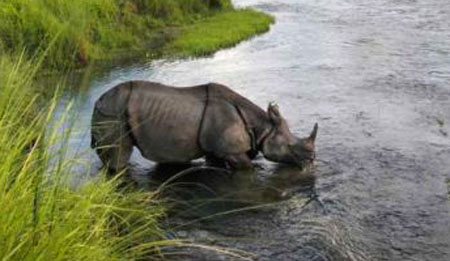
Nepal sees significant rise in rhino population
Source:Seattle PI
Nepal's rhinoceros population has risen significantly over the past three years owing to better security against poachers and community conservation programs, an official said Tuesday [April 26, 2011]. A survey this month showed that the country's rhino population was 534 compared to 435 in 2008, when the last count was done, said Maheswor Dhakal, an ecologist with Nepal's Department of National Parks and Wildlife Conservation. Dhakal said the number of rhinos had decreased during the decade of fighting between government troops and Maoists rebels that ended in 2006 with a peace agreement.
During the conflict, soldiers were pulled out of conservation duty to fight the insurgents, leaving the forests unguarded and allowing poachers to hunt the animals with little resistance. Since the end of the fighting, soldiers have been redeployed to keep poachers out, and the government has introduced programs with villagers living near the forests. "Working closely with the community to set up buffer zones has helped in our conservation," Dhakal said, adding that the result has been an increase in rhino births and a decrease in killings. Conservationists riding elephants spent three weeks this month counting the one-horned rhinos in the forests of Chitwan in southern Nepal and Bardia in the southwest. The one-horned rhinos, also called Indian rhinos, are an endangered species. They are found in the southern plain forests of Nepal and in India... Click To View The Source Article |
|
National Wildlife Humane Society Thank-you for allowing us into your email inbox. You are a valued member of NWHS and we look forward to providing you with current news concerning NWHS, other matters concerning wildlife, wildlife habitats and our wildlife rescue/sanctuary facility, "Top Of The Rock". Please invite other concerned humans to join our organization. It is our members that allow us to exist, expand and assist wildlife and precious wild habitat.
Humane is the responsibility of Humanity
FAIR USE NOTICE: This mailing may contain images and excerpts the use of which have not been pre-authorized. This material is made available for the purpose of analysis and critique, as well as to advance the understanding of political, media and cultural issues. All articles and commentary are provided as non-commercial, public educational and outreach content. The 'fair use' of such material is provided for under U.S. Copyright Law. In accordance with U.S. Code Title 17, Section 107, material on this mailing (along with credit links and attributions to original sources) is viewable for educational and intellectual purposes. If you are interested in using any copyrighted material from this mail for any reason that goes beyond 'fair use,' you must first obtain permission from the copyright owner.
Note: NWHS provides hyperlinks from email to third party sites as a convenience to users. NWHS does not endorse such third parties or the contents of any such sites. NWHS has no control over, makes no representation or warranty and disclaims all liability with respect to such sites. To use articles originated by NWHS, please use unaltered and provide a link back to NWHS. http://www.humanewildlife.org/ |
|
To Contact National Wildlife Humane Society
info@humanewildlife.org "A world without wildlife is a world not fit for humans"
Click Here To Visit NWHS Newsletter Archive
| | ||