|
|

|
National Wildlife Humane Society |
| Wildlife Conservation News |
|
|
|
| NWHS Intro |
| White Nose Syndrome |
| Leopard Rescued |
| Thai Ivory Bust |
| Black Bear Cubs |

National Wildlife Humane Society
A wildlife conservation organization working to preserve and protect threatened and endangered species.
|

| |
|

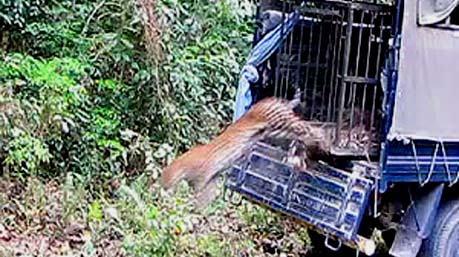
Leopard rescued and released in Assam
Source:Wildlife Trust of India
Kaziranga (Assam) March 26, 2011: In an exemplary management of a potential human-animal conflict, a leopard trapped in a narrow culvert in the northeast Indian state of Assam was successfully rescued through collaborative efforts of authorities and local people. It was released in Nambor Wildlife Sanctuary, located near the site of rescue, yesterday [March 25, 2011]. The leopard was sighted by workers at the Halmira Tea Estate in Golaghat, about 60 km from Kaziranga National Park, Wednesday evening. When the people made attempts to chase it away, the animal entered the culvert for shelter, entrapping itself.
The following morning, the Forest Department, alerted by local people, along with International Fund for Animal Welfare - Wildlife Trust of India (IFAW-WTI) veterinarians visited the site to rescue the leopard. The local people had bamboo-fenced one end of the culvert and set up a cage at the other to capture it. However, the animal was unable to move, and hence had to be tranquilised for a safe rescue. "This is a classic case of how these kinds of situations can be easily handled if the crowd is effectively controlled. Throughout India, generally human-carnivore confrontations get aggravated when people ignore the authorities" requests to keep away and do as they please. So many people as well as animals get unnecessarily injured this way. Most cases need no intervention, apart from providing a free unhindered passage for the animal," said Dr NVK Ashraf, Chief Veterinarian, WTI... Click To View The Entire Article At Wildlife Trust of India's Website NWHS NOTE: Wildlife Trust of India is allied with NWHS in similar conservation projects (Uttar Pradesh, Valmiki, and Rapid Action Program). You can learn more at their ally web page at NWHS. Click To View "Wild Tiger Conservation" at Wildlife Trust of India's NWHS Webpage |
|
Huge Illegal Shipment of Elephant Tusks Seized in Thailand
Source:Voice Of America BY:Daniel Schearf, Bangkok
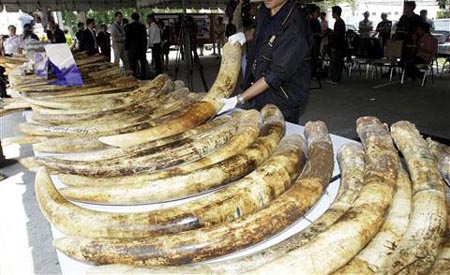
Thai customs officials have seized more than two tons of African elephant tusks in the largest haul of smuggled ivory in recent history [April 01, 2011]. The illegal ivory was the biggest smuggling bust by Thailand to date, worth an estimated $3.5 million and the first seized from a boat shipment. Thai customs investigators uncovered 247 African elephant tusks Wednesday at Bangkok’s sea port. The tusks were hidden in a shipment of frozen fish from Kenya, imported by a Thai company.
Prasong Poontaneat, director general of Thai Customs, says the use of a freezer shows ivory smugglers are using more sophisticated methods to try to evade detection. He says authorities were successful this time because they got intelligence information about the smuggled shipment. They then X-rayed the container and found that the shipment of sardines inside was suspiciously overweight. When they inspected the packages they found the smuggled ivory. Thailand is a major transit point for trafficking wildlife products, much of which goes to markets in China... Click To View Article At Source |
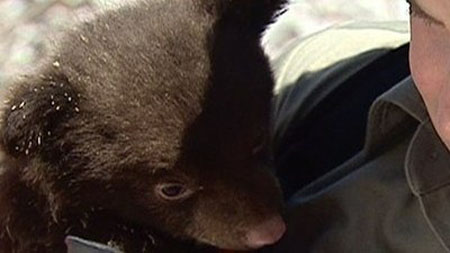
Biologists monitor newborn black bear cubs
Source:Fox13 News BY:Aaron Vaughn
HEBER, Utah - Dozens of Utah biologists hiked into the Utah backcountry to a bear's den in Daniel's Canyon Friday morning. The biologists were there to monitor a bear family. There a mother bear with her four cubs were found. The mother bear is one of 25 female black bears having their reproductive success tracked. They had a surprise to find out she had birthed that many cubs. "It's really rare to have a den with four cubs, that's not something that happens very often especially in the west," says Kevin Bunnell from the Division of Wildlife.
Three males and one female cub were accounted for. Some of the biologists brought their children along to see the cubs. "They were really really cute," said Bridger Bunnell. "They really do sound like babies. Sometimes you didn't think it was coming from the bears, but it really was." said Ann Dolling. After the cubs were collared they were placed back into the den with their mother. Biologists from the Division of Wildlife Resources say they will be back next year at the same time to check on the cubs and their mother to monitor their health... Click To View The Source Article And Videos Of Cubs |
|
National Wildlife Humane Society Thank-you for allowing us into your email inbox. You are a valued member of NWHS and we look forward to providing you with current news concerning NWHS, other matters concerning wildlife, wildlife habitats and our wildlife rescue/sanctuary facility, "Top Of The Rock". Please invite other concerned humans to join our organization. It is our members that allow us to exist, expand and assist wildlife and precious wild habitat.
Humane is the responsibility of Humanity
FAIR USE NOTICE: This mailing may contain images and excerpts the use of which have not been pre-authorized. This material is made available for the purpose of analysis and critique, as well as to advance the understanding of political, media and cultural issues. All articles and commentary are provided as non-commercial, public educational and outreach content. The 'fair use' of such material is provided for under U.S. Copyright Law. In accordance with U.S. Code Title 17, Section 107, material on this mailing (along with credit links and attributions to original sources) is viewable for educational and intellectual purposes. If you are interested in using any copyrighted material from this mail for any reason that goes beyond 'fair use,' you must first obtain permission from the copyright owner.
Note: NWHS provides hyperlinks from email to third party sites as a convenience to users. NWHS does not endorse such third parties or the contents of any such sites. NWHS has no control over, makes no representation or warranty and disclaims all liability with respect to such sites. To use articles originated by NWHS, please use unaltered and provide a link back to NWHS. http://www.humanewildlife.org/ |
|
To Contact National Wildlife Humane Society
info@humanewildlife.org "A world without wildlife is a world not fit for humans"
Click Here To Visit NWHS Newsletter Archive
| | ||