|
|

|
National Wildlife Humane Society |
| Wildlife Conservation News |
|
|
|
| NWHS Intro |
| Night Wildlife Kenya |
| Rare Leopard Frog |
| Elephant Ivory |
| Andean Cat |

National Wildlife Humane Society
A wildlife conservation organization working to preserve and protect threatened and endangered species.
|

| |
|


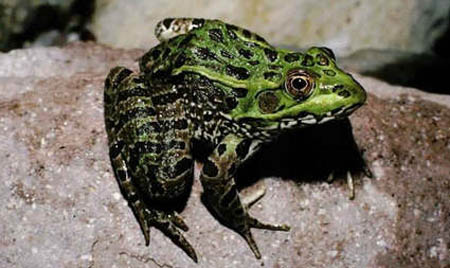
Critical habitat of 11,000 acres proposed for rare leopard frog
Source:Digital Journal
The rare and threatened Chiricahua leopard frog of the southwestern US received an added gift this week in its fight against extinction, a proposed designation of more than 11,000 acres of critical habitat situated in Arizona and New Mexico. The US Fish and Wildlife Service has proposed 11,136 acres located in Apache, Cochise, Gila, Graham, Greenlee, Pima, Santa Cruz, and Yavapai counties in Arizona, as well as Catron, Hidalgo, Grant, Sierra, and Socorro counties in New Mexico be designated as critical habitat for the rare frog.
"Protecting critical habitat is the most powerful tool this country has for saving endangered plants and animals, so we're thrilled the Chiricahua leopard frog is finally getting the habitat protection it needs to survive," said Tierra Curry, a Center for Biological Diversity biologist, according to a news release. Among the many threats faced by the rare frog are predators such as nonnative bullfrogs and crayfish, as well as a fungal disease. Livestock grazing, stream diversions, mining, groundwater pumping, water pollution, climate change, woodcutting, urban and agricultural encroachment, and loss of natural fire regimes have all contributed to its natural habitat and range degradation. Chiricahua leopard frogs, known by a unique call similar to a snore lasting one to two seconds, reach two to five inches in length as adults. It was once found in more than 400 aquatic locales throughout the southwestern US, but is now confined to fewer than 80 of these sites, less than 20 percent of its historic range... Click To View The Full Article |
|
Agony and Ivory
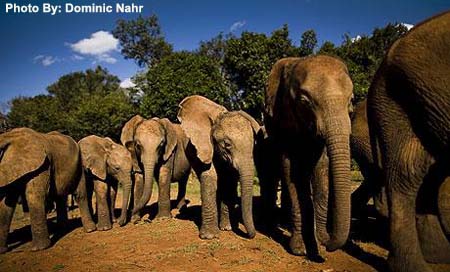
The Chinese lust for ivory has led to the vast killing of Africa's elephants. Is it too late to save them? Source:The Telegraph BY:David Harrison
Jolson Kitheka had been on patrol for just a couple of hours when he saw his first dead elephant. He was out scanning every tree trunk or bush for snares, the lethal metal traps used by poachers to catch, maim and kill their prey. Yet about 200 yards ahead, partly obscured by trees on Kenya's vast Tsavo West national park, lay the unmistakable grey bulk of an adult elephant on the ground. Walking gingerly towards the giant creature, his worst fears were confirmed: it had been killed by poachers firing poisoned arrows. The tusks were crudely hacked off, along with the trunk.
"It was the work of professional poachers," Kitheka says, flinching. "They had sawn into its head to cut out the tusks from the root. The trunk and most of his face had gone. I could see the gaps where the tusks had been. The blood had clotted, liquid seeping out. I felt sick." His experience has become an alarmingly common one of late. Twenty-one years after a worldwide ban was imposed on the ivory trade, elephant poaching is on the rise all over Africa. The elephant Jolson found was one of 220 killed by poachers in Kenya last year, up 400 per cent on the 46 killed just two years earlier. Yet Kenya is a country with some of the best wildlife protection and enforcement in Africa... Click To View This Article In Entirety |
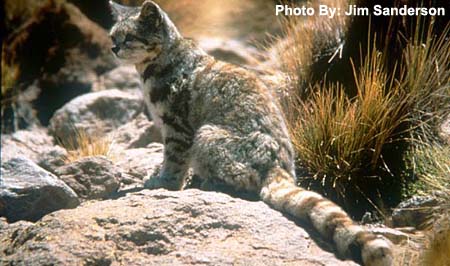
New Andean cat population discovered
Source:ZME Science
The Andean cat (Leopardus jacobita) is an extraordinary elusive creature, being relatively small, well camouflaged and incredibly hard to find dwelling in a habitat usually at 3,000 meters in altitude. Actually, up to the late 1990s the snow leopard-like cat was known to scientists only through a few pictures sporadically taken by locals when such a rare opportunity made itself possible. Researchers have now recently made a significant find when such felines were found in the Patagonian steppe at elevations as low as 650 meters. This might help shed more insight on the Andean cat and help conservation efforts of thee species, which is classed as endangered by the IUCN Red List.
"These confirmed records show the lowest elevations ever reported for the Andean cat," said Wildlife Conservation Society (WCS) conservationist Andres Novaro, lead author of the study appearing in CATNews. "According to genetic studies underway led by Daniel Cossios, this new population appears to represent an evolutionary lineage distinct from the highland population." The Andean cat faces a number of threat which might lead it to extinction, be it deforestation, oil drilling, climate change, road building, getting killed by locals (they consider it a pest, and some hunt it for it’s supernatural power it allegedly confers when eaten)... Click To View The Entire Article |
|
National Wildlife Humane Society Thank-you for allowing us into your email inbox. You are a valued member of NWHS and we look forward to providing you with current news concerning NWHS, other matters concerning wildlife, wildlife habitats and our wildlife rescue/sanctuary facility, "Top Of The Rock". Please invite other concerned humans to join our organization. It is our members that allow us to exist, expand and assist wildlife and precious wild habitat.
Humane is the responsibility of Humanity
FAIR USE NOTICE: This mailing may contain images and excerpts the use of which have not been pre-authorized. This material is made available for the purpose of analysis and critique, as well as to advance the understanding of political, media and cultural issues. All articles and commentary are provided as non-commercial, public educational and outreach content. The 'fair use' of such material is provided for under U.S. Copyright Law. In accordance with U.S. Code Title 17, Section 107, material on this mailing (along with credit links and attributions to original sources) is viewable for educational and intellectual purposes. If you are interested in using any copyrighted material from this mail for any reason that goes beyond 'fair use,' you must first obtain permission from the copyright owner.
Note: NWHS provides hyperlinks from email to third party sites as a convenience to users. NWHS does not endorse such third parties or the contents of any such sites. NWHS has no control over, makes no representation or warranty and disclaims all liability with respect to such sites. To use articles originated by NWHS, please use unaltered and provide a link back to NWHS. http://www.humanewildlife.org/ |
|
To Contact National Wildlife Humane Society
info@humanewildlife.org "A world without wildlife is a world not fit for humans"
Click Here To Visit NWHS Newsletter Archive
| | ||