|
|

|
National Wildlife Humane Society |
| Wildlife Conservation News |
|
|
|
| NWHS Intro |
| Cheetah Foster Mom |
| Rehab Tiger India |
| Elephant Census |
| Lizards & Ticks |

National Wildlife Humane Society
A wildlife conservation organization working to preserve and protect threatened and endangered species.
|

| |
|



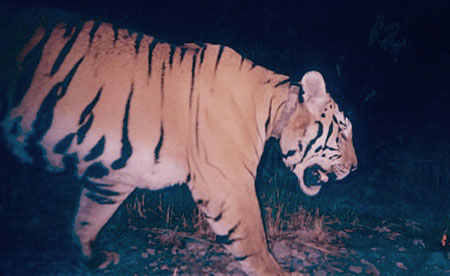
Photographs confirm survival of rehabilitated tiger in Manas
Source:Wildlife Trust Of India
An adult male tiger, captured following conflicts with people in Sibsagar district in northern Assam and released in Manas National Park [India] more than eight months ago, was photographed in the wild last month. The tiger was tranquilised and captured from a human settlement by the Assam Forest Department assisted by IFAW-WTI (International Fund for Animal Welfare – Wildlife Trust of India) to mitigate conflict that resulted in the death of two persons in March. After short-listing three potential areas, Manas NP was decided as the most suited for the tiger’s release. Accordingly, it was radio-collared for post-release monitoring and released in Manas.
With no attacks on humans reported since then, this incident promises to strengthen the case for rehabilitation of tigers that accidentally come into conflict with people. "The photographs acquired through camera-traps indicate its survival in the wild. And, there has been no report of attacks on people by this tiger since its release, presenting a hope that rehabilitation can be a viable option for tigers involved in conflicts," said Dr NVK Ashraf, Chief Operating Officer, Wildlife Trust of India (WTI). Generally, cases of human-carnivore conflicts, especially those resulting in human deaths, end up with the animal being killed or resigned to a life in captivity. "We are continuing to track it, though the signals received are inconsistent as the battery on the radio collar is dying. The radio collar is expected to drop off anytime now. There has been no direct conflict with people but we are trying to find out if it is involved in cattle-lifting," said Dr Bhaskar Choudhury, Manager, WTI, who is overseeing the monitoring... Click To View The Full WTI Article NWHS NOTE: Wildlife Trust of India is an ally of National Wildlife Humane Society on several important wild tiger projects in India. For more information on these wild tiger projects, and an opportunity to assist, please view their ally page at the NWHS website (includes an interesting video on these tiger projects). Click To View The NWHS-WTI Alliance Webpage |
|
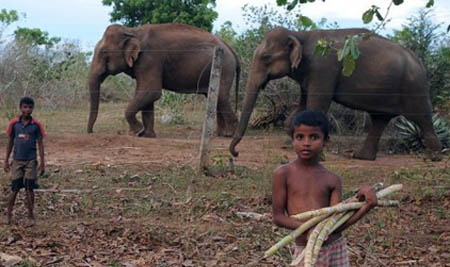
Sri Lanka plans first census of elephants
Source:AFP
COLOMBO - Sri Lanka is planning its first ever census of elephants as the animals increasingly come into conflict with villagers, a top official said Wednesday. Government wildlife director Chandrawansa Pathiraja said a head count would start in August to aid better planning of conservation and minimise clashes between elephants and humans. "We will carry out the census within a 48-hour period," Pathiraja told AFP. "We expect dry weather at this time."
He said a meeting of enumerators would be held next month to work out details of the census, and the department also hopes to rope in volunteers to help. "We have had just over 200 elephants deaths last year," Pathiraja said. "During the same period about 50 people were killed by wild elephants and we have seen this trend in the past three years." Elephants are killed mostly by farmers whose crops are destroyed while marauding animals also raid villages in search of food. Sri Lanka's elephant population is believed to have dwindled to about 4,000 from an estimated 12,000 in 1900. Most of the jungles in Sri Lanka's northern and eastern regions were inaccessible for wildlife authorities during the fighting between government troops and Tamil Tiger rebels... Click To View The Article In Entirety |
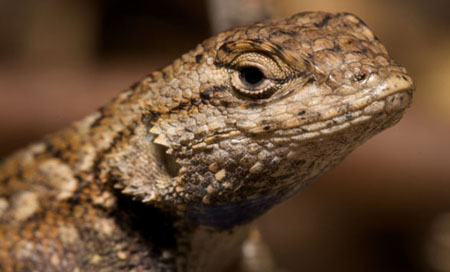
Tick population plummets in absence of lizard hosts
Source:UC Berkeley News Watch BY:Sarah Yang
BERKELEY - The Western fence lizard’s reputation for helping to reduce the threat of Lyme disease is in jeopardy. A new study led by researchers at the University of California, Berkeley, found that areas where the lizard had been removed saw a subsequent drop in the population of the ticks that transmit Lyme disease. "Our expectation going into this study was that removing the lizards would increase the risk of Lyme disease, so we were surprised by these findings," said study lead author Andrea Swei, who conducted the study while she was a Ph.D. student in integrative biology at UC Berkeley. "Our experiment found that the net result of lizard removal was a decrease in the density of infected ticks, and therefore decreased Lyme disease risk to humans."
The study, to be published online Tuesday, Feb. 15, in the journal Proceedings of The Royal Society B, illustrates the complex role the Western fence lizard (Sceloporus occidentalis) plays in the abundance of disease-spreading ticks. Lyme disease - characterized by fever, headache, fatigue and a bullseye rash - is spread through the bite of ticks infected with spirochete bacteria called Borrelia burgdorferi. In the Western region of the United States, the Western black legged tick (Ixodes pacificus) is the primary vector for Lyme disease bacteria... Click To View The Entire Article |
|
National Wildlife Humane Society Thank-you for allowing us into your email inbox. You are a valued member of NWHS and we look forward to providing you with current news concerning NWHS, other matters concerning wildlife, wildlife habitats and our wildlife rescue/sanctuary facility, "Top Of The Rock". Please invite other concerned humans to join our organization. It is our members that allow us to exist, expand and assist wildlife and precious wild habitat.
Humane is the responsibility of Humanity
FAIR USE NOTICE: This mailing may contain images and excerpts the use of which have not been pre-authorized. This material is made available for the purpose of analysis and critique, as well as to advance the understanding of political, media and cultural issues. All articles and commentary are provided as non-commercial, public educational and outreach content. The 'fair use' of such material is provided for under U.S. Copyright Law. In accordance with U.S. Code Title 17, Section 107, material on this mailing (along with credit links and attributions to original sources) is viewable for educational and intellectual purposes. If you are interested in using any copyrighted material from this mail for any reason that goes beyond 'fair use,' you must first obtain permission from the copyright owner.
Note: NWHS provides hyperlinks from email to third party sites as a convenience to users. NWHS does not endorse such third parties or the contents of any such sites. NWHS has no control over, makes no representation or warranty and disclaims all liability with respect to such sites. To use articles originated by NWHS, please use unaltered and provide a link back to NWHS. http://www.humanewildlife.org/ |
|
To Contact National Wildlife Humane Society
info@humanewildlife.org "A world without wildlife is a world not fit for humans"
Click Here To Visit NWHS Newsletter Archive
| | ||