|
|

|
National Wildlife Humane Society |
| Wildlife Conservation News |
|
|
|
| NWHS Intro |
| Chobe Fundraiser |
| Whooping Cranes |
| Tiger Task Force |
| Arizona Ocelots |

National Wildlife Humane Society
A wildlife conservation organization working to preserve and protect threatened and endangered species.
|

| |
|



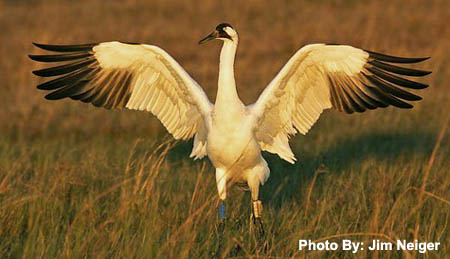
Endangered cranes to be reintroduced in Louisiana
Source:Reuters By:Emily Stephenson
Ten whooping cranes, the most endangered species of crane in the world, will be reintroduced in a Louisiana conservation area more than 60 years after the birds' numbers dwindled to near zero, the U.S. Interior Department said on Tuesday [Feb. 8, 2011]. "The whooping crane is an iconic species that should be returned and restored to health along the Gulf Coast," said Interior Secretary Ken Salazar. "The reintroduction of these remarkable birds will be a milestone moment for the Gulf Coast."
Whooping cranes - named for their loud, trumpeting call - are the world's most endangered species of crane and are only found in North America. The total population, once believed to have numbered more than 15,000, fell to just 15 birds in the 1940s as a result of hunting and habitat loss, according to the National Wildlife Federation. The entire Louisiana population had been wiped out or removed by the 1950s. The surviving birds all belonged to one flock that migrated between Canada and Texas and is still the only self-sustaining wild population of whooping cranes. "That's as close to extinction as anything's ever come," said Heather Ray, director of development for Operation Migration. Her group and others have worked to re-establish the whooping crane. "There are now only about 560 birds in the wild and captivity," said Tom Hess, the Louisiana project's field manager... Click To View The Full Article |
|
Special tiger force for 2 Maharashtra reserves
Source:Hindustan Times By:Pradip Kumar Maitra
Sensing that the current security structure at two tiger reserves in the state is inadequate, the Maharashtra government is planning to raise a special task force to protect the animals and current forest guards from poachers. The state finance department has given the nod to create this force in two tiger reserves of the four in the state. Stating this on Friday, principal chief conservator of forests (wildlife) Dineshchandra Pant said: "The state finance department has decided to give the green signal for the special armed force."
"In addition to setting up the special armed force, the state government has decided to strengthen the wildlife wing, for which the number of posts will be increased," Pant added. The force's mandate will also be to reduce man-animal conflicts in areas abutting the sanctuaries. Of the tiger reserves in Melghat, Sahyadri, Tadoba and Pench (bordering MP), the last two will get the protection force. The two together have about 65 tigers. Each will get 112 additional armed personnel, including 96 forest guards, 12 foresters, three range forest officers and one assistant conservator of forests. The state police department will train them and they will be paid by the National Tiger Conservation Authority (NTCA). Apart from weapons, the tiger task force will be provided with terrain vehicles. |

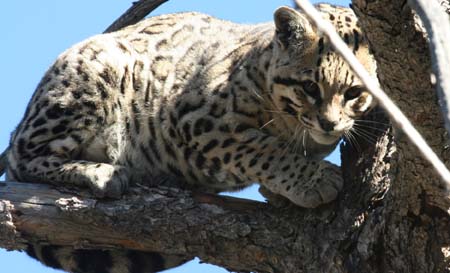
Ocelot sightings in Arizona good news for species
Source:Tucson Sentinel BY:Spring Eselgroth
Two confirmed sightings of ocelots in Arizona during the past year bode well for the endangered species' future here, a biologist said. "This is really exciting news," said Sergio Avila of the Sky Island Alliance, an environmental group in southern Arizona. "These cats are telling us something important, and what they're telling us is that Arizona is a good place for ocelots."
The latest sighting occurred Tuesday morning at a home in the Huachuca Mountains of southern Arizona. The report was confirmed by the Arizona Game and Fish Department after the young male cat was observed by a wildlife management officer, according to Jim Paxon, a department spokesman. The ocelot, traditionally a tropical cat with a natural habitat spanning from the Mexican lowlands to central South America, was designated an endangered species in 1972. There's only one known population in the U.S., a colony of 25 cats in southwestern Texas. Tuesday's sighting [Feb. 8, 2011] was the first live ocelot confirmed in Arizona since 1964. In April 2010, an ocelot was struck and killed by a vehicle near Globe... Click To View The Entire Article |
|
National Wildlife Humane Society Thank-you for allowing us into your email inbox. You are a valued member of NWHS and we look forward to providing you with current news concerning NWHS, other matters concerning wildlife, wildlife habitats and our wildlife rescue/sanctuary facility, "Top Of The Rock". Please invite other concerned humans to join our organization. It is our members that allow us to exist, expand and assist wildlife and precious wild habitat.
Humane is the responsibility of Humanity
FAIR USE NOTICE: This mailing may contain images and excerpts the use of which have not been pre-authorized. This material is made available for the purpose of analysis and critique, as well as to advance the understanding of political, media and cultural issues. All articles and commentary are provided as non-commercial, public educational and outreach content. The 'fair use' of such material is provided for under U.S. Copyright Law. In accordance with U.S. Code Title 17, Section 107, material on this mailing (along with credit links and attributions to original sources) is viewable for educational and intellectual purposes. If you are interested in using any copyrighted material from this mail for any reason that goes beyond 'fair use,' you must first obtain permission from the copyright owner.
Note: NWHS provides hyperlinks from email to third party sites as a convenience to users. NWHS does not endorse such third parties or the contents of any such sites. NWHS has no control over, makes no representation or warranty and disclaims all liability with respect to such sites. To use articles originated by NWHS, please use unaltered and provide a link back to NWHS. http://www.humanewildlife.org/ |
|
To Contact National Wildlife Humane Society
info@humanewildlife.org "A world without wildlife is a world not fit for humans"
Click Here To Visit NWHS Newsletter Archive
| | ||