|
|

|
National Wildlife Humane Society |
| Wildlife Conservation News |
|
|
|
| NWHS Intro |
| Sumatran Tiger Cubs |
| Corbett Tiger Killed |
| African Wolf |
| Polar Bear Swim |

National Wildlife Humane Society
A wildlife conservation organization working to preserve and protect threatened and endangered species.
|

| |
|



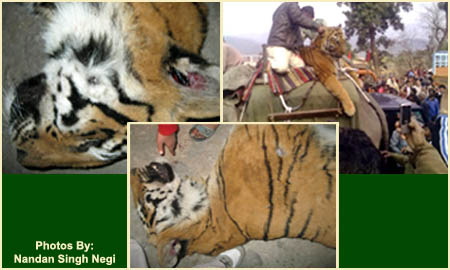
Tiger killed in Corbett
Source:Hindustan Times BY: Nihi Sharma Sahani
A male tiger was shot dead on Thursday afternoon in Ramnagar forest division, post protest from villagers of Sunderkhal adjoining Corbett Tiger Reserve (CTR). A man-eating big cat reportedly killed a 27-year-old young man late on Wednesday evening. As a result, Sunderkhal villagers not only blocked National Highway 121 (Ramnagar-Ranikhet) on Thursday morning but also pelted stones at forest officials. Facing huge pressure, forest staff immediately undertook combing on elephants to trace the man-eating tiger. Within few hours combing staff found a tiger near the spot where body parts of victim were recovered. Giving no second thought, they shot the animal dead.
Speaking to Hindustan Times, Ravindra Juyal division forest officer (DFO) Ramnagar informed, "The tiger was found in Devijaudkhatta where victim's body parts were recovered. We immediately shot the animal dead before it could take more lives." Wild Life Experts have expressed shock over the way tiger was killed on Thursday. "The tiger was about 7 years old and was shot 25-30 times. It is barbaric," noted Brijendra Singh member National Tiger Conservation Authority. Notably, a fortnight ago forest authorities gave orders to kill a man-eating tigress that killed a woman of Sunderkhal village. The decision was taken when agitated villagers staged protest and demanded immediate eviction of the animal. In great hurry, forest department then shot a tigress but couldn't recover its body. It was assumed that the animal must have been injured, though not dead. However, the fresh killing of tiger has raised several questions on forest department. When the orders to kill man-eating tigress were given by forest authorities, how can they shoot a tiger dead on the basis of same notification? Why has the department failed to recover the body of the injured tigress? It is learnt that within a period of two months, the fifth human death was reported on Wednesday due to tiger attack. "No fresh orders were given to kill the man-eating tiger. We carried forward earlier orders of killing," Ravindra Juyal added... Click Here To Read Source Article (has a pop-up ad, but interesting public comments) NWHS NOTE: NWHS Newsletters have covered the articles concerning the conflict tigress that killed four women (separate incidents) who were in the forest at dusk collecting fodder. The tigress was reported to be wounded but has not yet been found. This male tiger was shot using the same "shoot to kill" orders issued on the tigress, although they are unrelated incidents. It may also be asked, if this male tiger, that was shot, is it even the same one that killed the 27-year-old man? It may have simply wandered up on the human remains, and spotted by those doing the killing. We feel there will be more to come concerning these specific incidents and will keep our readers informed. Below are the two NWHS Newsletters, with previous articles concerning the tigress that the "shoot-to-kill" orders were applied to. NWHS thanks Nandan Singh Negi for rights to use his above photos. NWHS Newsletter #68, Jan. 1, 2011 NWHS Newsletter #70, Jan. 15, 2011 BREAKING NEWS: This article was released just prior to this NWHS Newsletter being sent out. There are still many details that lack clarity, because the tiger wounded two weeks ago was a female. NWHS will continue to monitor these controversial incidents, and hopefully will be able to sort out the facts in upcoming newsletter(s). Click - Ramesh orders inquiry into Uttarakhand tiger killing |
|
New African Wolf Species Identified
Source:Wired Science By:Duncan Geere
Conservationists in Egypt have discovered a new species of wolf, which shares DNA with Indian and Himalayan cousins. The "Egyptian jackal", as it's known, is not in fact a jackal at all, despite the visual similarities it bears to another local species, the golden jackal. The discovery sheds light on how wolf species migrated through Africa and Europe, proving that grey wolves emerged in Africa about 3 million years before they spread to the northern hemisphere.
As long ago as 1880 it had been noticed that the Egyptian jackal looked suspiciously like the grey wolf. Several biologists in the 20th century, studying skulls, made the same claim. Still, the creature retained its name. Now, the difference has been formalised. The research is reported in the journal PLOS One. Said author David Macdonald in a press release: "A wolf in Africa is not only important conservation news, but raises fascinating biological questions about how the new African wolf evolved and lived alongside the real golden jackals." Eli Rueness of the University of Oslo, who also contributed to the paper, added: "We could hardly believe our own eyes when we found wolf DNA that did not match anything"... Click Here To Read Article In Full |
Polar bear swims 9 days straight
Source:CBC News
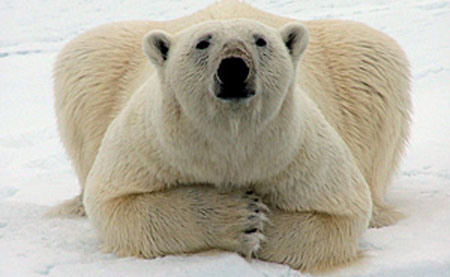
A female polar bear swam the equivalent of 16 marathons back-to-back off the coast of Alaska, researchers report. After swimming nearly 700 kilometres through the Beaufort Sea over nine days, she went on to swim and walk intermittently on the sea ice for an additional 1,800 kilometres over a period of about two months, according to a report published in the January issue of Polar Biology.
The study demonstrates that bears can adapt in some ways to the loss of sea ice in the Arctic as a result of climate change, said George Durner, a research zoologist with the U.S. Geological Survey who co-authored the paper. "They can swim between ice floes that are far apart. They can swim between ice and land, even though that distance can be great," he said. But it also shows that doing so can have a negative impact, he added. The bear lost 22 per cent of her body weight and her year-old cub over the course of her journey, and had obviously been food-deprived. "I guess it shows the vulnerable side of polar bears to large changes in their environment," Durner said. The researchers aren't sure how unusual the bear's behaviour is, but she did seem to travel much farther than any other bear studied before... Click To View The Entire Article |
|
National Wildlife Humane Society Thank-you for allowing us into your email inbox. You are a valued member of NWHS and we look forward to providing you with current news concerning NWHS, other matters concerning wildlife, wildlife habitats and our wildlife rescue/sanctuary facility, "Top Of The Rock". Please invite other concerned humans to join our organization. It is our members that allow us to exist, expand and assist wildlife and precious wild habitat.
Humane is the responsibility of Humanity
FAIR USE NOTICE: This mailing may contain images and excerpts the use of which have not been pre-authorized. This material is made available for the purpose of analysis and critique, as well as to advance the understanding of political, media and cultural issues. All articles and commentary are provided as non-commercial, public educational and outreach content. The 'fair use' of such material is provided for under U.S. Copyright Law. In accordance with U.S. Code Title 17, Section 107, material on this mailing (along with credit links and attributions to original sources) is viewable for educational and intellectual purposes. If you are interested in using any copyrighted material from this mail for any reason that goes beyond 'fair use,' you must first obtain permission from the copyright owner.
Note: NWHS provides hyperlinks from email to third party sites as a convenience to users. NWHS does not endorse such third parties or the contents of any such sites. NWHS has no control over, makes no representation or warranty and disclaims all liability with respect to such sites. To use articles originated by NWHS, please use unaltered and provide a link back to NWHS. http://www.humanewildlife.org/ |
|
To Contact National Wildlife Humane Society
info@humanewildlife.org "A world without wildlife is a world not fit for humans"
Click Here To Visit NWHS Newsletter Archive
| | ||