|
|

|
National Wildlife Humane Society |
| Wildlife Conservation News |
|
|
|
| NWHS Intro |
| 2 New Tiger Reserves |
| China Zoos |
| Ape Poachers Bust |
| Madagascar Lemurs |

National Wildlife Humane Society
A wildlife conservation organization working to preserve and protect threatened and endangered species.
|

| |
|


Ban underlines China's changing attitude toward animals
Source:WildChina
For many people in China, just as the concepts of conservation and environmental awareness are fairly new, so is the notion that animals deserve decent treatment. But that is changing. Yesterday a nationwide ban on circus-style animal performances in the 300 state-owned zoos that are members of the China Zoo Association went into effect. There is hope that the long-overdue ban will dramatically reduce the mistreatment of animals in Chinese zoos in the name of entertainment.
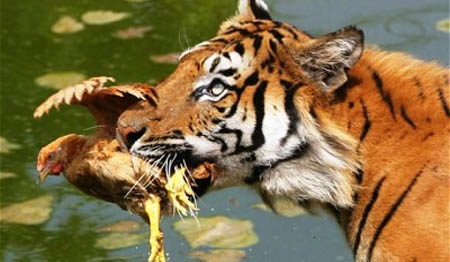
Animals were often beaten during training or in performances and often suffered injuries or even died in the 'zoo circuses'. It is estimated that Chinese zoo circus performances draw a total audience of more than 150,000 zoogoers annually. The new ban also covers other common practices at Chinese zoos. The Telegraph's Shanghai correspondent Malcolm Moore reports: "zoos will no longer be able to pull the teeth of baby tigers so that tourists can hold them and will have to stop attractions where live chickens, goats, cows and even horses are sold to visitors who can then watch them be torn apart by big cats." Last week we visited the Kunming Zoo, which was built in 1953 and has been accused of treating its animals poorly. We were pleased to see its animal performance area had been dismantled. We applaud China's new zoo regulations, but conditions for animals in zoos in China can still be improved greatly. We are hopeful that as China's government and its people continue to show a greater appreciation for nature and wildlife, such improvements will come soon... Click To View The Source Article NWHS NOTE: NWHS is hopeful that we are seeing a heightened awareness in China, concerning the welfare of wildlife. Perhaps this changing attitude will carry over to the desire (and popularity) of some Chinese, to purchase and utilize endangered wildlife such as tiger parts, pangolin meat, elephant ivory and rhino horn. |
|
Chimpanzee and gorilla heads seized in Gabon
Source:BBC News Africa
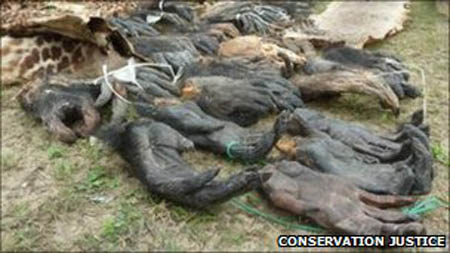
One of the biggest hauls of illegal ape parts in Central Africa has been seized by officials in Gabon, the global campaign group WWF says. Five people were arrested for the cache which included the head and hands of an endangered gorilla, 12 chimpanzee heads and 30 chimpanzee hands.
Africa's wildlife is often poached for the profitable bushmeat trade or for use in traditional good luck charms. Gabon's rainforests teem with wildlife, including lowland gorillas and forest elephants, and national parks make up around one tenth of the country. The raids were conducted by Gabon's water and forestry and defence ministries with the help of various environmental aid groups. Conservation Justice, one of the environmental groups involved, said the crackdown is significant. Other confiscated items include 12 leopard skins, a portion of lion skin, snake skins and five elephant tails... Click Here To Read Article In Full |
New hope for rare lemurs in Madagascar
Source:WildMadagascar .org BY:Rhett Butler
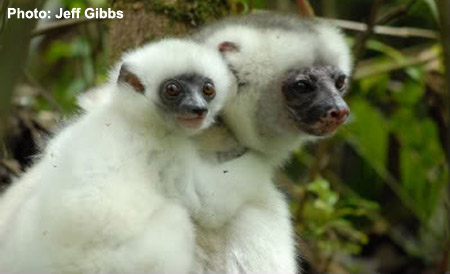
A survey of a remote forest area in Madagascar turned up seven new groups of silky sifaka, a critically endangered lemur threatened by habitat destruction. The finding raises hope that the species, which is listed as one of the world's 25 most endangered primates, is surviving in Marojejy National Park despite an outbreak of illegal rosewood logging in 2009 and 2010. The seven week expedition was led by Cornell University's Erik Patel, who heads SIMPONA, a non-profit organization that aims to protect the silky sifaka and its habitat. Patel's team has found 31 silky sifaka groups consisting of 131 total individuals in Marojejy National Park in the past few years. SIMPONA was joined in the most recent survey by Madagascar National Parks, Madagascar's protected areas authority.
"I am encouraged by our latest survey results," Patel told Mongabay .com. "Our latest survey region had been heavily impacted by illegal rosewood extraction in 2004/5 and 2009/2010. It was a relief that we did not find any active rosewood logging." "We are all just grateful that Marojejy National Park remains so much calmer than Masoala National Park, for example, where illegal rosewood logging continues at a high level." The survey, which assessed 24 square kilometers of rugged terrain, counted 23 individuals among the seven groups... Click To View The Entire Article |
|
National Wildlife Humane Society Thank-you for allowing us into your email inbox. You are a valued member of NWHS and we look forward to providing you with current news concerning NWHS, other matters concerning wildlife, wildlife habitats and our wildlife rescue/sanctuary facility, "Top Of The Rock". Please invite other concerned humans to join our organization. It is our members that allow us to exist, expand and assist wildlife and precious wild habitat.
Humane is the responsibility of Humanity
FAIR USE NOTICE: This mailing may contain images and excerpts the use of which have not been pre-authorized. This material is made available for the purpose of analysis and critique, as well as to advance the understanding of political, media and cultural issues. All articles and commentary are provided as non-commercial, public educational and outreach content. The 'fair use' of such material is provided for under U.S. Copyright Law. In accordance with U.S. Code Title 17, Section 107, material on this mailing (along with credit links and attributions to original sources) is viewable for educational and intellectual purposes. If you are interested in using any copyrighted material from this mail for any reason that goes beyond 'fair use,' you must first obtain permission from the copyright owner.
Note: NWHS provides hyperlinks from email to third party sites as a convenience to users. NWHS does not endorse such third parties or the contents of any such sites. NWHS has no control over, makes no representation or warranty and disclaims all liability with respect to such sites. To use articles originated by NWHS, please use unaltered and provide a link back to NWHS. http://www.humanewildlife.org/ |
|
To Contact National Wildlife Humane Society
info@humanewildlife.org "A world without wildlife is a world not fit for humans"
Click Here To Visit NWHS Newsletter Archive
| | ||