|
|

|
National Wildlife Humane Society |
| Wildlife Conservation News |
|
|
|
| NWHS Intro |
| Rainforest Trip |
| Bear Law Change |
| Iran Tiger Dies |
| Wild Buffalo India |

National Wildlife Humane Society
A wildlife conservation organization working to preserve and protect threatened and endangered species.
|

| |
|


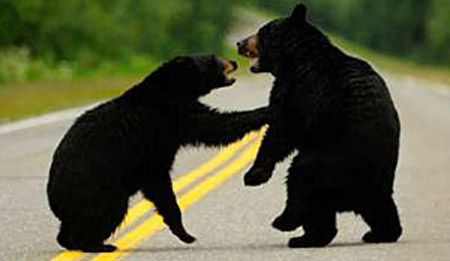
Colorado looks poised to ban hunting bears in dens
Source:LA Times
Hibernating bears would be off-limits to Colorado hunters under a new rule that state wildlife officials are considering after a debate over whether a 703-pound black bear was sleeping when it was killed in a cave late last year. The enormous black bear shot in northwestern Colorado set what may be a state record. But it sparked public outrage after the hunter told a newspaper that he tracked the male bear to a cave and shot it after five hours waiting for the animal to emerge.
Though the hunter said the bear was awake and snarled at him, a flurry of angry emails and calls to state wildlife authorities resulted. On Wednesday, the state Wildlife Commission decided unanimously to draft a rule banning the hunting of bears in dens. Commissioners said they've never heard of anyone "den hunting" in Colorado because it's considered unsportsmanlike. But commissioner Dorothea Farris argued that if Colorado doesn't follow other states and specifically ban den hunting, the public could sour on bear hunting altogether. "We think it's critical that fair chase is the cornerstone of ethical hunting," said Suzanne O'Neill, executive director of the Colorado Wildlife Federation. An outfitter and bear hunter at the meeting agreed. "We don't go out and hunt bears in dens. It's just not done," said Scott Limmer, a regional director for the Colorado Outfitters Assn... Click To View The Full Article |
|
Iran's Siberian tiger dies
Source:Times Of Malta
A Siberian tiger delivered to Iran by Russia in a swap deal last year has died from a disease which one official said it contracted before it was given to Tehran. The tiger was a resident of Tehran's Eram Zoo since April 2009 when Russia gave it to Iran along with a Siberian tigress in exchange for two Persian leopards. Hooshang Ziaee, an advisor to Iran’s Environmental Protection Organisation, told ISNA news agency that the tiger had been infected with Feline Immunodeficiency Virus but it was unclear when it died.
"The preliminary laboratory tests show that the Siberian tiger tested positive for FIV," Mr Ziaee said, adding that a Bengal tiger and five other lions at the Eram zoo had also tested positive for FIV. "The final cause for the death of the Siberian tiger was that it and other felines fed on diseased donkeys," he said. Eram zoo director Amir Elhami said the tiger had been infected with FIV before arriving to the zoo but denied that other animals contracted the virus. "The doctors tested the dead feline and have concluded that it already had immunodeficiency which means he was vulnerable to any disease," Elhami was quoted as saying by Fars news agency. Iran obtained the two Siberian tigers from Russia as part of its efforts to breed anew the species which had become extinct 50 years earlier in the country Ziaee said, adding that the tigress was healthy. Russia swapped the tigers for the Persian leopards in order to re-introduce the breed, extinct in its Caucasus since the start of the last century... Click Here To Read Article Concerning This Controversy Click Here To Read The Original April 2010 Story of Leopard/Tiger Swap |

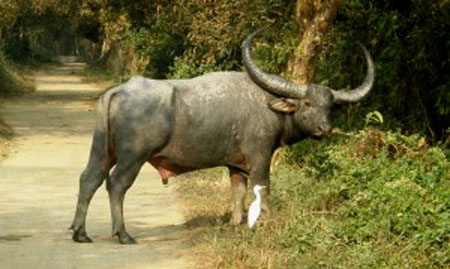
Wild Buffalo Moved from Kaziranga to Dibru Saikhowa National Park
Source:Rang7
A male member of the extinct spices of wild water buffalo was rehabilitated to Diru Saikhowa National Park from the Centre of Wildlife Rehabilitation Conservation, Kaziranga of Kaziranga National Park recently. The male wild buffalo was first rescued in Kaziranga National Park in 2006 after which it was sent to the rehabilitation centre of Kaziranga for recovery. This is the second rehabilitation programme of shifting wild buffaloes to Diru Saikhowa National Park. The first rehabilitation included the transfer of two buffaloes in 2006. Of the two, one died in a territorial fight with another wild buffalo, while the second one is still alive today
The Dibru Saikhowa National Park spread over 765 sq kms is located in the flood prone areas of Dibrugarh and Tinsukia. Due to its vulnerable position, the National Park is often in news for floods, poaching problems, smuggling of rare orchids found here and illegal fishing which is banned by the Assam state government within the territories of its National Parks. However the efforts of the forest official and forest guards have helped to maintain the welfare and bio diversity of the National Park along with protecting its residents. Acknowledging the 'extinction' tag of the wild buffalo, the rehabilitation programme was undertaken by the Assam Forest Department in collaboration with Wildlife Trust of India... Click To Read The Entire Article |
|
National Wildlife Humane Society Thank-you for allowing us into your email inbox. You are a valued member of NWHS and we look forward to providing you with current news concerning NWHS, other matters concerning wildlife, wildlife habitats and our wildlife rescue/sanctuary facility, "Top Of The Rock". Please invite other concerned humans to join our organization. It is our members that allow us to exist, expand and assist wildlife and precious wild habitat.
Humane is the responsibility of Humanity
FAIR USE NOTICE: This mailing may contain images and excerpts the use of which have not been pre-authorized. This material is made available for the purpose of analysis and critique, as well as to advance the understanding of political, media and cultural issues. All articles and commentary are provided as non-commercial, public educational and outreach content. The 'fair use' of such material is provided for under U.S. Copyright Law. In accordance with U.S. Code Title 17, Section 107, material on this mailing (along with credit links and attributions to original sources) is viewable for educational and intellectual purposes. If you are interested in using any copyrighted material from this mail for any reason that goes beyond 'fair use,' you must first obtain permission from the copyright owner.
Note: NWHS provides hyperlinks from email to third party sites as a convenience to users. NWHS does not endorse such third parties or the contents of any such sites. NWHS has no control over, makes no representation or warranty and disclaims all liability with respect to such sites. To use articles originated by NWHS, please use unaltered and provide a link back to NWHS. http://www.humanewildlife.org/ |
|
To Contact National Wildlife Humane Society
info@humanewildlife.org "A world without wildlife is a world not fit for humans"
Click Here To Visit NWHS Newsletter Archive
| | ||