|
|

|
National Wildlife Humane Society |
| Wildlife Conservation News |
|
|
|
| NWHS Intro |
| European Cheetahs |
| Tracking Rhinos |
| Sri Lanka Sanctuary |
| Rare Red Foxes |

National Wildlife Humane Society
A non-profit wildlife conservation organization working to preserve and protect threatened and endangered species.
|

| |
|



Rhino horns fitted with GPS trackers
Source:CNN Watch BY:Robyn Curnow
Mafikeng, South Africa - Across the South African bushveld a small white helicopter chased a rhino, one of Africa's most endangered animals. Eventually, over the din of the chopper blades, we heard a pop from the dart gun aimed at the rhino's rear. The dart immobilized the animal and a small group of khaki-wearing game farmers, vets and others rushed in on small vehicles to blindfold the confused, stumbling animal. They told us that covering the rhino's eyes and ears would lessen the trauma of what was to happen next.
The group of conservationists then began monitoring the rhino as someone drilled into the rhino's horn, using an electric drill powered by a generator sitting on the back of a pick-up truck. They burrowed an eight centimeter hole, about an inch wide. Inside they embedded a silver canister and then plugged up the incision with putty and wrapped some masking tape over the rhino horn, like a make-shift bush bandage. This radical surgery is an experiment that many in South Africa hope will help to curtail the massive surge in rhino poaching. More than 250 rhinos have been slaughtered for their horns this year, a huge increase compared to previous years. The hope is that the technology inside the silver canister will deter and even help to catch rhino poachers red-handed... Click Here To Read The Article And View Video |
|
Sri Lanka turns rebel hideout into wildlife sanctuary
Source: Sri Lanka News
COLOMBO - Sri Lanka is to turn a vast jungle area that was a base for the separatist Tamil Tiger rebels into a wildlife sanctuary, 18 months after the end of island’s bloody civil war, the government said Tuesday. The jungles of Mullaittivu, from where the rebels launched attacks for decades until they were defeated by government troops last year, has been declared a safe haven for wild animals, the information department said.
"The wildlife sanctuary would be a solution for the conflict between the humans and elephants in the surrounding areas," it said in a statement, adding the sanctuary would be about 100,000 acres (40,500 hectares). Spreading human settlement has left elephants short of habitat in Sri Lanka, with the animals often entering villages and farms looking for food. Sri Lanka's elephant population has dwindled to about 4,000 from about 12,000 in 1900, according to wildlife officials... Click Here To Read The Article At Source |

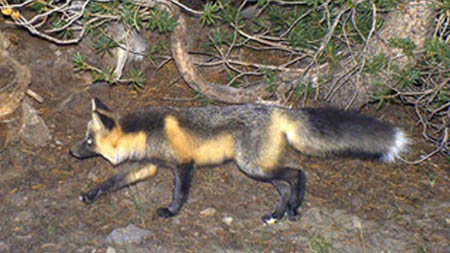
2 more rare red foxes confirmed in Sierra Nevada
Source:Deseret News By:Scott Sonner AP
RENO, Nev. - Federal wildlife biologists have confirmed sightings of two more Sierra Nevada red foxes that once were thought to be extinct. Scientists believe the foxes are related to another that was photographed this summer near Yosemite National Park. More importantly, they say, DNA samples show enough diversity in the Sierra Nevada red foxes to suggest a "fairly strong population" of the animals may secretly be doing quite well in the rugged mountains about 90 miles south of Reno.
The first confirmed sighting of the subspecies in two decades came in August when a remote camera captured the image of a female fox in the Humboldt-Toiyabe National Forest near Sonora Pass. Forest Service officials confirmed Friday that two more foxes, one male and one female, were photographed in September in the neighboring Stanislaus National Forest, about 4 miles from the original. That indicates there is the "continued persistence of a genetically unique population of Sierra Nevada red fox in the southern Sierra Nevada, rather than a single individual," the agency said. The DNA samples were obtained from fox feces, or scat, collected at the sites where the two most recent animals were spotted. They were caught on film by motion-activated cameras triggered when the bait, in this case, a sock full of chicken was disturbed. "There's enough diversity in the DNA that we think there is a fairly strong population there after not showing up in this isolated area for years and years," Forest Service wildlife biologist Diane Macfarlane said Friday... Click To Read The Entire Article |
|
National Wildlife Humane Society Thank-you for allowing us into your email inbox. You are a valued member of NWHS and we look forward to providing you with current news concerning NWHS, other matters concerning wildlife, wildlife habitats and our wildlife rescue/sanctuary facility, "Top Of The Rock". Please invite other concerned humans to join our organization. It is our members that allow us to exist, expand and assist wildlife and precious wild habitat.
Humane is the responsibility of Humanity
FAIR USE NOTICE: This mailing may contain images and excerpts the use of which have not been pre-authorized. This material is made available for the purpose of analysis and critique, as well as to advance the understanding of political, media and cultural issues. All articles and commentary are provided as non-commercial, public educational and outreach content. The 'fair use' of such material is provided for under U.S. Copyright Law. In accordance with U.S. Code Title 17, Section 107, material on this mailing (along with credit links and attributions to original sources) is viewable for educational and intellectual purposes. If you are interested in using any copyrighted material from this mail for any reason that goes beyond 'fair use,' you must first obtain permission from the copyright owner.
Note: NWHS provides hyperlinks from email to third party sites as a convenience to users. NWHS does not endorse such third parties or the contents of any such sites. NWHS has no control over, makes no representation or warranty and disclaims all liability with respect to such sites. To use articles originated by NWHS, please use unaltered and provide a link back to NWHS. http://www.humanewildlife.org/ |
|
To Contact National Wildlife Humane Society
info@humanewildlife.org "A world without wildlife is a world not fit for humans"
Click Here To Visit NWHS Newsletter Archive
| | ||