|
|

|
National Wildlife Humane Society |
| Wildlife Conservation News |
|
|
|
| NWHS Intro |
| Elephant Rice Perfume |
| Aarge Cheetah Cub |
| Networking Dolphins |
| Bushmeat Hunting |

National Wildlife Humane Society
A non-profit wildlife conservation organization working to preserve and protect threatened and endangered species.
|

| |
|


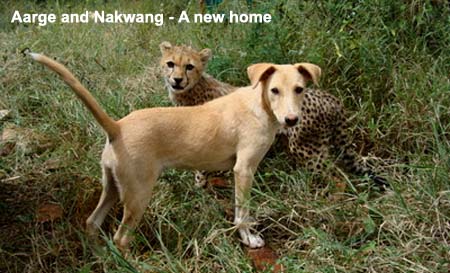
‘Aarge - cheetah cub’ what a special animal she is…
Source: Milgis Trust at WildlifeDirect By: Helen Douglas-Dufresne
When our Milgis team headed off to collect Aarge (please see my blog) in August, they wondered if she would survive until they got to the Milgis [view photos taken on August 16th, from the link below]. She was incredibly weak and in quite a sorrowful sight, but according to the man who picked her up, she was a lot better than when they decided to pick her up! They had made a little upstairs house for her to live in so that she did not lie on the sand and pick up "mango worms". Basically that's all she did for the first week, just sleep, and was happy to have something in her belly.
When we got her to Elkanto she started recovering very quickly, especially when Kosma the warrior took it on to himself to be with her as much as he could, and to sleep with her. Soon any company, human or animal, she was happy. If she was left on her own, she would call and call. If one had the time to spend with her, and sit down with her, in no time she was purring and showing real friendship, pushing her face to yours and licking! Then we found her a real friend! Nakwang, a puppie of her own age, who if she was out of sight Aarge would panic. It's an incredibly special friendship between these two. They play and play all day! I have some wonderful video clips of them playing!! [NWHS NOTE: We shall try to get these clips from the field, and post them for everyone to enjoy] To find out what happened to Aarge and Nakwang (it's awesome)... Click Here To View Full WildlifeDirect Post Click To View Milgis Trust's NWHS Support/Info Page |
|
Networking for Dolphins
Source: Science Now By: Virginia Morell
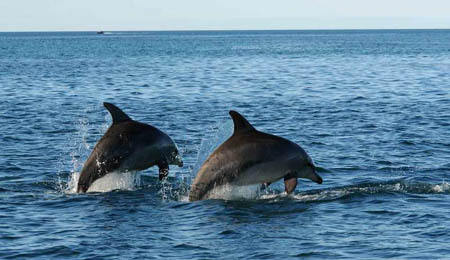
Like a marine mammal version of Facebook, male and female bottlenose dolphins spend their days courting friends and building alliances. Two new studies show just how important such friendships are to dolphins, and the role friends and alliances play in life's biggest game: the race to reproduce. Male bottlenose dolphins (Tursiops sp.) form tight bonds with friends and allies that are as intricate and devious as those of humans. Researchers already know for example, that males team up as duos or trios - known as first-level alliances, so that they can mate with a female without her swimming away. (Females come into estrus only every 4 to 5 years and are thus a rare prize.) But rival males will often try to steal the female, causing the duo or trio to join forces with other duos and trios in what's known as a second-level alliance.
"There can be huge battles over a single female," says Richard Connor, an animal behaviorist at the University of Massachusetts, Dartmouth, who has been studying wild dolphins in Shark Bay, Australia for 24 years. "A trio under attack will get help from their buddies." Now Connor and colleagues have found an even higher level of alliance. In the biggest fights, the team found, the second-level alliance may receive help from another group of male dolphins, forming what the researchers call a "third-level" alliance. Even among chimpanzees, scientists have not witnessed such sophisticated partnerships where one group of animals receives help from another group in a fight... Click Here To Read The Article In Full |
Bushmeat hunting alters forest structure in Africa
Source: Mongabay dot Com By: Jeremy Hance
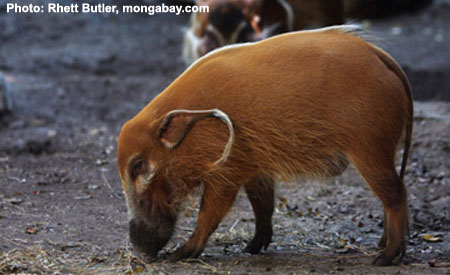
According to the first study of its kind in Africa, bushmeat hunting impacts African rainforests by wiping-out large mammals and birds, such as forest elephants, primates, and hornbills - that are critical for dispersing certain tree species. The study, published in Biotropica, found that heavy bushmeat hunting in the Central African Republic changes the structure of forest species by favoring small-seeded trees over large-seeded, leading to lower tree diversity of trees that have big seeds.
"When hunters remove big animals, they remove at the same time the ecological functions of the animals," lead author Hadrien Vanthomme, from the Museum National d'Histoire Naturelle in France, explained to mongabay.com. "To keep it simple, animals can have two opposite impacts on forest regeneration: they can favor it (mostly by carrying seeds away from the parent plants, phenomenon called dispersal) or they can oppose regeneration (by destroying seeds or young seedlings). So basically, we expect that if a guild of animals implied in seed dispersal of a plant is removed, the regeneration of this plant species will be compromised." Due to a dearth in data, Vanthomme and colleagues did not know which animals spread which plants, but instead had to hypothesize likely ecological interactions... Click Here To Read Full Article |
|
National Wildlife Humane Society Thank-you for allowing us into your email inbox. You are a valued member of NWHS and we look forward to providing you with current news concerning NWHS, other matters concerning wildlife, wildlife habitats and our wildlife rescue/sanctuary facility, "Top Of The Rock". Please invite other concerned humans to join our organization. It is our members that allow us to exist, expand and assist wildlife and precious wild habitat.
Humane is the responsibility of Humanity
FAIR USE NOTICE: This mailing may contain images and excerpts the use of which have not been pre-authorized. This material is made available for the purpose of analysis and critique, as well as to advance the understanding of political, media and cultural issues. All articles and commentary are provided as non-commercial, public educational and outreach content. The 'fair use' of such material is provided for under U.S. Copyright Law. In accordance with U.S. Code Title 17, Section 107, material on this mailing (along with credit links and attributions to original sources) is viewable for educational and intellectual purposes. If you are interested in using any copyrighted material from this mail for any reason that goes beyond 'fair use,' you must first obtain permission from the copyright owner.
Note: NWHS provides hyperlinks from email to third party sites as a convenience to users. NWHS does not endorse such third parties or the contents of any such sites. NWHS has no control over, makes no representation or warranty and disclaims all liability with respect to such sites. To use articles originated by NWHS, please use unaltered and provide a link back to NWHS. http://www.humanewildlife.org/ |
|
To Contact National Wildlife Humane Society
info@humanewildlife.org "A world without wildlife is a world not fit for humans"
Click Here To Visit NWHS Newsletter Archive
| | ||