|
|

|
National Wildlife Humane Society |
| Wildlife Conservation News |
|
|
|
| NWHS Intro |
| Ewaso Lions Warriors |
| Tigers 6% Solution |
| New Wolf Pack |
| Asian "Unicorn" |

National Wildlife Humane Society
A non-profit wildlife conservation organization working to preserve and protect threatened and endangered species.
|

| |
|



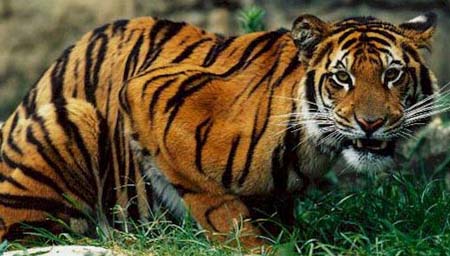
Bringing the Tiger Back from the Brink: The Six Percent Solution
Source: PLoS Biology; Public Library of Science
The Tiger Summit, to be hosted by Prime Minister Vladimir Putin in Russia in November 2010, the Chinese Year of the Tiger and the International Year of Biodiversity, promises to be the most significant meeting ever held to discuss the fate of a single non-human species. The Summit will culminate efforts by the Global Tiger Initiative (GTI), launched in 2008 by Robert Zoellick, World Bank President. Leaders of 13 tiger range states, supported by international donors and conservationists attending the summit, are being asked to commit to substantive measures to prevent the unthinkable: extinction of the world's last wild tiger populations.
Wild tiger numbers are at an historic low. There is no evidence of breeding populations of tigers in Cambodia, China, Vietnam, and DPR Korea. Current approaches to tiger conservation are not slowing the decline in tiger numbers, which has continued unabated over the last two decades. While the scale of the challenge is enormous, we submit that the complexity of effective implementation is not: commitments should shift to focus on protecting tigers at spatially well-defined priority sites, supported by proven best practices of law enforcement, wildlife management, and scientific monitoring. Conflict with local people needs to be mitigated. We argue that such a shift in emphasis would reverse the decline of wild tigers and do so in a rapid and cost-efficient manner. Despite a long history of concern for wild tigers, both their range and total number have collapsed: fewer than 3,500 animals now live in the wild, occupying less than 7% of their historical range... Click Here To View The Entire Article |
|
Wolf pup in northeast Washington may indicate state's third pack
Source: WASHINGTON DEPARTMENT OF FISH AND WILDLIFE
A gray wolf pup recently trapped and radio-collared near the Canadian border in northeast Washington indicates the state may be home to a third breeding wolf pack. A wolf specialist hired by the Washington Department of Fish and Wildlife (WDFW) caught the 50-pound young wolf earlier this month in northern Pend Oreille County, just south of the Canadian border. Attempts are under way to locate and radio-collar adult wolves in the area.
The presence of the pup, and photos of other wolves captured on a remote camera in the area, indicate there is a pack in the area, said Harriet Allen, who heads WDFW’s endangered-species section. "We don’t know at this point whether the den where the pup was born was in Washington or British Columbia," Allen said. "We plan to monitor the pack next spring to determine the den location. If the den is in Washington, the pack can be considered a Washington pack; if the den is in British Columbia, it is a Canadian pack. Our Canadian colleagues are aware of wolf activity in that area, and will assist with monitoring on their side of the border." A successful breeding wolf pack is documented by locating a breeding pair of adults with two or more pups that survive until Dec. 31, Allen said... Click Here To Read The Article In Full |

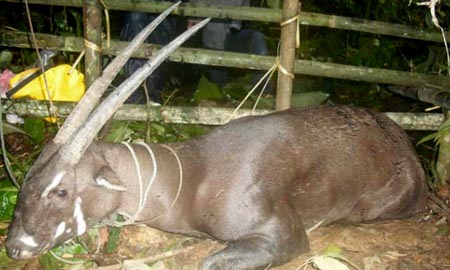
Rare Asian 'Unicorn' Sighted, Dies in Captivity
Source: LiveScience
One of the rarest animals in the world has been sighted for the first time in more than 10 years, according to the government of Laos. Sightings of the animal, called a saola, are so rare that the creature has been likened to a unicorn, despite the fact that it has two horns, not one.
The Lao government announced that in late August villagers in the central province of Bolikhamxay captured a saola, which looks similar to an antelope, and brought it back to their village. When news of the saola's capture reached Lao authorities, the Bolikhamxay Provincial Agriculture and Forestry Office immediately sent a team, advised by the International Union for Conservation of Nature (IUCN) and the Wildlife Conservation Society (WCS) to examine the saola and release it. Unfortunately the animal, an adult male, weakened by the ordeal of several days in captivity, died shortly after. The animal was photographed while still alive... Click Here To Read Full Article |
|
National Wildlife Humane Society Thank-you for allowing us into your email inbox. You are a valued member of NWHS and we look forward to providing you with current news concerning NWHS, other matters concerning wildlife, wildlife habitats and our wildlife rescue/sanctuary facility, "Top Of The Rock". Please invite other concerned humans to join our organization. It is our members that allow us to exist, expand and assist wildlife and precious wild habitat.
Humane is the responsibility of Humanity
FAIR USE NOTICE: This mailing may contain images and excerpts the use of which have not been pre-authorized. This material is made available for the purpose of analysis and critique, as well as to advance the understanding of political, media and cultural issues. All articles and commentary are provided as non-commercial, public educational and outreach content. The 'fair use' of such material is provided for under U.S. Copyright Law. In accordance with U.S. Code Title 17, Section 107, material on this mailing (along with credit links and attributions to original sources) is viewable for educational and intellectual purposes. If you are interested in using any copyrighted material from this mail for any reason that goes beyond 'fair use,' you must first obtain permission from the copyright owner.
Note: NWHS provides hyperlinks from email to third party sites as a convenience to users. NWHS does not endorse such third parties or the contents of any such sites. NWHS has no control over, makes no representation or warranty and disclaims all liability with respect to such sites. To use articles originated by NWHS, please use unaltered and provide a link back to NWHS. http://www.humanewildlife.org/ |
|
To Contact National Wildlife Humane Society
info@humanewildlife.org "A world without wildlife is a world not fit for humans"
Click Here To Visit NWHS Newsletter Archive
| | ||