|
|

|
National Wildlife Humane Society |
| Wildlife Conservation News |
|
|
|
| NWHS Intro |
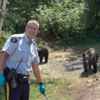
| Guard Bears |
| Oldest Animal Species |
| Lost Amphibians |
| Rothschild Giraffe |

National Wildlife Humane Society
A non-profit wildlife conservation organization working to preserve and protect threatened and endangered species.
|

| |
|


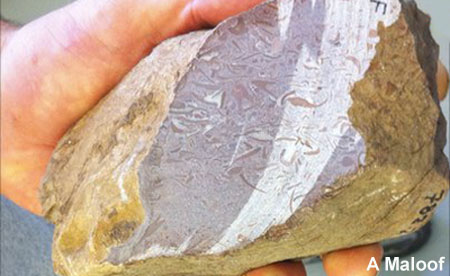
Fossils may be "Earliest Animals"
Source: BBC Earth News By: Jonathan Amos
Tiny, irregularly shaped fossils from South Australia could be the oldest remains of simple animal life found to date. The collection of circles, anvils, wishbones and rings discovered in the Flinders Ranges are most probably sponges, a Princeton team claims.
The rocks in which the forms were found are 640-650 million years old. This is at least 70 million years older than some other claims for the most ancient animals in the fossil record. The research, led by Professor Adam Maloof, is published in the journal Nature Geoscience. The oldest known, generally accepted fossilised sponges prior to the Flinders claim are about 520 million years old. Not everyone is ready to accept the Princeton assessment yet, however... Click Here To View The Entire Article |
|
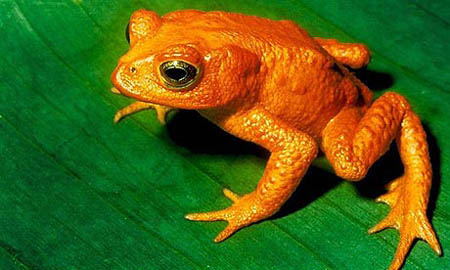
Search launched for 'lost' amphibians
Source: The Guardian By: Jenny Percival
It has orange skin, bulging eyes and was last seen in Costa Rica 20 years ago. Now the hunt is on to rediscover the golden toad, a species that tops an international list of 100 "lost" amphibians. Conservationists in 14 countries on five continents have launched their unprecedented search because the amphibian population is suffering a startling decline, with more than one-third of species under threat of extinction.
The golden toad, which was abundant until the late 1980s when it all but disappeared, tops the most-wanted list, followed by the gastric brooding frog, which reproduces by swallowing eggs and raising the tadpoles in the stomach before giving birth to froglets through the mouth. The Mesopotamia beaked frog, last seen in Colombia in 1914, has a distinctive pyramid-shaped head, while the hula painted frog is thought to have disappeared in the mid-50s when Syrian marshlands were drained to eradicate malaria. Scientists say amphibians are particularly sensitive to changes in the environment and act as an indicator of environmental damage. They also play the vital role of controlling insects that spread disease and damage crops, while the chemicals in amphibian skins have been used in the creation of lifesaving drugs, including a painkiller 200 times more potent than morphine... Click Here To Read The Article In Full |
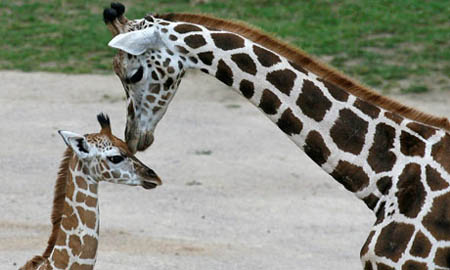
Rare giraffe added to IUCN Red List
Source: Arkive News
A rare subspecies of giraffe has become the latest charismatic mammal to be added to the IUCN Red List of Threatened Species. With fewer than 670 individuals remaining, Rothschild's giraffe (Giraffa camelopardalis rothschildi) has now been classified as Endangered by the IUCN, making it the second most threatened of the nine recognised giraffe subspecies. The listing has been welcomed by conservationists, with Dr Julian Fennessy, co-founder of the Giraffe Conservation Foundation, saying, "I am delighted and of course saddened at the same time that the Rothschild giraffe has finally made the IUCN Red List status. We have been striving for this for a while now and hope this will highlight to the world the critical state its tallest creature is in."
Named after the zoologist Lord Walter Rothschild, Rothschild's giraffe is easily distinguished from other giraffe subspecies by the lack of markings below its knees. It once ranged widely across Kenya, Uganda and southern Sudan, but agricultural development, human settlement and poaching have eliminated the subspecies from most of its former range. With only a few small populations now remaining in Kenya and Uganda, isolated from each other and so unable to interbreed, the situation for this giraffe is now critical. With such tiny numbers, and with recent genetic evidence suggesting it may in fact be a distinct species, the conservation of Rothschild's giraffe is clearly an urgent priority... Click Here To Read Article With Video |
|
National Wildlife Humane Society Thank-you for allowing us into your email inbox. You are a valued member of NWHS and we look forward to providing you with current news concerning NWHS, other matters concerning wildlife, wildlife habitats and our wildlife rescue/sanctuary facility, "Top Of The Rock". Please invite other concerned humans to join our organization. It is our members that allow us to exist, expand and assist wildlife and precious wild habitat.
Humane is the responsibility of Humanity
FAIR USE NOTICE: This mailing may contain images and excerpts the use of which have not been pre-authorized. This material is made available for the purpose of analysis and critique, as well as to advance the understanding of political, media and cultural issues. All articles and commentary are provided as non-commercial, public educational and outreach content. The 'fair use' of such material is provided for under U.S. Copyright Law. In accordance with U.S. Code Title 17, Section 107, material on this mailing (along with credit links and attributions to original sources) is viewable for educational and intellectual purposes. If you are interested in using any copyrighted material from this mail for any reason that goes beyond 'fair use,' you must first obtain permission from the copyright owner.
Note: NWHS provides hyperlinks from email to third party sites as a convenience to users. NWHS does not endorse such third parties or the contents of any such sites. NWHS has no control over, makes no representation or warranty and disclaims all liability with respect to such sites. To use articles originated by NWHS, please use unaltered and provide a link back to NWHS. http://www.humanewildlife.org/ |
|
To Contact National Wildlife Humane Society
info@humanewildlife.org "A world without wildlife is a world not fit for humans"
Click Here To Visit NWHS Newsletter Archive
| | ||