|
|

|
National Wildlife Humane Society |
| Wildlife Conservation News |
|
|
|
| NWHS Intro |
| Milgis Trust |
| Jaguars In Belize |
| New Monkey Species |
| Pakistan Snow Leopard |

National Wildlife Humane Society
A non-profit wildlife conservation organization working to preserve and protect threatened and endangered species.
|

| |
|


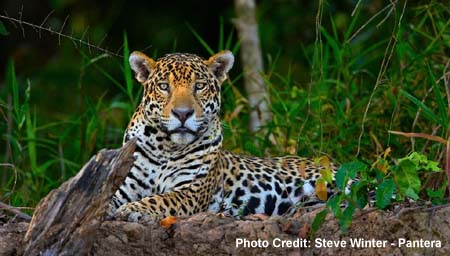
Belize sets aside land for jaguar corridor
Source: NatGeo News Watch Editor: David Braun
More than 7,000 acres of key jaguar habitat between Belize City and Belmopan, the capital of Belize, has been designated as a sanctuary for the embattled big cat, the conservation organization Panthera said yesterday. Describing the sanctuary as "another huge step forward in the fight to save wild cats," Panthera said the Labouring Creek Jaguar Corridor Wildlife Sanctuary was designated by officials as a protected area "and adds one more stretch of safe passageway to the species' range."
Howard Quigley, Panthera's Jaguar Program Executive Director, led the Belize team to ensure that federally owned lands, known as Crown lands, were not partitioned off to developers in the country, and Gaspar Vega, the Belize Minister of Natural Resources, signed into law the creation of the protected area, Panthera said in a news statement about the corridor. The largest cat living today in the Americas, the jaguar is no longer hunted for its beautiful coat but continues to be threatened by hunting due to competition with livestock, deforestation and loss of wild prey... Click Here To View The Entire Article |
|
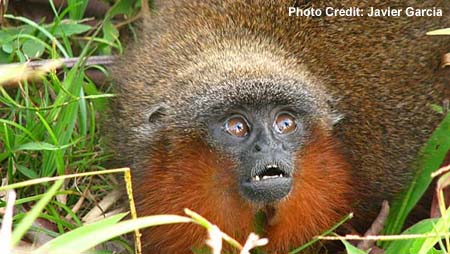
New species of titi monkey found in Colombia, in danger of extinction
Source: LA Times By: Lindsay Barnett
Biologists with the group Conservation International hope the discovery of a species of titi monkey previously unknown to science will lead to new efforts to protect it and other species in the Amazon. The presence of a distinct type of titi monkey in the Colombian department of Caqueta near the country's borders with Ecuador and Peru, was suspected for decades, "but for a long time we could not confirm if it was different from other titis," said Dr. Thomas Defler, a primatologist and professor at National University of Colombia in Bogota, who led the research team. "We now know that this is a unique species, and it shows the rich diversity of life that is still to be discovered in the Amazon."
Biologist Martin Moynihan reported observing the species when he traveled to the area in the mid-1970s. Other scientists were eager to confirm Moynihan's report and learn more about the Caqueta titi monkeys, but years of insurgent violence made traveling to the region too dangerous. In 2008, research student Javier Garcia, a Caqueta native, was able to make an extensive survey of the region and discovered 13 populations of the Caqueta titi monkeys there. Caqueta titi monkeys can be distinguished from many of their closest cousins because they lack a signature white strip of fur across their foreheads exhibited by many titi monkeys. Caqueta titis are similar in size to domestic house cats and have bushy red beards... Click Here To Read The Article In Full |
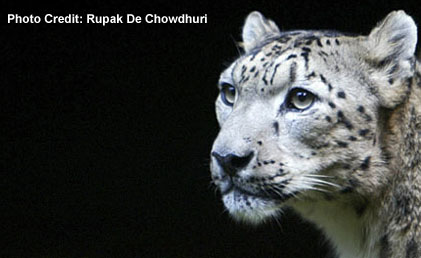
Endangered snow leopard clawing its way back
Source: Guardian Environment Network By: Zofeen Ebrahim
Innovative conservation project in Pakistan sees a slow but sure rise in the number of the endangered big cats. For more than 10 years, Shafqat Hussain has been on the trail of the endangered snow leopard. He has heard the beast's growl, and has seen its pugmarks against a snowy track. But his dream of coming eye-to-eye with the elusive nocturnal feline remains unfulfilled. "If you've seen the cat, you've seen the Holy Grail," says Hussain. However, he is not as much "driven by sighting the animal, as ensuring its survival", says the 41-year-old Hussain, an environmentalist and anthropology professor at Trinity College in the United States.
Snow leopards are globally endangered, according to the International Union for Conservation of Nature's (IUCN) Red List of Threatened Species, with total population estimated at between 4,000 and 7,000. In 1999, Hussain started an innovative insurance programme in two Baltistan villages, named Project Snow Leopard, with funding from the Royal Geographical Society and the U.S.based Snow Leopard Conservancy.
His "alternate approach", Hussain explains, "helps in the conservation and protection of the snow leopards, but also compensates the local herders for every goat killed by the feline, on the condition that the villagers will not kill it"...
Click Here To Read Article |
|
National Wildlife Humane Society Thank-you for allowing us into your email inbox. You are a valued member of NWHS and we look forward to providing you with current news concerning NWHS, other matters concerning wildlife, wildlife habitats and our wildlife rescue/sanctuary facility, "Top Of The Rock". Please invite other concerned humans to join our organization. It is our members that allow us to exist, expand and assist wildlife and precious wild habitat.
Humane is the responsibility of Humanity
FAIR USE NOTICE: This mailing may contain images and excerpts the use of which have not been pre-authorized. This material is made available for the purpose of analysis and critique, as well as to advance the understanding of political, media and cultural issues. All articles and commentary are provided as non-commercial, public educational and outreach content. The 'fair use' of such material is provided for under U.S. Copyright Law. In accordance with U.S. Code Title 17, Section 107, material on this mailing (along with credit links and attributions to original sources) is viewable for educational and intellectual purposes. If you are interested in using any copyrighted material from this mail for any reason that goes beyond 'fair use,' you must first obtain permission from the copyright owner.
Note: NWHS provides hyperlinks from email to third party sites as a convenience to users. NWHS does not endorse such third parties or the contents of any such sites. NWHS has no control over, makes no representation or warranty and disclaims all liability with respect to such sites. To use articles originated by NWHS, please use unaltered and provide a link back to NWHS. http://www.humanewildlife.org/ |
|
To Contact National Wildlife Humane Society
info@humanewildlife.org "A world without wildlife is a world not fit for humans"
Click Here To Visit NWHS Newsletter Archive
| | ||