|
|

|
National Wildlife Humane Society |
| Wildlife Conservation News |
|
|
|
| NWHS Intro |
| Panther Survives Hit |
| Elephant Trackers |
| Wolves Re-Listed! |
| Myanmar Tiger Reserve |

National Wildlife Humane Society
A non-profit wildlife conservation organization working to preserve and protect threatened and endangered species.
|

| |
|


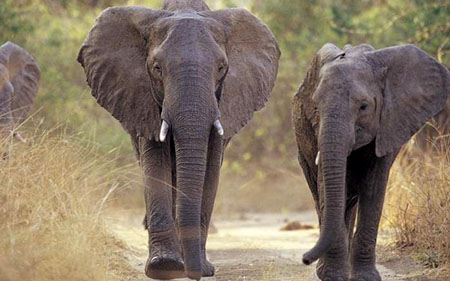
Two elephants shifted to Bengdubi to search for injured elephant
Source: Northern Voices Online By: Tarak Sarkar
Darjeeling (ANI): To capture an injured elephant running wild in the Bengdubi Forest Range of West Bengal two captive elephants have been shifted to the area to help forest officers trace the animal. Army personnel inside the Bengdubi range had spotted the injured elephant on Tuesday. But a subsequent search by forest officials of the Darjeeling Wildlife Division I and Kerseong Wildlife subdivision yielded no results, prompting the Forest Department to engage captive elephants to trace the injured elephant. The injury is said to be in the left leg of the elephant, as he was seen limping and unable to move around freely.
"First, we will examine the injury and then only we'll get to know what has happened, and how it has happened. We just know that the elephant has an injury in the left leg. We got to know that the animal is injured by the way he was walking," said Narayan Chandra Rai, Divisional Forest Officer (DFO) of Kerseong division, West Bengal. The forest officials said the injured elephant was sighted later, but it ran away whenever it saw the captive elephants. They added that locating the animal has become a problem... Click Here To View The Entire Article |
|
Wolves Back on Endangered Species List!
Source: Daily Kos By: RL Miller
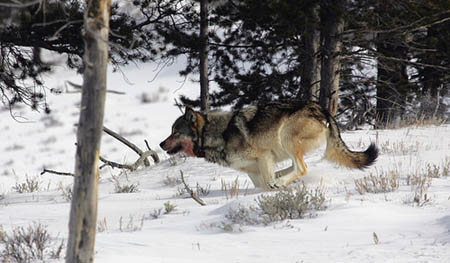
Howls of joy for wolves! Judge Donald Molloy in Montana has ordered that the Northern Rocky Mountain gray wolf goes back on the endangered species list in Montana and Idaho. The judge's opinion (50 pg pdf) decries the politics of the original delisting. As background, the wolf was placed on the Endangerd Species List in 1974. The animal recovered to the point where the Obama administration delisted the wolf in May 2009 in Montana and Idaho, but not Wyoming. The first two states had what were supposed to be good plans for wolf management; Wyoming's plan for wolf management remained one step above "exterminate 'em all," and thus the wolf remained on the Endangered Species list in that state alone.
The district court disapproved of the "two out of three states ain't bad" approach. The key holding: The Endangered Species Act does not allow the U.S. Fish & Wildlife Service to list only part of a "species" as endangered, or to protect a listed distinct population segment only in part as the Final Rule here does; and the legislative history of the Endangered Species Act does not support the Service's new interpretation ofthe phrase "significant portion of its range," To the contrary it supports the historical view that the Service has always held, the Endangered Species Act does not allow a distinct population segment to be subdivided... Click Here To Read The Article In Full |
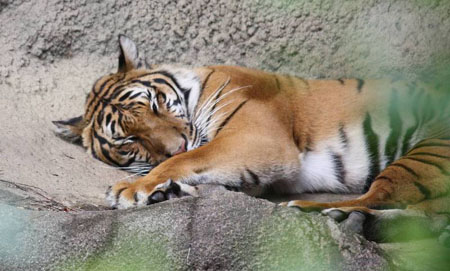
World's Largest Tiger Reserve Created in Myanmar
Source: suite101 By: Darla Sue Dollman
On August 4, 2010, Myanmar, the largest country in mainland Southeast Asia, announced it has tripled the size of the Hukaung Valley Tiger Reserve, which will make this protected area the largest tiger reserve in the world. According to a recent Associated Press article, the Myanmar government originally dedicated 2500 square miles of the valley in 2004 for the protection of Southeast Asia's wildlife. The newly expanded reserve is now 8450 square miles. The Hukaung Valley Tiger Reserve has been plagued by illegal hunting in years past and officials fear the number of tigers currently living in the reserve has dropped to fifty, but they are hoping that the increase in protected territory will help increase the tiger population.
Deep within the Hukaung Valley, the Indochinese Tiger - an endangered species and one of six surviving subspecies of tigers - makes its home. The male Indochinese Tiger averages 8 to 9 feet long and 400 pounds, while the female averages 7 to 8 feet long and 280 pounds. Indochinese Tigers eat wild pigs, deer and cattle. Indochinese tigers can also be found in southern China, Vietnam, Malaysia, Thailand, Burma, Cambodia and Laos.
In addition to the Indochinese Tiger and an estimated 370 different birds species, the Hukaung Valley Tiger reserve is home to many other endangered and protected animals found on the IUCN Red List of threatened species. The endangered Asian Elephant and critically endangered Rufous-necked Hornbill live on the reserve...
Click Here To Read Article |
|
National Wildlife Humane Society Thank-you for allowing us into your email inbox. You are a valued member of NWHS and we look forward to providing you with current news concerning NWHS, other matters concerning wildlife, wildlife habitats and our wildlife rescue/sanctuary facility, "Top Of The Rock". Please invite other concerned humans to join our organization. It is our members that allow us to exist, expand and assist wildlife and precious wild habitat.
Humane is the responsibility of Humanity
FAIR USE NOTICE: This mailing may contain images and excerpts the use of which have not been pre-authorized. This material is made available for the purpose of analysis and critique, as well as to advance the understanding of political, media and cultural issues. All articles and commentary are provided as non-commercial, public educational and outreach content. The 'fair use' of such material is provided for under U.S. Copyright Law. In accordance with U.S. Code Title 17, Section 107, material on this mailing (along with credit links and attributions to original sources) is viewable for educational and intellectual purposes. If you are interested in using any copyrighted material from this mail for any reason that goes beyond 'fair use,' you must first obtain permission from the copyright owner.
Note: NWHS provides hyperlinks from email to third party sites as a convenience to users. NWHS does not endorse such third parties or the contents of any such sites. NWHS has no control over, makes no representation or warranty and disclaims all liability with respect to such sites. To use articles originated by NWHS, please use unaltered and provide a link back to NWHS. http://www.humanewildlife.org/ |
|
To Contact National Wildlife Humane Society
info@humanewildlife.org "A world without wildlife is a world not fit for humans"
Click Here To Visit NWHS Newsletter Archive
| | ||