|
|

|
National Wildlife Humane Society |
| Wildlife Conservation News |
|
|
|
| NWHS Intro |
| Snow Leopard Cubs |
| Iberian Lynx Release |
| Saving Hippos |
| Relocating Turtle Nests |

National Wildlife Humane Society
A non-profit wildlife conservation organization working to preserve and protect threatened and endangered species.
|

| |
|




Released lynxes have cubs
Source: Iberia Nature
The seven Iberian lynxes (four females and three males) released in December 2009 in Guadalmellato, Cordoba are breeding successfully. Three cubs have been born to one mother, and two other females are believed to be pregnant.
The seven animals were the first to be released from the lynx captive breeding programme with the aim of establishing new territories across Spain. In this first case, an area close to the main lynx stronghold of Andujar was chosen. To make their adaptation easier supplementary food in the form of penned rabbits has been provided, the lynxes can get in, but the rabbit can’t get out. The animals have also been fitted with radio-trackers.
The biologists in charge of the project are delighted not only with the news of the cubs, but also because no lynxes have so far died, three to four were expected to do so as they succumbed to the ordeal of adapting to their new territory. One animal has also come into contact with lynxes from Andujar which bodes well that this small population can expand...
Click Here To View The Entire Article |
|
Saving one of West Africa's last hippo populations
Source: Mongabay By: Jeremy Hance
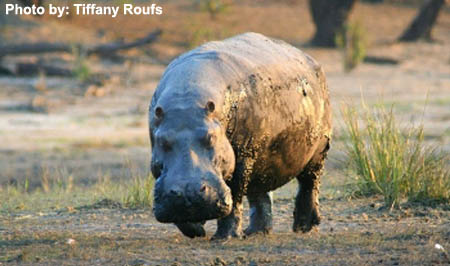
A new study in Tropical Conservation Science highlights the need for further conservation actions to save one of West Africa's last hippo populations, located in southern Burkina Faso. Researchers surveyed 41 hippos in the 'Mare aux Hippopotames' Biosphere Reserve of Burkina Faso in 2008, up by six individuals since 2006, but down from a population of 68 in 1985. The hippos (Hippopotamus amphibious) remain threatened by possible conflict with locals and the fact that a number of their ponds are outside the protected area.
While surveying the hippo population, the researchers discovered that during the rainy season the hippos migrate to four temporary ponds outside of the protected area. From there they raid adjacent agricultural fields for food, putting in place the possibility of human-hippo conflict. The researchers recommend that these ponds be quickly placed under protection to ensure the long-term survival of the hippo population.
In addition, the researchers say that the presence of the hippos could be a potential draw for tourists and provide additional income to local people...
Click Here To Read The Article In Full |
A High-Risk Egg Race To Save The Sea Turtles
Source: NPR By: NPR Staff
As the oil spill coats Gulf Coast beaches, rescuers are hatching a daring plan to save as many as 70,000 sea turtle eggs from the disaster. Each year, thousands of newly hatched sea turtles scramble from their nests in the Florida Panhandle's sandy beaches and Alabama coasts into the water. With those waters fouled by oil and chemical dispersant, a whole generation of sea turtles could be harmed or even destroyed.
Hundreds of turtles and birds have already died in the oil spill, but the U.S. Fish and Wildlife Service is determined that this year's hatchlings won't be among the casualties. Biologists plan to relocate all the nests from the Gulf Coast to Florida's eastern coast, agency spokesman Chuck Underwood tells NPR's Scott Simon. "They'll be allowed to complete their incubation, and hopefully the turtles will emerge," Underwood says. Then "we can collect them and release them to the ocean."
In a couple of weeks, he says, the rescue team will dig up an estimated 700 to 800 nests, place them in foam containers and ship them overland to Florida's far side...
Click Here To Read Article |
|
National Wildlife Humane Society Thank-you for allowing us into your email inbox. You are a valued member of NWHS and we look forward to providing you with current news concerning NWHS, other matters concerning wildlife, wildlife habitats and our wildlife rescue/sanctuary facility, "Top Of The Rock". Please invite other concerned humans to join our organization. It is our members that allow us to exist, expand and assist wildlife and precious wild habitat.
Humane is the responsibility of Humanity
FAIR USE NOTICE: This mailing may contain images and excerpts the use of which have not been pre-authorized. This material is made available for the purpose of analysis and critique, as well as to advance the understanding of political, media and cultural issues. All articles and commentary are provided as non-commercial, public educational and outreach content. The 'fair use' of such material is provided for under U.S. Copyright Law. In accordance with U.S. Code Title 17, Section 107, material on this mailing (along with credit links and attributions to original sources) is viewable for educational and intellectual purposes. If you are interested in using any copyrighted material from this mail for any reason that goes beyond 'fair use,' you must first obtain permission from the copyright owner.
Note: NWHS provides hyperlinks from email to third party sites as a convenience to users. NWHS does not endorse such third parties or the contents of any such sites. NWHS has no control over, makes no representation or warranty and disclaims all liability with respect to such sites. To use articles originated by NWHS, please use unaltered and provide a link back to NWHS. http://www.humanewildlife.org/ |
|
To Contact National Wildlife Humane Society
info@humanewildlife.org "A world without wildlife is a world not fit for humans"
Click Here To Visit NWHS Newsletter Archive
| | ||