|
|

|
National Wildlife Humane Society |
| Wildlife Conservation News |
|
|
|
| NWHS Intro |
| UN Gorilla Rescue |
| Disappearing Snakes |
| African Grey Parrots |
| Losing Ocelots |

National Wildlife Humane Society
A non-profit wildlife conservation organization working to preserve and protect threatened and endangered species.
|

| |
|



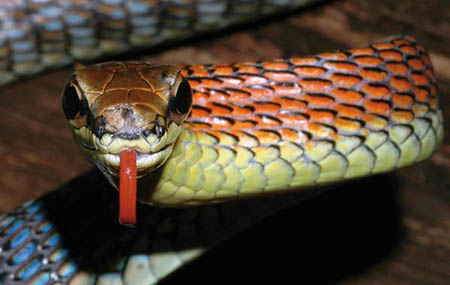
Global mystery: Why are snakes dying off?
Source:Christian Science Monitor By:Stephen Kurczy
Climate change is a possible explanation for the snake's 'drastic decline' in Europe and Africa. Snakes now join a list of declining animal populations that includes fish, amphibians, reptiles, birds, and mammals.
Good news for Indiana Jones and others with ophidiophobia: a new study shows snake populations have declined worldwide. Bad news for farmers and those afraid of rats and mice: rodents now have fewer predators to outsmart. The world's first global study on snake populations revealed that 11 of 17 snake populations in the United Kingdom, France, Italy, and Nigeria plummeted between 1998 to 2002. Some populations fell by as much as 90 percent, according to the study from the Centre for Ecology & Hydrology in England.
"Since the drastic decline, the populations have not continued to decline they have not died out, they are still present, but they are present at much lower densities than before," lead scientist Chris Reading says in a telephone interview from England...
Click Here To View The Entire Article |
|
The Last of Cameroon's Grey Parrots
Source: Bush Warriors Blog
Grey parrots are found only in the rainforests of West and Central Africa, but they’re prized as pets in countries around the world. People are captivated by their beautiful colors, gentle nature and ability to mimic humans. But demand for the birds could be threatening their very existence.
The Worldwide Fund for Nature (WWF) estimates that 450,000 of the birds were captured and exported from Africa between 1994 and 2003. The number would be even higher if it included illegal exports. Seeing the danger of extinction, many countries in Europe, North America and Africa have banned trade in grey parrots. Cameroon issued a ban three years ago. But conservationists say the measures have failed to reduce the trade. Illegal operations have continued and have even increased.
Ofir Drori is the director of LAGA, a wildlife law enforcement group that’s helping the government of Cameroon, says despite the ban at least 1,000 parrots are exported from Cameroon every month...
Click Here To Read The Article In Full NWHS NOTE: NWHS would like to remind the public NOT to purchase import wild caught pets. |

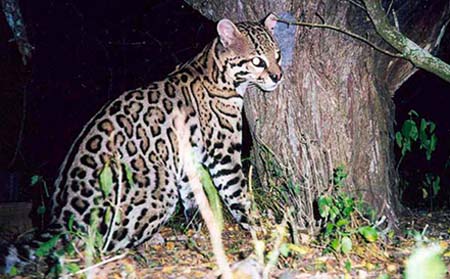
Ocelot fatality renews call for wildlife crossings
Source: San Antonio Express-News By:Lynn Brezosky
LOS FRESNOS — To the motorist who killed it, the animal might have been an unfortunate instance of late-night road kill, a stray something-or-other darting from the greenery lining an irrigation ditch on the highway to South Padre Island. But the passer-by who found the spotted carcass along Texas 100 that morning in early May knew it was a wild ocelot, one of less than 50 remaining in the United States.
Mourning shot through the community of biologists fighting to keep the population from extinction. "When there's so few ocelots we're always concerned about losing another one," said Kelly McDowell, project leader for the South Texas Refuge Complex, which has been conducting extensive research and public outreach about the ocelots. "We're hoping that maybe we're just hearing more about things, but that may be naive, too."
Ocelots once roamed Texas' coastal prairie up into Louisiana and Arkansas, but habitat fragmentation and hunting depleted their numbers. There was rejoicing last week when a trip camera at the Laguna Atascosa Wildlife Refuge captured a second kitten born to a female named Esperanza...
Click Here To Read Article |
|
National Wildlife Humane Society Thank-you for allowing us into your email inbox. You are a valued member of NWHS and we look forward to providing you with current news concerning NWHS, other matters concerning wildlife, wildlife habitats and our wildlife rescue/sanctuary facility, "Top Of The Rock". Please invite other concerned humans to join our organization. It is our members that allow us to exist, expand and assist wildlife and precious wild habitat.
Humane is the responsibility of Humanity
FAIR USE NOTICE: This mailing may contain images and excerpts the use of which have not been pre-authorized. This material is made available for the purpose of analysis and critique, as well as to advance the understanding of political, media and cultural issues. All articles and commentary are provided as non-commercial, public educational and outreach content. The 'fair use' of such material is provided for under U.S. Copyright Law. In accordance with U.S. Code Title 17, Section 107, material on this mailing (along with credit links and attributions to original sources) is viewable for educational and intellectual purposes. If you are interested in using any copyrighted material from this mail for any reason that goes beyond 'fair use,' you must first obtain permission from the copyright owner.
Note: NWHS provides hyperlinks from email to third party sites as a convenience to users. NWHS does not endorse such third parties or the contents of any such sites. NWHS has no control over, makes no representation or warranty and disclaims all liability with respect to such sites. To use articles originated by NWHS, please use unaltered and provide a link back to NWHS. http://www.humanewildlife.org/ |
|
To Contact National Wildlife Humane Society
info@humanewildlife.org "A world without wildlife is a world not fit for humans"
Click Here To Visit NWHS Newsletter Archive
| | ||