|
|

|
National Wildlife Humane Society |
| Wildlife Conservation News |
|
|
|
| NWHS Intro |
| NWHS Oil Spill Page |
| CERCOPAN Mangabeys |
| Big Beaver Dam |
| Elephants Fear Bees |

National Wildlife Humane Society
A non-profit wildlife conservation organization working to preserve and protect threatened and endangered species.
|

| |
|


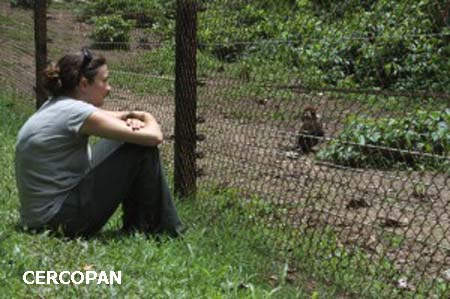
Hanging out with the Mangabeys
Source:WildlifeDirect:CERCOPAN By:Grace Rawnsley
One of the best things about having new Rhoko Managers is new blogs from new perspectives. At the moment, everything at Rhoko is exciting and exhilarating for us, as we’ve had many new experiences we couldn’t even dream of! Although we are incredibly busy running Rhoko, we always try to visit our primate enclosures everyday to observe our group of mangabeys. They are surprisingly big and powerful animals and the soap-operas of their families are fantastically entertaining.
A few days ago, Alex had his first encounter inside the mangabey enclosure, which can be a really intimidating experience. Conducting a fence check due to a bad storm the previous night, Sylvain, our research coordinator and Alex went into the enclosure. I stayed watch outside to spot any males sneaking up on them while they were working.
Within 5 minutes of being inside the enclosure, the dominant and quite aggressive male, Clyde, decided to investigate this new, unfamiliar face who had entered his group...
Click Here To View The Entire Article Click Here To View CERCOPAN AT NWHS |
|
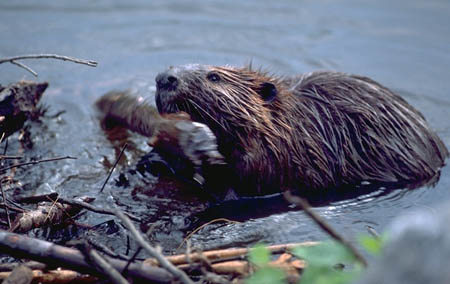
Canada's eager beavers build world's largest dam
Source:Inform
Ecologist says beavers have created world's largest dam in northwestern Canada. A Canadian-based ecologist said Friday that he has located the world's largest beaver dam in northwestern Canada using Google satellite technology. Ecologist Jean Thie located the 2,788-foot (850-meter) dam using Google Earth and NASA technology while researching the rate of melting permafrost in the country's far north.
Situated in northern Alberta's Wood Buffalo National Park, which straddles the Alberta-Northwest Territories border, the dam stretches more than eight football fields long, said Thie.
"I couldn't believe it when I saw it, it's a vast, vast area. There may be longer dams out there, but this, by far, is the largest I have seen so far. And, it would not have been possible to view it without something like Google Earth," said Thie...
Click Here To Read The Article In Full |
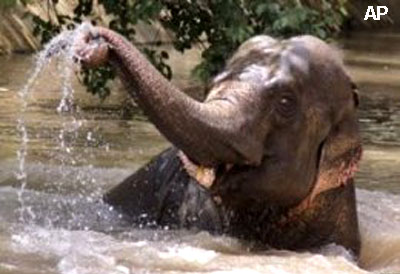
Elephants Fear Bees, New Research Shows
Source:Huffington Post By:Katharine Houreld
JOHANNESBURG — Eek, a bee! Lore has it that elephants are afraid of mice, but scientists have now discovered that elephants are truly afraid of bees, and that the pachyderms even sound an alarm when they encounter them. The researchers hope this discovery can help save farmers' crops from elephants. And they hope it will save elephants too.
Conflict between humans and elephants in countries like Kenya occur often. A single hungry elephant can wipe out a family's crops overnight. Farmers will huddle by fires all night during the harvest season. When an elephant nears, the farmers spring up with flaming sticks while their children bang on pots and pans. Not all fields can be guarded, and sometimes the elephants aren't frightened off. Farmers sometimes kill elephants for raiding their crops. Rampaging elephants have also killed people, and they are then hunted down by park rangers.
The discovery that elephants emit low-frequency alarm calls around bees could help lessen these conflicts, said Lucy King, a researcher into animal behavior whose paper on elephants alarm calls...
Click Here To Read Article |
|
National Wildlife Humane Society Thank-you for allowing us into your email inbox. You are a valued member of NWHS and we look forward to providing you with current news concerning NWHS, other matters concerning wildlife, wildlife habitats and our wildlife rescue/sanctuary facility, "Top Of The Rock". Please invite other concerned humans to join our organization. It is our members that allow us to exist, expand and assist wildlife and precious wild habitat.
Humane is the responsibility of Humanity
FAIR USE NOTICE: This mailing may contain images and excerpts the use of which have not been pre-authorized. This material is made available for the purpose of analysis and critique, as well as to advance the understanding of political, media and cultural issues. All articles and commentary are provided as non-commercial, public educational and outreach content. The 'fair use' of such material is provided for under U.S. Copyright Law. In accordance with U.S. Code Title 17, Section 107, material on this mailing (along with credit links and attributions to original sources) is viewable for educational and intellectual purposes. If you are interested in using any copyrighted material from this mail for any reason that goes beyond 'fair use,' you must first obtain permission from the copyright owner.
Note: NWHS provides hyperlinks from email to third party sites as a convenience to users. NWHS does not endorse such third parties or the contents of any such sites. NWHS has no control over, makes no representation or warranty and disclaims all liability with respect to such sites. To use articles originated by NWHS, please use unaltered and provide a link back to NWHS. http://www.humanewildlife.org/ |
|
To Contact National Wildlife Humane Society
info@humanewildlife.org "A world without wildlife is a world not fit for humans"
Click Here To Visit NWHS Newsletter Archive
| | ||