|
|

|
National Wildlife Humane Society |
| Wildlife Conservation News |
|
|
|
| Member News |
| Mosquito Music |
| Sea Lion Mystery |
| Blue Whale Songs |

National Wildlife Humane Society
A non-profit wildlife conservation organization working to preserve and protect threatened and endangered species.
|

| |
|


|
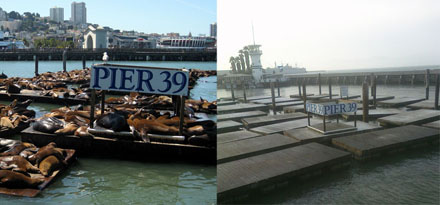
Famous San Francisco Sea Lions Abandon Pier 39
Source: Wired Science By: Alexis Madrigal
“We have no idea where they moved on to or why,” said Shelbi Stoudt, who manages a team that helps stranded animals in the San Francisco Bay from the Marine Mammal Center in Sausalito, California.
The sea lions’ disappearance is as strange as their initial colonization of the pier about 20 years ago, in late 1989. They just started showing up one day and as their numbers increased, their traditional hang out, Seal Rocks, became less populated. There are all sorts of theories about why the pier became a favorite haul-out spot for the sea lions, but no one knows for sure why the animals’ behavior changed......
Click Here To Read The Article In Full |
Blue Whales’ Lower-Pitch Songs Signal Population Increase
Source: The Epoch Times By: Helena Zhu
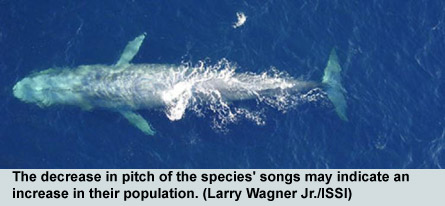
The pitch of blue whale songs around the world has been lowering for the past few decades, and scientists think that it may indicate an increase in the population of this endangered animal, which was commercially hunted until 1972.
Studying blue whale song data from the Southern California coast to the Indian and Southern Oceans, Mark McDonald of WhaleAcoustics, John Hildebrand of Scripps Oceanography, and Sarah Mesnick of NOAA Fisheries Southwest Fisheries Science Center discovered a downward curve in the pitch, or frequency, of the songs.
“The best documented song type, observed offshore California, now is sung at a frequency 31 percent lower than it was in the 1960s,” they wrote in their research paper. “Worldwide Decline in Tonal Frequencies of Blue Whale Songs,” published in the journal Endangered Species Research....
Click Here To Read More |
|
National Wildlife Humane Society Thank-you for allowing us into your email inbox. You are a valued member of NWHS and we look forward to providing you with current news concerning NWHS, other matters concerning wildlife, wildlife habitats and our wildlife rescue/sanctuary facility, "Top Of The Rock". Please invite other concerned humans to join our organization. It is our members that allow us to exist, expand and assist wildlife and precious wild habitat.
Humane is the responsibility of Humanity
FAIR USE NOTICE: This mailing may contain images and excerpts the use of which have not been pre-authorized. This material is made available for the purpose of analysis and critique, as well as to advance the understanding of political, media and cultural issues. All articles and commentary are provided as non-commercial, public educational and outreach content. The 'fair use' of such material is provided for under U.S. Copyright Law. In accordance with U.S. Code Title 17, Section 107, material on this mailing (along with credit links and attributions to original sources) is viewable for educational and intellectual purposes. If you are interested in using any copyrighted material from this mail for any reason that goes beyond 'fair use,' you must first obtain permission from the copyright owner.
Note: NWHS provides hyperlinks from email to third party sites as a convenience to users. NWHS does not endorse such third parties or the contents of any such sites. NWHS has no control over, makes no representation or warranty and disclaims all liability with respect to such sites. To use articles originated by NWHS, please use unaltered and provide a link back to NWHS. http://www.humanewildlife.org/ |
|
To Contact National Wildlife Humane Society
info@humanewildlife.org "A world without wildlife is a world not fit for humans"
Click Here To Visit NWHS Newsletter Archive
| | ||