 Florida
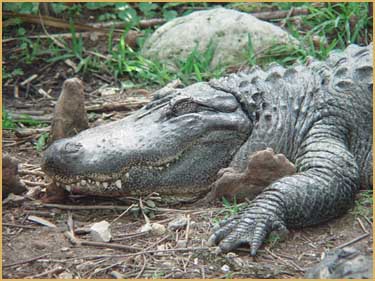
Alligator (Alligator mississipiensis)
Florida
Alligator (Alligator mississipiensis)
Poll to Help Manage
Gators
Officials
seek input for first review of gator management plan in
decades.
By
Tom Palmer
The Lakeland Ledger
September 17,
2006
Lakeland
Fla - Some Floridians have seen
alligators their entire lives and some Floridians know little
about them outside of press accounts of fatal attacks on pets
or humans.
State wildlife
officials want to hear from that kind of cross section of
residents as part of the first comprehensive review of
alligator management in Florida in decades.
The online poll is
being conducted by the Florida Fish and Wildlife Conservation
Commission.
"It's very open-ended,"
said Harry Dutton, a wildlife biologist in the agency's
Tallahassee headquarters who is directing the
effort.
"This is something that
really hasn't been talked about comprehensively in 20 years,"
Dutton said.
Alligators are aquatic
reptiles that were once driven to the brink of extinction by
unregulated hunting.
Dutton said today
biologists estimate Florida's alligator population at about 1
million, but explained that includes everything from baby
alligators to old males more than 10 feet long.
The bulk of Florida's
alligators are 4 feet or shorter, he said.
That fact points out
what he hopes will be a complementary effect of the survey,
which will be to educate the public about alligators while
soliciting their opinions.
Dutton said FWC
officials are looking at the issue from various angles,
ranging from commercial harvest to conservation and scientific
research.
Results of the survey,
which will begin next week and continue until Sept. 29, will
be reported to the Florida Fish and Wildlife Conservation
Commission's seven-member governing commission at its Dec. 6-7
meeting in Key Largo.
If any changes are
proposed, they will not be adopted until after the agency
holds a series of public meetings.
To participate in the
survey, go to MyFWC.com/gators/input.html. The site
also contains detailed information about
alligators.
Source: The Ledger Online
 The rare Bugun
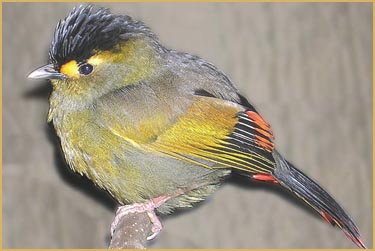
Liocichla. (Photo: Ramana Athreya)
The rare Bugun
Liocichla. (Photo: Ramana Athreya)
'New
rare bird' spotted in
India
September 12, 2006 - By BBC
News
North East INDIA -
A new species of bird has been discovered in the north-east of
India, according to an ornithological journal. Indian Birds
said the rare species has been named Bugun Liocichla - only 14
of these birds are known to exist.
The bird has olive
plumage with a distinctive black cap and red, black and white
patches on its wings.
The journal said that
the small bird had been first spotted by an Indian astronomer
more than 10 years ago in Arunachal Pradesh state.
But it was not until
May this year that astronomer Ramana Athreya managed to find
it again in the Eaglenest wildlife sanctuary in the state and
confirm the discovery of a new species.
Ornithologists say the
bird's closest relative appears to be another rare Liocichla
species found in only a few mountains in central China.
Liocichla are members
of the diverse bird family known as babblers.
In June, a quail
believed to have been extinct for nearly 80 years was
rediscovered by a prominent ornithologist in the north-eastern
Indian state of Assam.
The grey-and-black
streaked quail was spotted by wildlife specialist Anwaruddin
Choudhury in Assam's Manas national park.
Source: BBC News Online
Judge Says Wildlife Refuge Hunts
Illegal
MATT APUZZO Associated
Press
WASHINGTON - Dozens of wildlife
refuges could be closed to hunters after a federal judge ruled
that the government never considered the consequences of
steadily expanding hunting rights for six years.
U.S. District Judge
Ricardo M. Urbina has ruled that the U.S. Fish and Wildlife
Service violated federal law when it allowed or expanded
hunting at 37 refuges from 1997-2003.
While the agency
studied the consequences of opening each refuge to hunters,
Urbina said officials had a responsibility to look at the
effects systemwide.
"No one was looking at
the cumulative effect when you open 37 refuges," said Jonathan
Lovvorn, vice president of the Humane Society of the United
States and an attorney in the case. "You can't have each
refuge sticking their head in the sand."
President Theodore
Roosevelt began the wildlife refuge system in 1903, setting
aside a tiny island off the east coast of Florida to protect
pelicans and other birds from hunters. The system now includes
more than 535 refuges where wildlife and its habitat are
protected.
Environmental groups
have criticized the government for allowing hunting, fishing
and other recreational activities in many
refuges.
While Urbina said in
Thursday's ruling that wildlife officials violated the law, he
stopped short of overturning the hunting rules and asked
attorneys for both sides to propose solutions.
Lovvorn said that could
mean banning or scaling back hunting. A Fish and Wildlife
Service spokesman said the agency remains committed to
allowing hunting when it is compatible with the refuge
mission.
"At this point there
hasn't been any indication anything is going to change
immediately," spokesman David Eisenhauer said. "It's a little
early to say what's going to happen."
The refuges at issue in
the lawsuit are located primarily in the South, Virgina and
Appalachia and the Pacific Northwest.
Source: Mercury News Online
Online