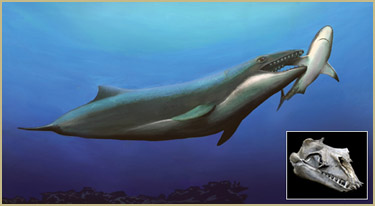
 Janjucetus Whale - Artist's
Concept
Janjucetus Whale - Artist's
Concept
Blue Whale Ancestor Was No Gentle
Giant
By
Alister Doyle, Environment
Correspondent
OSLO, Norway - A
ferocious-looking fossil with sharp teeth found in Australia
shows that ancestors of today's toothless blue whales were not
all "gentle giants," a report said on Wednesday.
The 25 million-year-old fossil is of an early type
of baleen whale, a group including modern humpback whales,
minke whales and blue whales that feed via baleen, comb-like
plates in their mouths that filter plankton from sea
water.
"This bizarre, new baleen whale did not even have
baleen," Erich Fitzgerald, of Monash University in Australia,
said of the small whale that was probably up to 3.5 metres (11
ft 6 in) long.
"It had teeth and
was a powerful predator that captured large fish, perhaps
sharks, maybe even other whales," he told Reuters.
"Some of the early
baleen whales weren't gentle giants."
Most scientists have
believed that baleen whales quickly evolved baleen for feeding
on tiny fish and plankton after breaking from a common
ancestor with toothed whales almost 40 million years
ago.
Modern toothed whales
include dolphins, killer whales and sperm whales -- the
species made famous as the bane of Captain Ahab in Herman
Melville's "Moby Dick."
"This rewrites the
picture of baleen whale evolution," Fitzgerald said. The
fossil was found near Jan Juc, a town in Victoria,
south-eastern Australia, and dubbed "Janjucetus."
Its sharp teeth were
about 3 cms (1.2 inches) long and it also had large eyes,
apparently suited for hunting, according to Fitzgerald's
report, published in the journal Proceedings of the Royal
Society B.
Blue whales, which can
exceed 150 tonnes and grow longer than 30 metres, are the
largest creatures ever to inhabit the earth -- bigger than any
dinosaur. Whales evolved from land mammals, where their
closest relative is the hippopotamus
Source:Scientific American.com
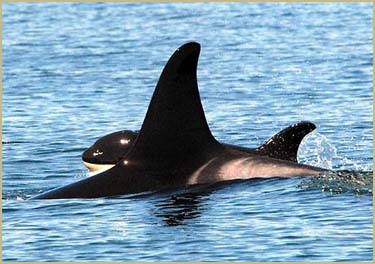 KELLEY BALCOMB-BARTOK / CENTER FOR WHALE
RESEARCH
KELLEY BALCOMB-BARTOK / CENTER FOR WHALE
RESEARCH
Missing Orca Calf Resurfaces "alive and
well"
By
Alwyn Scott Seattle Times staff
reporter
August 26, 2006
A baby orca that
vanished from sight last week was found Sunday, ending fears
that the calf, believed to be just 8 days old, had
died.
"We're absolutely
certain that the calf is alive and well," said Kelley
Balcomb-Bartok, a researcher at the Center for Whale Research
on San Juan Island, after the calf was seen swimming with its
pod Sunday in Boundary Pass, north of Stuart Island. The calf
was first seen Aug. 13 in Haro Strait between San Juan Island
and Vancouver Island, perhaps a day after it was
born.
Researchers were
delighted to see the baby swimming with K pod, as its birth
increased the size of the southern resident orca group to 90
from fewer than 80 in 2001. The animals were listed in
February as endangered under the federal Endangered Species
Act.
But a day later
researchers spent 90 minutes with the mother and didn't see
the calf. The day after that, no pod members were
seen.
Researchers now believe
the pod swam from the Straight of Juan de Fuca to the open
ocean. The pod returned later in the week and was seen Friday
by commercial tour groups. The next day, members of the pod
were seen off the west side of San Juan Island on their way to
the Fraser River in British Columbia, where they feed on
salmon. But the baby, known as K-41, was still
missing.
On Sunday, tour groups
saw the baby and called the center, whose researchers went out
and confirmed the calf was back with its mother.
Researchers said they
may never know why the baby, about 8 feet long and 400 pounds,
disappeared. Young orcas nurse for their first year and
usually don't stray far from their mothers, although one K-pod
baby spent time with another mother several years
ago.
Maybe K-41 was just
being a kid.
"It seems to be very
precocious and moving around a lot," said Ken Balcomb, senior
scientist at the center. "It doesn't surface with the pod.
It's often totally out of
sync."
Source:Seattle
Times