|
NWHS
#015
August 20,
2006
Dear NWHS Supporter,
Welcome to issue #015 of the NWHS E-Newsletter. We thank
all subscribers for allowing us into your email inbox.
Please feel free to forward this email to others that are
interested in wildlife. If you enjoy this
newsletter, invite others to sign up.
You may visit the National Wildlife Humane Society's
website at: http://www.humanewildlife.org
More NWHS news can be viewed on our site at:
Please refrain from replying directly
back to us from this Newsletter. If you wish to email us,
concerning this Newsletter, or any other matter, please do so
at:
If you see a current and interesting
wildlife story, feel free to send us a link (to the info@
email address) to share with the other
subscribers.
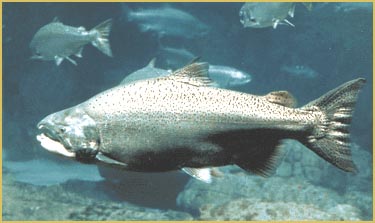 Chinook
Salmon
Chinook
Salmon
Genetic Testing To Help Anglers,
Fish
August 15, 2006 - By Jeff Barnard, Associated
Press
GOLD BEACH,
Ore. - The last time Scott Boley came home
from salmon fishing, he had 17 fish to show for three days of
work.
"That's pretty skimpy fishing," said Boley, the
skipper of a salmon troller, a partner in the Fishermen Direct
Seafood market and a member of the federal panel that sets
ocean salmon fishing seasons.
But Boley hopes those
fish and barcodes tied to their jaws represent a better future
for Oregon and California salmon fishermen, who saw their
catch cut by nearly 90 percent this summer to protect
dwindling returns of wild chinook to California's Klamath
River.
As part of a pilot program funded by the Oregon
Watershed Enhancement Board, Boley and other trollers are
clipping a piece of pectoral fin from each fish they catch and
sending it to the Hatfield Marine Science Center for DNA
testing that shows within 48 hours what river basin it came
from.
Using a Global Positioning System receiver, they
log into a computer the latitude and longitude of each fish,
plus their names, the date, the water temperature and the
depth at which the fish was caught.
Then they tie onto
each fish a metal tag carrying a barcode, which can be used in
the future to access that information from a Web site.
Scientists and fishermen hope the genetic testing and
unprecedented detail on where salmon swim will help fisheries
managers keep the commercial salmon fleet fishing while
protecting struggling runs like the Klamath's wild chinook.
Canada already uses overnight genetic testing to
increase the salmon harvest off the coast of British
Columbia's Queen Charlotte Islands while protecting weak
stocks on the west coast of Vancouver Island.
For the
past four years, boats from the Department of Fisheries and
Oceans have gone out the week before the season opens to check
fish DNA. If too many fish from weak stocks show up, fishermen
wait or go somewhere else. During the season, fish landed on
shore are checked to make sure not too many weak stocks are
being taken.
Queen Charlottes fishermen are now
landing an extra $17 million worth of salmon a year, said
Terry Beacham, research scientist with the department's
Pacific Biological Station. Meanwhile, the harm to the weak
stocks from Vancouver Island is less.
The Oregon
program grew out of research Oregon State University salmon
geneticist Michael Banks started in 1994 to distinguish the
winter run of chinook from California's Sacramento River from
other runs.
In recent years, a network of labs has
developed a salmon genetic database that covers 120 watersheds
from Alaska to California.
Using 13 different genetic
markers on the salmon genome, known as microsatellites,
researchers can spot the native river basin of an individual
fish with 95 percent certainty, Banks said. Using 16
microsatellites, they can distinguish between the winter,
spring and fall runs of chinook from California's Sacramento
River.
Testing of fish caught off Newport in June
showed they came from rivers from British Columbia to
California, with more than half from the Sacramento, and very
few from the Klamath, Banks said. By the end of salmon fishing
this fall, he hopes to sample 2,000 fish.
Gil Sylvia,
superintendent of the Coastal Oregon Marine Experiment
Station, hopes the genetic testing and barcodes will boost
marketing opportunities for fishermen and guard against
farm-raised salmon being sold as wild-caught
salmon.
Source: Associated
Press
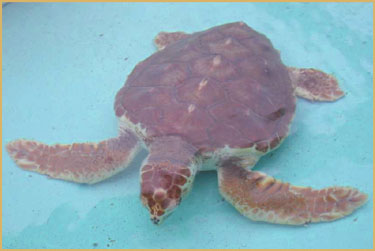
Loggerhead Sea Turtle
Sea
Turtle Nests Numbers
Down
By Ed Beckley - Outer
Banks Sentinel Correspondent
August 10,
2006
The Network for Endangered Sea Turtles (NEST) has
noted a drop in the nest production of loggerhead turtles on
the Outer Banks. The group is specifically expressing concern
about the effects of nourished sand and its impact on the
species.
Millie Overman of Kill Devil Hills is the
local volunteer coordinator for NEST, which has 70 local
volunteers and a mission to protect the turtles from becoming
extinct. The group holds a permit under the NC Wildlife
Non-Game Division. The turtles are protected under the
Endangered Species Act of 1973.
Overman said that since
the group began in 1996, there has been as many as 23 nests
from Carova to Hatteras, in a one-year period, with 15 to 20
nests annually being the norm. The lowest number of nests
prior to this year was nine. Overman said that typically the
nest counts in the southern beaches, such as Nags Head, are
higher than the northern areas because reptiles are
cold-blooded and prefer warmer climes.
This year, there
are three nests along the beaches from Corova and Corolla in
Currituck County and Kitty Hawk.
[Editor's note: there
are approximately 76 nests on National Seashore property which
is located from South Nags Head to Oregon Inlet, and begins
again south of Pea Island and runs along Hatteras Island and
includes portions of Ocracoke Island. At least part of the
reason for the number of nests in those areas is the warmer
temperatures in the southern part of the area.]
"Our
nests have been low in count for the past three years,"
Overman said. When asked why, she responded, "Unfortunately,
it jumps right in there with the beach re-nourishment." The
turtles are avoiding the areas where the man-dumped sand piles
angle directly down to the tide, and where there isn't enough
beach without wash-over that would submerge the eggs, she
said. This is a particularly bad problem in South Nags Head,
she added.
Overman made it clear that NEST is a
non-profit organization and does not take a political stand.
She said she is apolitical and is not bashing supporters of
beach nourishment.
However, she said, she has learned the
habits of turtles after 15 years of sleeping by them and
another problem is "we've created a terrain that isn't
conducive to turtle nesting because they cannot
climb."
She was referring to embankments in Kitty Hawk
and Nags Head, created by non-native sand, imported and placed
on the beaches in an effort to save homes from beach erosion.
Turtles are forced to lay their eggs at the base of the
embankments, closer to the ocean than they would otherwise
lay, and the high tides snatch the eggs into the sea. She said
the Kitty Hawk nest is so currently threatened.
NEST
states that sea turtles thrived in North Carolina waters long
before humans occupied the region, and despite the fact that
these ancient reptiles have successfully navigated the oceans
virtually unharmed for millions of years, today they face a
serious threat to their existence, largely because of human
activities. Threats include water pollution from oil and gas
due to boating and jet skis, poaching, lighted beaches which
disorients the turtles and directs them away from the water
after laying their eggs, and the loss of nesting habitat,
which locally relates to beach nourishment.
Overman
said it's not just the embankments that pose a problem. She
said non-native inland sand has been used to replace sand on
the beaches, which "isn't soft enough to dig out of... We
actually had a nest the year before last in Nags Head where
the water had run off and collected in the tunnel that the
turtles come up out of and the soil formed like an adobe
brick, and the turtles couldn't get out. We normally leave it
up to nature, but in this case, we had to remove the obstacle
so the turtles could emerge."
She also voiced concern
that non-native sand may be affecting the temperature in the
nest. Gender of the turtles is determined by the nest
temperature. "Cooler sand produces more males, and because we
are at the northern range for nesting, the fact that we
produce more males of the species affects the populations,"
she said.
"You don't have to re-nourish the beaches for
turtles," she said, "they've survived for centuries and know
how to adapt to the ebb and flow, but when you make it to
where they can't crawl up on the beach, well...."
Asked
if the towns are in violation of the Endangered Species Act,
Overman said no. "The obstacles that the turtles face now, you
can't say one person is responsible for. Yes, I wish we would
be a little more cautious about what type of sand we would
use, if we are going to do it [nourish the beaches]. They have
not violated the moratorium on using heavy equipment during
egg-laying periods, and they observe all the CAMA rules, and
the type of sand they use is approved."
When asked who
approves the sand, when it appears to be problematic, Overman
said she did not know but was certain the state wildlife
coordinator was looking into it. She also said that NEST has
not presented its findings to the local town
councils.
"The turtles can't speak for themselves," she
said, adding she could not imagine what kind of impact the
extinction of sea turtles might have on humanity. Every time
there is an extinction announced, however, she said, "I'm
afraid the picture is man is more concerned for himself than
what will be left behind on the planet."
Relatedly, the
Town of Nags Head is looking at a referendum for a $32 million
beach nourishment project, for the town's 12-miles of beach.
The vote could be held as soon as February.
Source: Outer Banks Sentinel
Karen
Sculac
Woman
Gave Tireless Devotion To
Cats
ANDREA BROWN -
GAZETTE.COM
August 14,
2006
Karen Sculac of Big Cats of Serenity Springs
died Saturday morning [8/12/2006] of pneumonia at age 47.
She became ill with strep throat about a week and a half ago,
yet kept cleaning and feeding her brood.
She was airlifted Friday to Memorial Hospital.
Her tireless dedication was her trademark.
“There were times she would get maybe two hours
of sleep. She would do whatever she could to keep these cats
going,” said her daughter, Ashley, 22.
“She put herself last.”
Family and volunteers gathered Sunday to
continue chores on the 17-acre sanctuary licensed by the U.S.
Department of Agriculture and the Colorado Division of
Wildlife.
Sculac opened the exotic cat center in 1993 with
her husband, Nick, a contractor who had a massive heart attack
last year and had to quit working. He had been scheduled for
medical tests Friday for his heart condition.
The Sculacs helped cover the cat costs by
conducting tours and taking donations at the rescue center a
mile from U.S. Highway 24.
Volunteers pitched in as the cat population
grew.
The cats include circus has-beens, over-the-hill
photography models, discarded family pets and refugees from
closed zoos.
“My mom had the biggest heart. She could never
say no to anybody,” Ashley Sculac said. But big cats have big
appetites.
The center had been struggling financially for
years, Karen Sculac told The Gazette in an interview for an
article published last month.
Her death presents a new challenge because she
had no health insurance, and the family will struggle to pay
medical bills, said Collette Colvin, a volunteer for the
sanctuary.
“Karen was the heart and soul of this place,”
Colvin said. “It will take many people to fill her shoes.”
Sculac’s daughter said the sanctuary was her
mother’s dream, and the family plans to keep it alive. “We are
going to keep going strong,” she said. “It was her family and
her cats - that’s what she lived by.”
A memorial service is planned this week, but
details have not been announced.
In addition to her husband, Nick, and daughter,
Ashley, Karen Sculac is survived by daughters Amber, 24, and
Whitney, 22; granddaughters Sienna, 4, and Danica, 3 months;
and her parents Jerry Brill of Colorado Springs and Joyce
Modie of California.
The sanctuary is accepting donations on its Web
site: www.bigcatsofserenitysprings.org
People who want to help can also call
719-347-9200.
Or email Collette Colvin at: collette@bigcatsofserenitysprings.org
CONTACT THE WRITER: 636-0253 or andrea.brown@gazette.com
Staff writer Perry Swanson contributed to this
report.
Source: Colorado Springs Gazette
NWHS
Edit:
All of us at the National
Wildlife Humane Society, wish to express our sincerest
condolences to the Sculac Family. We would like to encourage
NWHS Supporters to assist the Sculacs and Big Cats Of Serenity
Springs in this time of need. If you would like to send a
check directly to the Sanctuary, you may assist by mailing
to:
Big Cats of
Serenity Springs
PO Box 112
Calhan, CO
80808 |
If you no longer wish to receive our NWHS Newsletter, just
email
us and ask to be removed. Make certain to specify the email
address you wish to be removed from the subscription list, if
different from the email used to write us. Articles not under the National Wildlife Humane Society
(NWHS) by-line, do not necessarily reflect the opinions or
policies of NWHS. Articles not origintating from NWHS, are
passed onto interested recipients as is, and
uneditied.
Privacy Policy: Your name, email address, or
any other private info will never be sold, traded, or furnished
to any other parties. Your privacy is assured, and all info is
stored offline. All subscribers' addresses are hidden from all
other subscribers and sent as "blind copies" (BCC:).
 | | |