|
NWHS
#014
August 13,
2006
Dear NWHS Supporter,
Welcome to issue #014 of the NWHS E-Newsletter. We thank
all subscribers for allowing us into your email inbox.
Please feel free to forward this email to others that are
interested in wildlife. If you enjoy this
newsletter, invite others to sign up.
You may visit the National Wildlife Humane Society's
website at: http://www.humanewildlife.org
More NWHS news can be viewed on our site at:
Please refrain from replying directly
back to us from this Newsletter. If you wish to email us,
concerning this Newsletter, or any other matter, please do so
at:
If you see a current and interesting
wildlife story, feel free to send us a link (to the info@
email address) to share with the other
subscribers.
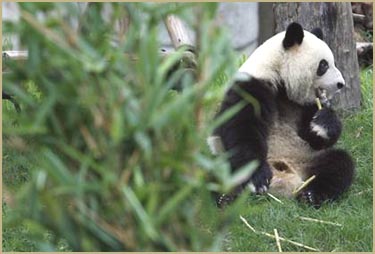 A Giant Panda
Eats Bamboo - LIU JIN/AFP/Getty Images
A Giant Panda
Eats Bamboo - LIU JIN/AFP/Getty Images
One panda, One Giant
Cub
GreatNewsNetwork/MSNBC
Beijing, China
- [Six-year-old Zhang Ka] a giant panda in China has
given birth to the heaviest cub born in captivity after the
longest period in labor and elsewhere twin pandas each gave
birth to twins, Xinhua news agency reported.
Six-year-old Zhang Ka delivered the
baby on Monday at the Wolong Giant Panda Research Center in
the mountainous southwest, Xinhua said.
The cub
weighed just 218 grams (half a pound), but was still the
heaviest panda ever born in captivity, where most cubs are
born at between 83 and 190 grams, Xinhua said.
“It is
very rare for them to be even near 200 grams,” it said in a
report late on Monday.
But the
size and the fact that it was Zhang Ka’s first meant a
“painstaking and eventful” birth for the mother, who was born
in the wild.
“The
whole process lasted about 34 hours and was the longest in the
history of panda reproduction,” Xinhua quoted Zhang Hemin,
head of the Wolong center, as saying.
Both
mother and baby were doing well, the agency said.
----------------------------------------------------------------------
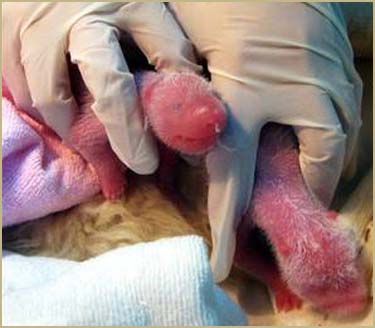 Twin baby
Pandas - Color China Photo via AP
Twin baby
Pandas - Color China Photo via AP
Elsewhere, Twins Birth
Twins
Two twin panda sisters, also
aged six, gave birth to two pairs of twin male cubs -- with
much less drama -- on Sunday and Monday respectively in the
Chengdu Giant Panda Reproduction and Research Center near
Wolong, Xinhua said.
It
brought the number of panda cubs born in captivity in China so
far this year to six, it said.
The
giant panda is one of the world’s most exotic and endangered
species and is found only in China, where it is a national
treasure.
An
estimated 1,600 wild pandas live in nature reserves in
Sichuan, Gansu and Shaanxi provinces.
It is
extremely hard to breed giant pandas in captivity. Females
only ovulate once a year, with a slim 24- to 48-hour window
for breeding when artificial reproduction methods are usually
adopted. Infant mortality is also high.
Pandas
eat bamboo shoots and spend a lot of time sleeping. They
usually wean their young at around 18 months, and healthy
pandas live into their late 20s or early 30s.
source: GreatNewsNetwork
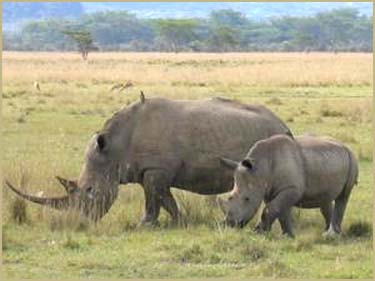
Poaching has apparently driven black rhinos
extinct in West Africa
Extinction Fear For Black
Rhino
By Richard Black
Environment correspondent, BBC News
website
The West African black
rhino appears to have become extinct, according to the World
Conservation Union (IUCN). The snake was
discovered by a German researcher who described it with the
collaboration of two American scientists.
A mission to their last known habitat in northern Cameroon
failed to find any rhinos or signs of their existence.
The sub-species has declined in recent decades due
primarily to poaching, which has also brought the northern
white rhino close to extinction.
In East and Southern Africa, numbers of related sub-species
are rising with the use of effective protection measures.
But after two decades of warnings, the western black rhino
has apparently met its final end, according to the findings of
an extensive expedition by three specialists earlier this
year.
"They mounted 48 field missions,
patrolling for 2,500km, working block by block," said Richard
Emslie, scientific officer with the African rhino group in
IUCN's Species Survival Commission.
"They looked for spoor, they looked for the rhino's
characteristic way of feeding which has an effect like a
pruning shear, but they didn't find anything to indicate a
continued presence in the area," he told the BBC News website.
"They did, however, come across lots of evidence of
poaching, and that's the disconcerting thing."
Bleak prospects
Even before this latest survey, prospects for the
sub-species appeared bleak. In 2002, numbers were as low as
10. The animals were distributed over a wide range, making
breeding more difficult.
"With small numbers, bad luck can play a much bigger role -
if you just have male calves, for instance," commented Dr
Emslie.
During the last 150 years, numbers of all types of rhino
plummeted in all regions of Africa. The southern white rhino
reached its nadir in 1895, with a single population down to
about 30 individuals in one South African game park.
Since then, captive breeding and successful protection
measures have brought numbers up to nearly 15,000, and groups
have been re-established in other countries.
The black rhino's decline came later. The continent-wide
population numbered about 100,000 in 1900, but fell to a low
point of 2,400 by 1995. Again, protection measures and
breeding programmes are bringing stocks back up, but only, so
far, to about 3,600.
The main successes have been in Southern Africa, with some
East African countries also re-introducing and maintaining
populations.
It is a different story in West Africa, where poaching,
often fuelled by the guns and poverty of civil conflict, has
been harder to control.
The northern white rhino is down to as low as four
individuals in its only remaining habitat in the Democratic
Republic of Congo; and now the West African black rhino has
apparently vanished entirely.
Although genetically distinct, the different sub-species
may be similar enough in their food and habitat requirements
that animals could be re-introduced to West Africa from other
parts of the continent.
But that would require stable political and economic
conditions, the resources to take on poachers, and the
commitment to involve local people in the animals'
conservation.
Even if this were possible at some unspecified time in
Cameroon, it appears that one of Africa's great wildlife icons
has now lost a valuable branch of its family.
Source:BBC News Website
Judge Orders Bald
Eagle Removed From Endangered
List
WASHINGTON (AP) - The U.S. Fish and
Wildlife Service said Friday it is working to remove the bald
eagle from the list of endangered species, following a court
decision ordering it do so by Feb. 16 unless it can prove
further delays are necessary.
U.S. District Judge John
R. Tunheim’s order came in a lawsuit brought by Pacific Legal
Foundation on behalf of a Minnesota landowner who wants to
develop property in Morrison County where there is an active
bald eagle nest.
“We are evaluating the court decision
and preparing our response to it,” said Valerie Fellows, a
Fish and Wildlife spokeswoman in Washington. “However, we are
working diligently to delist the bald eagle, because it has
met the goals for recovery.”
The Minnesota Department
of Natural Resources issued a letter recommending no
development within 330 feet of the Morrison County nest to
ensure compliance with the Endangered Species Act and the
Eagle Protection Act, according to the court
filing.
Landowner Edmund Contoski, whose property abuts
Sullivan Lake in central Minnesota, filed the lawsuit in
federal court in Minnesota on Oct. 31,
2005.
Source:GlobeGazette.com |
If you no longer wish to receive our NWHS Newsletter, just
email
us and ask to be removed. Make certain to specify the email
address you wish to be removed from the subscription list, if
different from the email used to write us. Articles not under the National Wildlife Humane Society
(NWHS) by-line, do not necessarily reflect the opinions or
policies of NWHS. Articles not origintating from NWHS, are
passed onto interested recipients as is, and
uneditied.
Privacy Policy: Your name, email address, or
any other private info will never be sold, traded, or furnished
to any other parties. Your privacy is assured, and all info is
stored offline. All subscribers' addresses are hidden from all
other subscribers and sent as "blind copies" (BCC:).
 | | |
