Grizzly Bears
Feeding At McNeil River (AP)
Grizzly Bears
Feeding At McNeil River (AP)
Hidden Camera Focuses on
Alaska Grizzlies
Hidden camera transmits life of burly grizzly bears of
Alaska's McNeil River sanctuary to
world
MARY
PEMBERTON
Associated Press
Writer
ANCHORAGE, Alaska -
Only a lucky few humans are allowed each summer to get up
close and personal with the McNeil River bears, but thanks to
the wilderness equivalent of the "Big Brother" show, the
animals are available to the world.
A bear cam set up in
their favorite spot of the 114,400-acre McNeil River State
Game Sanctuary shows them brawling over salmon, cooling off in
the falls, sunbathing on the rocks and fattening up for the
long, Alaska winter.
The state holds a
lottery for about 250 people each year to visit the sanctuary
250 miles southwest of Anchorage to view the bears. The bear
cam allows the less lucky to get a look, too, said Mike
O'Meara, project manager for the Pratt Museum in Homer across
Cook Inlet from the sanctuary.
"The first thing they
have to say is 'Oh, this is live.' That intrigues them. Then
they really get wrapped up in watching the bears. A lot of
them are struck in how the bears interact and communicate with
each other," he said.
The bear cam is turned
on from 5 a.m. until 11 p.m. and has eight presets to zoom in
on where the animals are likely to be at any given hour.
During the afternoon, an interpreter at the museum controls
the solar-powered camera to get the best views.
O'Meara expects 20,000
museum visitors to use the bear cam this summer.
In the peak weeks in
July, the falls draw more brown bears than anywhere else in
the world. While numbers have been decreasing in recent years,
the bears still put on a good show. The record was 72 observed
at one time in 1999.
What makes McNeil truly
extraordinary is how close visitors can get to the bears,
which sometimes come to within 10 feet of a viewing platform
as they use steps built into the hillside to get down to the
falls. The camera is hidden in a fake boulder at the falls.
The microwave signal travels from the camera to the museum
through a series of repeater stations. From the museum, the
video feed is relayed to servers in Seattle, and from there is
published on the National Geographic's Web site, where viewers
can access it online in real time.
Two grants from the
National Park Service foundation totaling about $40,000 and a
$20,000 grant from the Mead Foundation paid for installing the
bear cam and setting up the high-quality video and audio
stream to the museum. Alaska Conservation Foundation
contributed $5,000. National Geographic is covering the costs
of maintaining the Web site to bring the bears to an
international audience, O'Meara said.
Real Networks of
Seattle contributed digitizing computers that allow the audio
and video to be streamed onto the Internet. The camera, which
went online in early June, will likely be shut off for the
season in late August, when most of the bears leave and
prepare for winter.
O'Meara and Michael
Yourkowski, general manager of SeeMore Wildlife Systems in
Homer, which first set up the bear cam in 1999 and has
improved on it since, said they hope it raises public
awareness about the bears and how recent changes have made
them more vulnerable to being hunted.
Last year,
the Alaska Board of Game decided to allow brown bear hunting
on state land just south and southeast of the sanctuary,
beginning July 1, 2007. That decision places the McNeil bears
at greater risk because they often roam outside the borders of
the sanctuary. They also aren't as likely as other wild bears
to run off when encountering humans, O'Meara and Yourkowski
said.
"The bears that come to
the falls are somewhat habituated to humans because the humans
are sitting there and watching them all the time. That makes
them not leery of hunters," Yourkowski said. O'Meara, a
longtime Alaskan who likes to hunt, said there's no challenge
in killing a McNeil River bear.
"It is a little like
going to the stock yards and plugging a poor, old cow," he
said.
National Geographic Wildcam
Grizzlies
Requires RealPlayer
Plugin
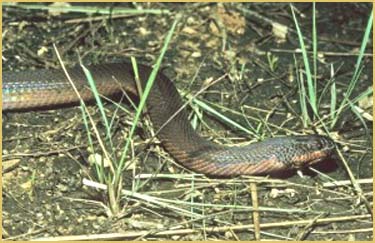 The
Kapuas mud snake Enhydris gyii, recently discovered in Kalimantan.
Image: WWF-Germany/Mark Auliya
The
Kapuas mud snake Enhydris gyii, recently discovered in Kalimantan.
Image: WWF-Germany/Mark Auliya
New chameleon-like snake
discovered in the Heart of
Borneo
World
Wildlife Fund /
greatnewswire.com
GLAND,
Switzerland - A new snake with the ability to
spontaneously change colour has been discovered in the forests
of the Heart of Borneo, one of the most biologically diverse
regions on Earth, possessing staggeringly high numbers of
unique species across all groups of plants and animals. This
ability of the snake to change colour is known from some
reptiles, such as the chameleon, but scientists have seen it
very rarely with snakes and have not yet understood this
phenomenon.
The snake was
discovered by a German researcher who described it with the
collaboration of two American scientists.
"I put the
reddish-brown snake in a dark bucket. When I retrieved it a
few minutes later, it was almost entirely white," said Dr Mark
Auliya, reptile expert at the Zoologisches Forschungsmuseum
Alexander Koenig in Germany, and a consultant for
WWF.
Dr Auliya collected two
specimens of the half-metre long poisonous snake in the
wetlands and swamped forests around the Kapuas river in the
Betung Kerihun National Park, an area in Kalimantan (the
Indonesian part of Borneo) where WWF supports conservation
work. The scientists named it the Kapuas mud
snake.
The genus Enhydris, to
which the new snake belongs, is composed of 22 species, only
two of which are widespread. All the others have a very
restricted range. The scientists believe this newly discovered
snake might only occur in the Kapuas River drainage
system.
In the last ten years,
361 new animal and plants species have been discovered on the
island of Borneo. This amounts to three new species a month in
an area only a little more than twice the size of
Germany.
"The discovery of the
‘chameleon" snake exposes one of nature's best kept secrets
deep in the Heart of Borneo," said Stuart Chapman, WWF's
international coordinator of the Heart of Borneo
initiative.
"Its ability to change
colour has kept it hidden from science until now. I guess it
just picked the wrong colour that day."
However, WWF warns that
the home of the new snake is threatened. Today, only half of
Borneo's forest cover remains, down from 75 per cent in the
mid-1980s.
But there is also hope
that this trend could be halted as the three Bornean
governments - Brunei Darussalam, Indonesia and Malaysia -
recently launched the Heart of Borneo initiative, which aims
to preserve approximately 220,000km2 of equatorial forests and
numerous wildlife species.
Source:World
Wildlife Fund
Marine census blows researchers out of the
water
Tom Spears, CanWest News Service;
Ottawa Citizen
OTTAWA - Mitchell
Sogin went fishing for bacteria in the seas, casting into deep
parts of the Atlantic and Pacific Oceans. What he found, in
this census of the tiniest sea creatures, was an invisible new
world of life.
Sogin's research team discovered 20,000 separate
species of microbes per every litre of sea water during its
study, which will be published today in the science journal
The Proceedings of the National Academy of Sciences. The
finding blows previous estimates out of the water, previously
gauged at 1,000 to 3,000, and threatens to make scientists
re-think the limits on how different forms of life can evolve
and adapt together.
''From that small sample, we see much greater
diversity than we ever imagined,'' said Sogin. ''The number of
different kinds of bacteria in the oceans could eclipse five
to 10 million.''
Sogin's findings, which were taken up to one
kilometre underwater, are based on a new method of counting
microscopic bugs: Instead of looking for whole microbes, he
extracted RNA from them and analysed all the distinct
types.
''It's like looking at licence plate numbers''
using genetic material, he said.
Most of these microbes would normally go unnoticed,
Sogin said, because a relatively small number of species
dominate each sample of water. However, the rest are lurking
in small numbers ready to multiply if environmental conditions
such as temperature or saltiness change, he said. Sogin calls
these uncommon and previously unknown types ''a rare
biosphere.''
Sogin's findings, in which some species were
present in very low numbers in the water samples, also
suggests species may be distributed unevenly, a hot topic of
debate for marine biologists.
''There may be a whole world of different
ecosystems or habitats (on the microbes' scale) waiting to be
discovered,'' said Sogin.
He added it's possible that rare microbes may be
biding their time. ''Perhaps, on very large time scales, they
(will) play an important role,'' by preserving different
genetic types that will take over if there's a drastic climate
change.
''We're going through a radical change of
environments now which might lead to those kinds of events,
where the microbial populations changed,'' said Sogin, noting
microbes likely make up 90 per cent or more of all living
aquatic life.
Sogin heads a research centre within the Marine
Biological Laboratory at Woods Hole, Mass. His work is part of
an international project called the Census of Marine Life,
which describes itself as ''a 10-year initiative to assess and
explain the diversity, distribution, and abundance of marine
life in the oceans past, present, and future.''
Source:Canada.com