|
NWHS
#012
July 30,
2006
Dear NWHS Supporter,
Welcome to issue #012 of the NWHS E-Newsletter. We thank
all subscribers for allowing us into your email inbox.
Please feel free to forward this email to others that are
interested in wildlife. If you enjoy this
newsletter, invite others to sign up.
You may visit the National Wildlife Humane Society's
website at: http://www.humanewildlife.org
More NWHS news can be viewed on our site at:
Please refrain from replying directly
back to us from this Newsletter. If you wish to email us,
concerning this Newsletter, or any other matter, please do so
at:
If you see a current and interesting
wildlife story, feel free to send us a link (to the info@
email address) to share with the other
subscribers.
 Bill Williams
River, Near Lake Havasu
Bill Williams
River, Near Lake Havasu
Truck Fire Spreads To
Wildlife
Sanctuary
Carrie Watters
The Arizona Republic
Jul.
29, 2006
BILL WILLIAMS RIVER
- A tanker truck on Friday exploded on a
bridge over the Bill Williams River National Wildlife Refuge
near Lake Havasu, spilling fuel into the river and sparking a
brush fire in the refuge that is home to wildlife including
two endangered bird species.
The accident occurred
shortly before 4 p.m. Officials closed Arizona 95 because of
the accident, then because of the fire. It was reopened late
Friday but then closed again.
The truck driver, who
apparently lost control of the vehicle, received only minor
injuries in the one-vehicle accident, said Officer Bridget
Reutter with the state Department of Public
Safety.
"Apparently the bridge looks like somebody
dropped a bomb on it," DPS Officer Tim Mason said. "It's just
completely engulfed in fire."
About 7,600 gallons of
fuel burned or spilled into the river, said Reutter and Leslie
Denney, an administrative technician with the wildlife
refuge.
Environmental and hazardous-materials workers
from DPS, the Arizona Department of Environmental Quality and
U.S. Environmental Protection Agency were on the scene or
consulting on the cleanup.
About 200 feet of booms
were placed in the river to keep the fuel from spreading,
Denney said.
The spill was only half of Denney's
concern. The tanker sparked a fire that had spread up the
riverbanks and about 1 1/2 miles into the refuge by late
Friday, Denney said.
Firefighters with the Bureau of
Land Management and others also were on the scene.
The
marshy banks where the fire burned is the summer home and
primary breeding ground for about a dozen endangered Yuma
clapper rails, Denney said.
The endangered Southwestern
willow flycatcher also nests in willows along the
river.
"Half of their cattails are being burned,"
Denney said.
Source: Arizona Republic
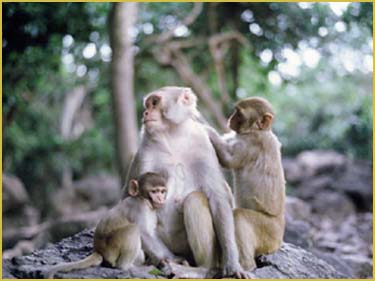 Rhesus
Macaques
Rhesus
Macaques
Study
Hints Language Skills Came Early in
Primates
July
26, 2006 - By Reuters
WASHINGTON -
Language centers in the brains of rhesus macaques light up
when the monkeys hear calls and screams from fellow monkeys,
researchers said in a study that suggests language skills
evolved early in primates.
Researchers who scanned the
brains of monkeys while playing them various sounds found the
animals used the same areas of the brain when they heard
monkey calls as humans do when listening to speech.
Writing in this week's issue of the journal Nature
Neuroscience, the international team of researchers said this
finding suggests that early ancestors of humans possessed the
brain structures needed for language before they developed
language itself.
"This intriguing finding brings us
closer to understanding the point at which the building blocks
of language appeared on the evolutionary timeline," said Dr.
James Battey, director of the National Institute on Deafness
and Other Communication Disorders, which helped conduct the
study.
"While the fossil record cannot answer this
question for us, we can turn to the here and now -- through
brain imaging of living nonhuman primates -- for a glimpse
into how language, or at least the neural circuitry required
for language, came to be."
The NIDCD's Allen Braun and
colleagues trained rhesus monkeys to sit quietly in PET
scanners. Positron emission tomography detects active cells
and can be used to see which parts of the brain are working.
They played coos and screams made by rhesus monkeys
that the test animals did not know, as well as "nonbiological
sounds" such as music and computer-generated noises.
The monkey sounds activated areas of the brain
corresponding to those used by humans in processing language
-- known as Broca's area, and Wernicke's area, the researchers
said.
In contrast, music and computer sounds mostly
activated the brain's primary auditory areas.
"This
finding suggests the possibility that the last common ancestor
of macaques and humans, which lived 25 to 30 million years
ago, possessed key neural mechanisms (that may have been used)
... during the evolution of language," the researchers wrote.
"Although monkeys do not have language, they do
possess a repertoire of species-specific vocalizations that --
like human speech -- seem to encode meaning in arbitrary sound
patterns."
For instance, many species of monkeys have
calls to warn of danger from above, such as an eagle, calls
referring specifically to leopards and also have various
sounds used while socializing.
Source: Reuters
Researchers Discover New Type of
CricketJuly 26, 2006 - Associated
Press
HURRICANE, Utah -
Researchers say they have discovered a new type of cricket in
the Grand Canyon-Parashant National Monument, located in a
remote strip of land on the Utah-Arizona border.
The
cricket was discovered in samples taken from the area last
spring by Kyle Voyles, a state of Arizona cave coordinator and
a physical science technician with the Bureau of Land
Management, and J. Judson Wynne, a Northern Arizona University
doctoral candidate.
Voyles and Wynne spent time
surveying 24 caves and taking samples from 15.
"Finding a new species is one thing, but finding a new
genus is beyond my wildest dream," Kyle Voyles, a state of
Arizona cave coordinator said. A genus is a broader category
in the classification of animals; it can encompass many
related species.
The monument is under joint
management of the BLM and the National Park Service and covers
more than 1,600 square miles of land on what's known as the
Arizona Strip. The area's deep canyons, mountains and red rock
buttes are cut off from the rest of Arizona by the Grand
Canyon at its south border.
"One thing I love about
the Arizona Strip is its untouched, untapped natural
resources," Voyles said. "It may not be a big tourist draw,
but there are a lot of potentially big important discoveries
out there."
The new cricket was found in the first
sample bottle. Voyles said Theodore Cohn, an entomologist with
San Diego State University, identified the crickets as a new
genus.
In addition to the possible new genus of
cricket, four new species of crickets have been identified
from the spring samples. A barklouse also was found in the
caves. Though common in South America, this was the first one
discovered in North America, Voyles said.
Previous
cave trips yielded two new species of millipedes within three
miles of each other.
What makes the yet-to-be-named
new genus of cricket special is that it has pincers on its
hind end. The pincers are functional, but it is not known why
they have them nor what purpose they serve.
The
discovery at the monument, which was dedicated in January, may
draw attention to caves that are largely overlooked in an area
where the inhabitants have to learn to adapt to harsh living
conditions.
Jeff Bradybaugh, superintendent of the
Grand Canyon-Parashant National Monument, said the discoveries
are very exciting.
"It points to some of the
uniqueness of the area and the undiscovered natural
resources," Bradybaugh said. "This might attract funding from
nongovernment sources and help develop partnerships with
universities to continue the research."
Source: Associated
Press |
If you no longer wish to receive our NWHS Newsletter, just
email
us and ask to be removed. Make certain to specify the email
address you wish to be removed from the subscription list, if
different from the email used to write us. Articles not under the National Wildlife Humane Society
(NWHS) by-line, do not necessarily reflect the opinions or
policies of NWHS. Articles not origintating from NWHS, are
passed onto interested recipients as is, and
uneditied.
Privacy Policy: Your name, email address, or
any other private info will never be sold, traded, or furnished
to any other parties. Your privacy is assured, and all info is
stored offline. All subscribers' addresses are hidden from all
other subscribers and sent as "blind copies" (BCC:).
 | | |
