|
NWHS
#010
July 16,
2006
Dear NWHS Supporter,
Welcome to issue #010 of the NWHS E-Newsletter. We thank
all subscribers for allowing us into your email inbox.
Please feel free to forward this email to others that are
interested in wildlife. If you enjoy this
newsletter, invite others to sign up.
You may visit the National Wildlife Humane Society's
website at: http://www.humanewildlife.org
More NWHS news can be viewed on our site at:
Please refrain from replying directly
back to us from this Newsletter. If you wish to email us,
concerning this Newsletter, or any other matter, please do so
at:
If you see a current and interesting
wildlife story, feel free to send us a link (to the info@
email address) to share with the other
subscribers.
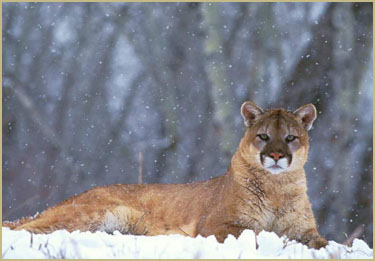 Colorado
Mountain Lion
Colorado
Mountain Lion
Mountain Lions and Fear Growing Out
West
July 14, 2006 —
By Judith Kohler, Associated Press
EVERGREEN, Colo. -
Carrie Ann Warner has repeatedly called authorities about the
stalker that has peered into her son's bedroom window at
night, killed the family cat and even chased the family into
their home in the wooded hills west of Denver.
The
mountain lion has eluded wildlife officers perched on the
porch with shotguns, traps baited with roadkill and even a
motion-detection camera fastened to a pine tree.
Six-year-old Schylure told his parents the lion stared
into his room "like it was mad at me."
"We're living
in this vale of fear," said Carrie Ann Warner, whose family
has built a steel enclosure around their back porch. "I've
reached my wit's end. I don't know what to do."
Reports of mountain lions roaming neighborhoods and
devouring family pets have cropped up from suburban Denver to
Fort Collins, one of the most heavily populated stretches in
the Rockies. In April, a lion attacked and broke the jaw of a
7-year-old boy on a trail in Boulder before it was chased off.
The following month, witnesses said a mountain lion
walked into a Boulder home, ate a pet cat and the cat's food
before being captured. And a man shot and killed a 130-pound
mountain lion that attacked his dog in May outside the
family's home near Buckhorn Canyon in the Arapahoe National
Forest.
The number of human-lion encounters nationwide
has increased from about two each year in the 1970s to between
six and 10, said Paul Beier, a conservation biology professor
at Northern Arizona University.
Still, mountain lion
fatalities are rare -- only 17 nationwide since 1890. The last
fatal attack is believed to be in January 2004, when a lion
killed a bicyclist in an Orange County, Calif., park.
A 2003 book by David Baron, "The Beast in the Garden:
A Modern Parable of Man and Nature" suggests mountain lions
may be learning to look at family pets and people as potential
food.
However, wildlife experts insist that, for the
most part, the animals are naturally wary of people. Ken
Logan, a nationally recognized mountain lion biologist, said
science doesn't support the premise that lions are starting to
view humans as dinner.
There are an estimated 3,000 to
7,000 mountain lions in Colorado. Hunting, development and
other activities wiped them out in most of the East and
Midwest, though most experts agree they are gradually moving
east, prompting North Dakota and South Dakota to start hunting
seasons.
Wildlife officers are trying to educate
people about how to get along with the big cats as development
pushes farther into the canyons and pine-studded hills the
animals once had to themselves.
"These are intelligent
animals," Logan said. "They can learn to live around humans."
But some Colorado residents say they're living in fear
of the mountain lions, which can weigh as much as 180 pounds.
Tracey English no longer allows her teenage son to jog
by himself in a nearby open space and her dog stays inside
unless it's being walked on a leash. Last month a mountain
lion was captured in a trap in her backyard.
"I don't
feel like we're living in a natural wilderness. Nothing about
it is natural," English said. "I believe the lions need to be
managed."
Jon Silver says he has caught rare glimpses
of mountain lions in the nearly 30 years he has lived west of
Boulder, and warns the people living on his rental properties.
"It's just a matter of adapting to your surroundings,"
Silver said. "If I'm in Manhattan and it's 11 o'clock at
night, maybe I wouldn't be walking down streets that weren't
well lit."
For Silver, adaptation has meant devising a
special dog run. His wife's German shepherd puppy, Me Too,
goes outside by running through a doggie door into the garage,
where it enters a door on the floor, scampers through a
40-foot underground tunnel, complete with a light triggered by
a sensor, and bursts into a 24-foot-long chain-link cage.
The door over the tunnel closes when the garage door
opens so the Silvers can drive cars in with no problem.
"I want to live with wildlife. It's their territory,"
Diana Silver said. "But I also want to protect my
dog."
Source: Associated Press
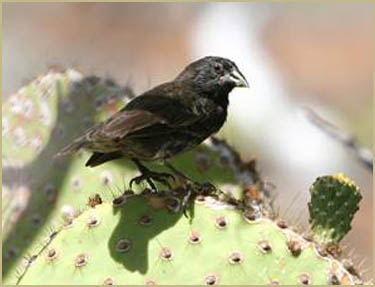 Darwin's Finch
- Galapagos Islands
Darwin's Finch
- Galapagos Islands
Finches on Galapagos Islands
Evolving
July 14, 2006 — By Randolph E. Schmid,
Associated Press
WASHINGTON -
Finches on the Galapagos Islands that inspired Charles Darwin
to develop the concept of evolution are now helping confirm it
-- by evolving.
A medium sized species of Darwin's
finch has evolved a smaller beak to take advantage of
different seeds just two decades after the arrival of a larger
rival for its original food source.
The altered beak
size shows that species competing for food can undergo
evolutionary change, said Peter Grant of Princeton University,
lead author of the report appearing in Friday's issue of the
journal Science.
Grant has been studying Darwin's
finches for decades and previously recorded changes responding
to a drought that altered what foods were available.
It's rare for scientists to be able to document
changes in the appearance of an animal in response to
competition. More often it is seen when something moves into a
new habitat or the climate changes and it has to find new food
or resources, explained Robert C. Fleischer, a geneticist at
the Smithsonian's National Museum of Natural History and
National Zoo.
This was certainly a documented case of
microevolution, added Fleischer, who was not part of Grant's
research.
Grant studied the finches on the Galapagos
island Daphne, where the medium ground finch, Geospiza fortis,
faced no competition for food, eating both small and large
seeds.
In 1982 a breeding population of large ground
finches, Geospiza magnirostris, arrived on the island and
began competing for the large seeds of the Tribulus plants. G.
magnirostris was able to break open and eat these seeds three
times faster than G. fortis, depleting the supply of these
seeds.
In 2003 and 2004 little rain fell, further
reducing the food supply. The result was high mortality among
G. fortis with larger beaks, leaving a breeding population of
small-beaked G. fortis that could eat the seeds from smaller
plants and didn't have to compete with the larger G.
magnirostris for large seeds.
That's a form of
evolution known as character displacement, where natural
selection produces an evolutionary change in the next
generation, Grant explained in a recorded statement made
available by Science.
The research was supported by
the National Science Foundation.
Source:
Associated Press
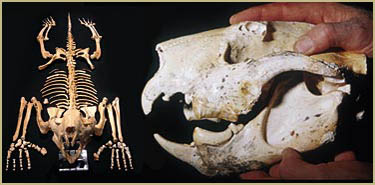 Marsupial Lion
Fossils (Thylacoleo)
Marsupial Lion
Fossils (Thylacoleo)
'Ferocious Fossils' Found in
Australia
July 13,
2006 — By Associated Press
SYDNEY, Australia
- Before there were cuddly koalas,
hoards of flesh-eating kangaroos, "demon ducks," and marsupial
lions roamed Australia's Outback, according to recent fossil
discoveries by paleontologists.
A team of researchers
from the University of New South Wales working in the eastern
state of Queensland made the discoveries in three new fossil
deposits during a recent two-week dig.
Many of the
fossils are older than 24 million years; one of the deposits
is thought to contain fossils up to 500 million years old,
according to Prof. Mike Archer, the university's dean of
science.
A saber-toothed kangaroo and a giant
10-foot-tall, 881-pound bird scientists nicknamed the "demon
duck of doom" were among the largely unknown species uncovered
in the dig, Archer told reporters Wednesday.
"They
were galloping kangaroos, they didn't hop," Archer said. "They
were also far more muscly than the kangaroos we know, with
sharp saber-like incisors and powerful forelimbs to help rip
and tear their prey."
The remains of ancient
tree-climbing crocodiles and marsupial lions were also
uncovered in the rocks.
Archer said many of the
animals were similar or related to others elsewhere in the
world, but had evolved uniquely in Australia. Hundreds have no
living representative.
"They are that bizarre. There
are literally, probably in the order of about 500 extinct
creatures in these rocks," he said.
Archer said a
detailed study of the fossils was expected to provide answers
about the evolution of climate and creatures in the past, as
well as about the directions they might follow over thousands
of years to come.
"The biggest excitement is what's
going to happen over the next year in the labs as the rocks
dissolve and the treasure inside emerges," he said.
Source: Associated
Press |
If you no longer wish to receive our NWHS Newsletter,
just email
us and ask to be removed. Make certain to specify the
email address you wish to be removed from the subscription
list, if different from the email used to write us.
Articles not under the National Wildlife Humane Society (NWHS) by-line, do
not necessarily reflect the opinions or policies of NWHS.
Articles not origintating from NWHS, are passed onto
interested recipients as is, and uneditied.
Privacy Policy: Your name, email address, or
any other private info will never be sold, traded, or
furnished to any other parties. Your privacy is assured, and
all info is stored offline. All subscribers' addresses are
hidden from all other subscribers and sent as "blind copies"
(BCC:).
 | | |
