|
NWHS
#009
July 9,
2006
Dear NWHS Supporter,
Welcome to issue #009 of the NWHS E-Newsletter. We thank
all subscribers for allowing us into your email inbox.
Please feel free to forward this email to others that are
interested in wildlife. If you enjoy this
newsletter, invite others to sign up.
You may visit the National Wildlife Humane Society's
website at: http://www.humanewildlife.org
More NWHS news can be viewed on our site at:
Please refrain from replying directly
back to us from this Newsletter. If you wish to email us,
concerning this Newsletter, or any other matter, please do so
at:
If you see a current and interesting
wildlife story, feel free to send us a link (to the info@
email address) to share with the other
subscribers.
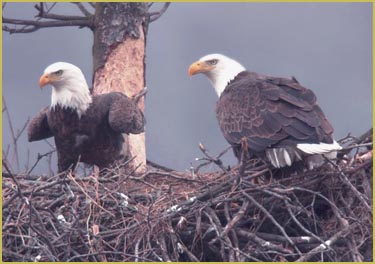 Bald
Eagles
Bald
Eagles
Bald
Eagles Recovering Across the
Country
July 05,
2006 - By Michael Cowden, Associated
Press
PITTSBURGH - When
Pennsylvania officials began a campaign in 1983 to
re-establish the state's bald eagle population, only three
pairs of the birds and 12 eaglets remained here. Now there are
more than 100 bald eagle nests in the state for the first time
in over a century.
The news, announced by the state
last week, is part of a wider trend nationally that has seen
the national bird making a spectacular recovery, according to
the U.S. Fish and Wildlife Service. Since the mid-1960s, the
number of bald eagles in the continental U.S. has increased
tenfold to over 7,000.
"Pennsylvania is just a
bellwether for every state," said Greg Butcher, director of
bird conservation at the National Audubon Society. "It's just
been a great couple of decades for eagles all across the
country."
Pennsylvania's population is dwarfed by
states like Florida, with about 1,133 breeding pairs,
according to Fish and Wildlife Service data. Minnesota,
Wisconsin, and Washington each have more than 500 breeding
pairs.
Alaska has about 100,000 bald eagles, more than
90 percent of the nation's population, said Jody Millar,
coordinator of the Fish and Wildlife Service's bald eagle
recovery program.
Vermont remains the only state in
the continental United States without a successful breeding
pair of bald eagles. A bald eagle couple hatched an eaglet
earlier this year along the Connecticut River, but the young
eagle later died. An active restoration project under way in
Addison County is releasing young eagles into the wild hoping
that when the birds mature they will raise young in the state.
For much of the 19th and early 20th centuries, eagles
were considered a nuisance and routinely shot by hunters,
farmers and fishermen. More than 100,000 were shot in Alaska
alone by salmon fishermen who didn't appreciate competition
from the raptors, Millar said.
The 1940 Bald Eagle
Protection Act outlawed shooting eagles. But in the years
after WWII the widespread use of the pesticide DDT reduced
eagle numbers further. DDT poisoned the birds, killing some
adults and making the eggs of those that survived thin. The
thin eggs dramatically reduced the chances of eaglets
surviving to adulthood.
DDT was banned in 1972. The
next year, the Endangered Species Act passed and the bald
eagles began their dramatic recovery.
"This is a case
where we recognized an environmental threat and took action to
relieve it," said Doug Wechsler, an ornithologist at the
Academy of Natural Sciences in Philadelphia. "It stands as a
model for what to do with other species. ... Most species,
they don't get this much attention."
Because of its
success, the bald eagle is scheduled to be removed from the
endangered species list within the next year or so. The move
has been endorsed by conservation groups.
Source: Associated Press
 Monarch
Butterflies
Monarch
Butterflies
Canada, Mexico, U.S. Agree to Protect
Butterflies
July 06, 2006
- By Maggie Fox, Reuters
WASHINGTON -
Wildlife officials in Mexico, the United States and Canada
have agreed to work together to protect the Monarch butterfly,
which makes a spectacular migration every year from Canada to
Mexico.
Officials from the U.S. Fish and Wildlife
Service, the National Park Service, Canada's Wildlife Service
and Parks Agency and Mexico's Secretariat of the Environment
and Natural Resources have designated 13 wildlife preserves as
protected areas, the Fish and Wildlife Service said Wednesday.
The "Trilateral Monarch Butterfly Sister Protected
Area Network" will develop international projects to preserve
and restore breeding, migration and winter habitat for the
orange and black butterflies.
Every autumn, millions
of monarchs leave eastern Canada and the United States and fly
distances of 2,800 miles and more to the oyamel fir forests of
Mexico's Sierra Madre Mountains for the winter. Monarchs west
of the Rocky Mountains migrate south to eucalyptus groves in
southern California.
The informal agreement will
include sharing information about ways to preserve the habitat
and migratory pathways of the butterflies, said Donita Cotter,
a spokeswoman for the U.S. Fish and Wildlife Service.
It will not require any legislation.
"I think
it's wonderful," Monarch researcher and ecologist Dr. Lincoln
Brower of Sweet Briar College in Virginia said in a telephone
interview.
"I think it will make a good symbolic
statement."
But Brower said the agreement will do
little to preserve the butterflies unless stronger action is
also taken to stop logging in Mexico and to change farming
practices in the United States that are destroying the plants
the butterflies rely on.
"We are going to lose the
whole thing if they don't stop this silly illegal logging in
Mexico," Brower said.
Illegal loggers have been
destroying the trees in Mexico's Monarch Butterfly Biosphere
Reserve, while development is threatening the California
eucalyptus groves. Brower said there is evidence that heavy
use of weedkillers is wiping out the milkweed plant, which is
the only thing that Monarch caterpillars will eat.
This agreement brings attention to the threats, Brower
said. "It is important that the countries keep up pressure on
each other," he said.
Source: Reuters
 Dinner Is
Served
Dinner Is
Served
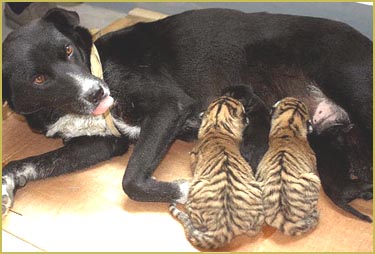
Dog Nurses Tiger Cubs in
China
Ted
Chamberlain
Who says you can't
teach an old dog new tricks? The mother of these tiger cubs
couldn't produce enough milk, so zookeepers in Hefei, China,
enlisted this dog. She began work when the cubs were one day
old, on May 2, when this picture was taken. This isn't the
first time a dog has played wet nurse to tigers at the Hefei
zoo, which organized a similar arrangement with another dog
last year.
It may not even be the oddest recent
example of cross-species suckling. As of February, India's
Namatia Ghosh, 46, was still breastfeeding the pet monkey her
husband found orphaned several years ago. "He is my son," she
told BBC News. Not to be outdone, Hlah Htay, 40, helped a
Burmese zoo feed two tiger cubs in April, according to the AFP
news service. The cubs had been separated from their
aggressive mother.
Tigers are born toothless. In the
wild they nurse for about six months but begin eating meat
after six to eight weeks, when the mother begins sharing her
kills.
Photograph from China
Newsphoto/Reuters/Corbis |
If you no longer wish to receive our NWHS Newsletter,
just email
us and ask to be removed. Make certain to specify the
email address you wish to be removed from the subscription
list, if different from the email used to write us.
Articles not under the National Wildlife Humane Society (NWHS) by-line, do
not necessarily reflect the opinions or policies of NWHS.
Articles not origintating from NWHS, are passed onto
interested recipients as is, and uneditied.
Privacy Policy: Your name, email address, or
any other private info will never be sold, traded, or
furnished to any other parties. Your privacy is assured, and
all info is stored offline. All subscribers' addresses are
hidden from all other subscribers and sent as "blind copies"
(BCC:).
 | | |
