|
NWHS
#007
June 25,
2006
Dear NWHS Supporter,
Welcome to issue #007 of the NWHS E-Newsletter. We thank
all subscribers for allowing us into your email inbox. As
you may have noticed, we have added a bit to the aesthetics of
this newsletter. We hope you like it :)
Please forward this email. If you enjoy this newsletter,
please invite others to sign up.
You may visit the National Wildlife Humane Society's
website at: http://www.humanewildlife.org
More NWHS news can be viewed on our site at:
If you would like to
receive this Newsletter and are not subscribed, just let us
know at info@humanewildlife.org. Please feel free to forward this Newsletter to
others you feel might be interested.
Please refrain from replying directly
back to us from this Newsletter. If you wish to email us,
concerning this Newsletter, or any other matter, please do so
at:
If you see a current and interesting
wildlife story, feel free to send us a link (to the info@
email address) to share with the other
subscribers.
 Bamboo Coral
In The Gulf Of Mexico
Bamboo Coral
In The Gulf Of Mexico
Coral
Reef Ecosystem May Fight
Illnesses
Associated Press
MIAMI - Biomedical
researchers who dove down nearly 3,000 feet to search a
newly-discovered coral reef found treasures they say may help
doctors fight cancer, Alzheimer's disease and other illnesses.
Scientists with the Harbor Branch Oceanographic
Institution descended to water sunless, black water in the
Florida Straits, a passage located between the Keys and Cuba.
There, they found a new coral reef ecosystem that
features man-size coral thickets and limestone towers.
"Gorgeous. Oh, beautiful goblets, just gorgeous," said
Shirley Pomponi, president of Harbor Branch. "It's a richer
area than we thought, for sure."
Most importantly,
they also found sponges and coral, including a new species of
bamboo coral. Scientists have previously used chemicals from
the underwater finds to fight diseases.
Researchers
discovered hints of the reef's existence in the 1970's, but
didn't witness the real majesty of this unknown ecosystem
until December. Using solar technology developed at the
University of Miami, they located sites that sustain
themselves without sunlight or obvious energy, according to
Mark Grasmueck, a UM assistant professor.
Armed with a
robotic torpedo, advanced sonars, sensors and cameras,
explorers descended in a state-of-the art, submersible bubble
the size of two vehicles.
Now, researchers will take
what they brought up from those depths to laboratories and
search for new medicinal compounds that might exist.
John Reed, Harbor Branch's chief scientist said the
goal is to find "something that kills cancer cells and doesn't
kill anything else."
Information from:
The Miami Herald, http://www.herald.com
Source: Associated Press
 Tanzanian
Bushbaby (galago)
Tanzanian
Bushbaby (galago)
First Field Surveys of Tanzanian
Mountains
Reveal over 160 Animal
Species, including New and Endemic
Species
June 2006 -
By World Wildlife
Fund
WASHINGTON, D.C. -
The first field surveys of the Rubeho Mountains in Tanzania
revealed over 160 animal species - including a new species of
frog and eleven endemic species - according to an article
published in the African Journal of Ecology this month.
The findings elevate the importance of protecting this
biologically-rich wilderness area and the broader Eastern Arc
Mountain range from destructive activities underway such as
clear-cutting for agriculture, logging and poaching.
"The wealth of life that's supported by the Rubehos is
typical of Tanzania's Eastern Arc Mountain range," Dr. Neil
Burgess, co-author of the article and African conservation
scientist, World Wildlife Fund. "We've documented some
destruction already underway, so protecting this mountain
range is an urgent priority not just for its unique wildlife,
but also for the people and economy of Tanzania. The Eastern
Arc catches and gathers water for Tanzanians - generating
about 50 percent of the nation's total electricity through its
hydropower."
For a total of 112 days over two years,
an international team of scientists from the Tanzania Forest
Conservation Group, Oxford Brookes University, and the
Zoological Museum of Copenhagen conducted surveys using a
variety of methods including tracking, phototraps and audio
recordings. The phototraps captured mammals like a Mountain
dwarf galago (Galagoides orinus) and a red duiker
(Cephalophus natalensis).
Using a tape recorder
and directional microphone, researchers recorded the calls of
two species of galagos. Galagos are small, nocturnal primates
with large, round eyes commonly known as bushbabies. Some
people believe "bush baby" refers to the animal's cries which
can sound similar to the cries of human babies.
In one
small valley, Nike Doggart of the Tanzania Forest Conservation
Group discovered a new species of frog (Arthroleptis
nikeae) hiding among the leaf litter under the forest
canopy. The smooth-skinned, brown patterned frog measures
about 2.25 inches from snout to bottom.
"Surveying
just one section of the Eastern Arc, we discovered a little
frog no one knew existed," said Nike Doggart, lead author of
the article and Technical Advisor, Tanzania Forest
Conservation Group. "Imagine what other wildlife we may
discover if we can help preserve the whole mountain range."
Researchers found eleven species endemic to or found
only in the Eastern Arc Mountain range. Among these eleven
species are the Mountain dwarf galago, two chameleons, the
checkered elephant shrew (Rhynchocyon cirnei) and
several birds. The Eastern Arc forests have the densest
occurrence of endemic species in all of Africa.
Over
the course of the survey, researchers also observed some
alarming encroachments into the forests where these animals
live even though the forests are within official reserves. The
team observed about 49 acres of one forest reserve had been
cleared for bean and tobacco farms. Elsewhere, there was
evidence of logging and hunting camps. These observations
underscore the urgent need for additional conservation
investment in the area and in helping limited forestry
department staff with tiny budgets effectively manage the
forest reserves.
The Rubeho Mountains are part of the
Eastern Arc Mountain range in eastern Tanzania and located
north of the city of Morogoro. Its forests are often covered
in a blanket of mist during the night and help collect water
for two nearby rivers which in turn provide water for several
settlements and a town. As a crucial source of water and home
to unique and threatened wildlife, World Wildlife Fund
considers the Eastern Arc Mountain range and coastal East
Africa a conservation priority and works with local
communities and partners to protect the natural richness of
the region.
The Tanzania Forest
Conservation Group is a Tanzanian conservation organization
which focuses on saving the unique plants and animals of
Tanzania's forests. For more information on TFCG, visit
www.tfcg.org.
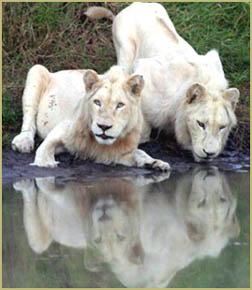 Young White
Lions
Young White
Lions
White
Lions
REUTERS/Antony
Kaminju
A pair of rare
young white lions drink at a watering hole at the Global
White Lion Protection Trust game reserve in Timbavati, South
Africa, in this picture taken May 31, 2006. The lions were
recently released into the wild as part of a re-introduction
program since their arrival from a Johannesburg zoo two years
ago.
NWHS Headquarters Office Building
Update
We have the new office
building. It is now onsite adjacent to Top Of The
Rock Animal Sanctuary, and is the national headquarters
for National Wildlife Humane Society. There
will be NO monthly payments, thanks to those who have already
assisted in this. We have to finish the inside, so will
now be purchasing romex wiring, insulation, socket boxes,
paneling, fasteners, paint and a small window air conditioner.
Oh, and an American flag and NWHS sign.
If anyone would care to
assist on these final costs, please feel free to click the
link below. There is now a photograph of the new buildling, on
premises, underneath the conceptual picture viewable from this
link.
Click To See How To
Help |
If you no longer wish to receive our NWHS Newsletter,
just email
us and ask to be removed. Make certain to specify the
email address you wish to be removed from the subscription
list, if different from the email used to write us.
Articles not under the National Wildlife Humane Society (NWHS) by-line, do
not necessarily reflect the opinions or policies of NWHS.
Articles not origintating from NWHS, are passed onto
interested recipients as is, and uneditied.
Privacy Policy: Your name, email address, or
any other private info will never be sold, traded, or
furnished to any other parties. Your privacy is assured, and
all info is stored offline. All subscribers' addresses are
hidden from all other subscribers and sent as "blind copies"
(BCC:).
 | | |
