|
NWHS
#005
June 12,
2006
Dear NWHS Supporter,
Welcome to issue #005 of the NWHS E-Newsletter. We
thank all subscribers for allowing us into your email
inbox. Please forward this email. Invite others to sign
up.
You may visit the National Wildlife Humane
Society's website at: http://www.humanewildlife.org
More NWHS news can be viewed on our
site at:
If you would
like to receive this Newsletter and are not subscribed, just
let us know at info@humanewildlife.org. Please feel free to forward this
Newsletter to others you feel might be interested.
Please refrain from replying
directly back to us from this Newsletter. If you wish to email
us, concerning this Newsletter, or any other matter, please do
so at:
If you see a current and
interesting wildlife story, feel free to send us a link (to
the info@ email address) to share with the other
subscribers.
Two Frog Species Feared
Extinct Found in Colombia
June 07, 2006 —
By Alister Doyle, Reuters
OSLO — Two frog species
feared extinct have been rediscovered in Colombia, a boost for
scientists battling to save rare amphibians threatened by a
deadly disease.
"These finds show there is still
hope...a lot of these species were pretty much written off,"
Claude Gascon, a senior vice-president at Conservation
International in Washington, told Reuters on Tuesday.
Scientists have found the Santa Marta Harlequin frog
and the San Lorenzo Harlequin frog, rated critically
endangered after no sightings in 14 years, in a reserve in the
Sierra Nevada de Santa Marta massif on Colombia's Caribbean
coast.
A fungal disease that smothers amphibians' skin
is decimating dozens of species of brightly-coloured frogs in
Central and South America, adding to pressures such as
pollution, climate change, deforestation and expanding cities.
The rediscovery of another species -- a painted frog
-- in Boyaca, Colombia, was announced last month.
Some
scientists say amphibians are on the front line of what may
become the worst extinction crisis since the dinosaurs
vanished 65 million years ago.
Gascon said it was not
clear if the frogs had resisted the skin fungus --
chytridiomycosis -- or were in a region as yet unaffected. The
disease had killed frogs 40 km (25 miles) from the site of the
two latest finds.
Alarmed by extinctions, amphibian
experts are seeking more than $400 million to fund captive
breeding in zoos and aquariums -- already aiding about 35
species. However, frogs cannot be re-introduced to the wild
because of the disease.
DOOMED TO FAIL
"We can
treat the disease in captivity but any re-introduction
programme is doomed to fail," said Joe Mendelson, a curator at
Zoo Atlanta and the acting head of the amphibian specialist
group at the World Conservation Union.
"Capture
programmes are usually all about supporting populations in the
wild. Because of the disease this can't work," he said. He
said captive breeding could be expanded to help "hundreds, if
not thousands, of species".
Amphibians -- toads,
frogs, newts and some worm-like creatures -- are highly
vulnerable to disease, pollution or changes in temperature
because they live on both land and in water and have a porous
skin that absorbs oxygen.
Some vanished species might
have had skills valuable to humans. The Australian Northern
Gastric Brooding frog, considered extinct and not sighted
since 1985, could shut off its digestive juices to incubate
its young in its stomach.
"You can imagine the kind of
knowledge in terms of helping fight ulcers that the gastric
brooding frog might have held," Gascon said.
Gascon
said the rediscovery of the frogs showed that preservation of
small habitats -- such as the El Dorado reserve where the two
frogs were found in Colombia -- could be a key to saving many
threatened species.
A global group of
conservationists, the Alliance for Zero Extinction, said last
year that preserving 595 sites around the world could help
save 794 endangered species.
Source: Reuters
Florida to Remove Manatee from
Endangered List
June 08, 2006 - By Jim Loney,
Reuters
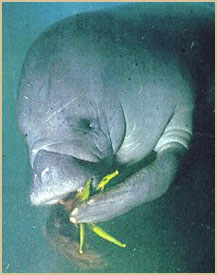
MIAMI - Florida's
wildlife commission voted Wednesday to remove the manatee from
the state's endangered species list, a move environmentalists
fear could erode safeguards for the popular sea creature.
State officials said the "downlisting" to threatened
from endangered would have no impact on protections afforded
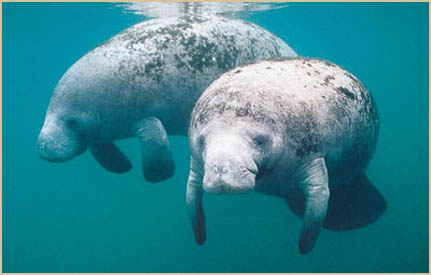
the massive, lumbering marine mammal often called the sea cow.
Manatees inhabit Florida's canals and coastal waters,
where they are frequently killed or injured by boats. A survey
this year found about 3,100 remaining manatees.
State
officials say manatees no longer qualify for endangered
status, which is reserved for creatures that face extinction.
Environmentalists, citing predictions the manatee population
could decline by 50 percent in the next 45 years, say the
criteria need to be changed.
The Florida Fish and
Wildlife Conservation Commission voted unanimously at a
meeting in West Palm Beach to change the manatee's status. But
the move will not take place until commission staffers draw up
a plan to ensure the creature's continued recovery, which
could take a year, an official said.
"Whatever
protections we woke up with today we go to bed with tonight,"
commission spokesman Willie Puz said.
The manatee
remains on the federal endangered species list and is
protected by other federal laws.
Slow-moving and
herbivorous, manatees can eat up to 15 percent of their body
weight daily. On average, adult manatees are about 10 feet
long and weigh about 1,000 pounds .
They are
vulnerable to speeding boats because they often drift lazily
at or just below the surface of the water. They are also
killed by cold weather and red tide algae blooms.
Patrick Rose, an official with the Save the Manatee
Club, said the downlisting could weaken protections and
decrease government funding at a time when threats from boats,
red tide and loss of habitat are rising.
"The world is
going to think the manatees are doing a lot better when
they're not," he said.
Source:
Reuters
NWHS Headquarters Office Building
Update
We continue to seek assistance in
getting together the down payment for the pre-fab cabin we are
purchasing in another week or so. We have the separate
US Postal address registered, a mailbox on the road, a
utility pole with security light and meter (and breaker box).
We also have a desk, chair, file cabinet, phone, and the all
important PC.

Click To See How To Help
We will post a photo of it after
it's set up. It is being purchased with the interior
unfinished, to allow as much as possible for the down-payment.
We can lay in wiring and receptacles first, then add in
paneling later.
Nothing fancy, but a good place to
build a national organization for the benefit of endangered
species, while preserving capital for more important things.
Like real animals....
|
If you no longer wish to receive our NWHS Newsletter,
just email
us and ask to be removed. Make certain to specify the
email address you wish to be removed from the subscription
list, if different from the email used to write us.
Articles not under the National Wildlife Humane Society (NWHS) by-line, do
not necessarily reflect the opinions or policies of NWHS.
Articles not origintating from NWHS, are passed onto
interested recipients as is, and uneditied.
Privacy Policy: Your name, email address, or
any other private info will never be sold, traded, or
furnished to any other parties. Your privacy is assured, and
all info is stored offline. All subscribers' addresses are
hidden from all other subscribers and sent as "blind copies"
(BCC:).
 | | |
