|
NWHS #003
May 31, 2006
Dear NWHS Supporter,
Welcome to issue #003 of the NWHS E-Newsletter. We thank
all subscribers for allowing us into your email inbox. Our
subscriber list continues to grow. Feel free to forward the
newsletter to your friends who care about wildlife. Invite
them to subscribe.
You may visit the National Wildlife Humane Society's
website at:
More NWHS news can be viewed on our site at:
If you would like to
receive this Newsletter and are not subscribed, just let us
know at news@humanewildlife.org. Please feel free to forward this Newsletter to
others you feel might be interested.
Please refrain from replying directly
back to us from this Newsletter. If you wish to email us,
concerning this Newsletter, or any other matter, please do so
at:
If you see a current and interesting
wildlife story, feel free to send us a link (to the info@
email address) to share with the other
subscribers.
Alligators Abound During Annual
Florida Count
May 29, 2006 — By Brian
Skoloff, Associated Press
ON LAKE OKEECHOBEE, Fla. — To
the unaided eye, the swamp seems to sleep at night. But hit it
with a spotlight and alligators suddenly appear everywhere,
their bulbous red eyes glowing on the water's black surface.
The biologists begin to count. In three hours, from
just a pair of airboats, they find 754 gators in one small
section of Lake Okeechobee, one of Florida's most concentrated
gator habitats.
The data becomes part of the state's
annual alligator count, used to set the number of hunting
permits issued in coming years. More hunters are expected this
season after three separate fatal attacks earlier this month.
Even with rampant development and loss of wetlands,
officials estimate there are more than one million alligators
in Florida -- a miraculous comeback for a species that was
approaching extinction 40 years ago.
State officials
and environmentalists attribute the population growth to
strict federal regulations on sales of alligator products like
skin and meat, along with tight limits on hunting and
trapping.
On this balmy May evening, as the setting
sun tinted the wispy clouds a fiery orange-red, biologist
Lindsey Hord dipped what looked like a meat thermometer into
the water.
Eighty-four degrees. Perfect. The warmer
the water, the more the gators surface.
Hord, who
works for the Florida Fish and Wildlife Conservation
Commission, used a GPS system to track his location
as he zipped around the lake in near blackness, aiming his
spotlight and counting eyes. Alligators are easier to find in
the dark when a single spotlight can illuminate dozens, even
some hidden in sawgrass.
Each year, scientists set out
into some 50 locations statewide for the monthlong population
assessment, recording alligator size and estimating age.
If they can't get close enough before a gator sinks
beneath the surface, the biologists use estimates, sometimes
using the distance between its eyes to determine size or
noting the pace with which it fled. The younger the gator, the
slower it retreats because older gators learn to associate
light with people, Hord said.
"That's just a survival
instinct," he said.
Though its brain is only the size
of a man's thumb, the American alligator has proven highly
adaptable since it emerged about 4 million years ago from a
line of reptiles that have survived on Earth for 200 million
years.
Now found from southeastern Oklahoma and
eastern Texas across to North Carolina and Florida, the
species can grow to 14 feet long and weigh up to 1,000 pounds
during a life span of more than 30 years.
In 1967,
after years of overhunting and habitat loss, the American
alligator was listed as an endangered species, but
conservation efforts and hunting regulations led the U.S. Fish
and Wildlife Service to pronounce it fully recovered 20 years
later. Florida lists it as a species of special concern,
giving the state authority over management and control
programs.
Now, even with hunting, numbers are
increasing in some areas and remaining stable in others, state
alligator researcher Allan Woodward said. "Our (hunters) are
targeting the real big alligators, 9 feet or larger, so we're
actually reducing the population of those, and the smaller
ones seem to be doing a lot better," Woodward said.
Environmentalists agree the alligator is thriving.
"With the right biological input, you can harvest a
number of alligators on an annual basis, as long as you don't
reopen a Wild West atmosphere in terms of the trade of
alligator products," said Charles Lee of Audubon of Florida.
Some 30
farms have permits to raise alligators and take eggs and
hatchlings from the wild. Up to half of the eggs can be taken
without affecting the population, Hord said.
"Survival
of young alligators is density-dependent. The higher the
number of alligators, the lower the survival rate of young,"
he said.
Based on previous counts, the state wildlife
commission added six weeks to this year's hunting season,
which will run Aug. 15 to Nov. 1.
Spokesman Tony Young
said he expects sales of hunting permits, allowing for two
kills each, to top last year's record of 2,770 because of
media reports on the three recent fatal attacks, just as
demand for shark fishing permits soared after the movie "Jaws"
came out in 1975.
Limited gator hunting also is
allowed in Alabama, Georgia, Louisiana and Texas.
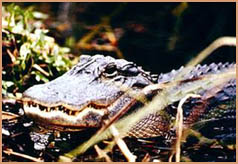
Photo: Florida Fish and Wildlife Conservation
A Mother's Day Gift to
Mother Earth:
Baby Bison Born on the
Prairie
|
|
 Photos courtesy Martha Collins Photos courtesy Martha Collins |
|
|
| |
American Prairie
Foundation
Just in time for last Mother's
Day, five wild baby bison have been born on the plains of
eastern Montana. The bison are part of a wild herd that live
on a new prairie wildlife preserve and are the first bison to
be born on this part of the Great Plains, the heart of their
historic range, in 120 years.
"These baby bison were the perfect Mother's Day
present for anyone who loves prairie wildlife," said Sean
Gerrity, president of the American Prairie Foundation (APF),
the nonprofit owner of the prairie preserve. "These baby bison
are entering this world just as the grass is starting to grow
after a long, cold winter. Just a few days old, they're
already running around, playing and chasing each other."
Although around a half-million bison live in North America,
just 20,000 or so can be considered "wild" and most wild bison
are beset by problems such as small herd size, intensive
management and culling practices, absence of major predators,
and non-native diseases. All told, there is no viable bison
herd that is free of problematic diseases such as brucellosis
or exists under natural conditions. In other words, there is
no bison herd large enough or healthy enough to maintain the
long-term genetic health of the species.
"These baby bison are a lot more than just cute, although
they certainly are that," said Dr. Curt Freese, director of
the Northern Great Plains office of World
Wildlife Fund, APF's partner on the prairie
preserve. "These bison babies represent a future for our
children and grandchildren that include wild bison. Most
people have no idea how threatened bison are."
About the American Prairie Foundation The
mission of American Prairie Foundation is to create and manage
a prairie-based wildlife reserve that, when combined with
public lands already devoted to wildlife, will protect a
unique natural habitat, provide lasting economic benefits, and
improve public access to and enjoyment of the prairie
landscape.
|