|
NWHS #002
May 26, 2006
Dear NWHS Supporter,
Thank-you to those who assisted in evaluating the
new NWHS E-Newsletter feature. We received positive feedback
from the folks that received the Beta #001 issue, who gave high
marks for layout and design.
You may visit the National Wildlife
Humane Society's website at:
If you would like to receive this Newsletter and are not subscribed, just let us know at info@humanewildlife.org. Please feel free to forward this
Newsletter to others you feel might be interested.
Please refrain from replying directly
back to us from this Newsletter. If you wish to email us, concerning
this Newsletter, or any other matter, please do so
at:
Now, For Something
Really Different
NWHS Feature News
We are going to do something most Newsletters never
do. We are going to take a very current impact issue and show
both sides. You, as the reader, can weigh and balance for
yourself with no news agenda to slant opinion. We plan on
doing this from time to time, and as membership grows, we can
add a poll, so readers can make their opinion become
interactive to others.
Big Oil And
Alaska
The following are
three articles from three different sources, concerning
opening up the last true wilderness in the United States, to
big oil company drilling operations. This area is known as the
North Slope and heavily involves the Arctic National
Wildlife Refuge (ANWR). There has been a bitter embroiled
battle concerning the ANWR amongst the U.S. Legislators. It
has been a largely partisan battle between the Democrats and
Republicans, with a few Republicans siding with the
Democrats to hold off on drilling operations there.
Many wildlife conservationists and environmentalists have
argued that there has not been enough impact study, to fully
understand what it will do to this public
land.
The Arctic National
Wildlife Refuge is the last true wilderness area in the
United States. Do we turn it over to the oil companies,
who have assured everyone there will be no negative impact, or
hold up on drilling until more studies are
completed?
The House voted
today to start drilling in The
Arctic National Wildlife Refuge, so at this point it doesn't
really matter what you think, concerning the House. So, now it's on to the Senate.
The following are from
3 sources..
Rueters News
Agency, National Center For Public Analysis, and
Alaska Action.org (an organization representing
wildlife and nature advocates for Alaska's last frontiers).
One very For, one Middle of the road, and one very Against. It
is interesting to see the different slants on "The
Slope".
One expert claims it
will end up saving us a penny a gallon on gas, another says 40
cents a gallon savings. I'm no expert (on fuel..lol) but I
think we should ween ourselves from nursing the big petroleum
breast, and get off oil dependency ASAP. Then the debate of
giving up the last unspoiled wilderness in the USA, would be a
moot point. I also understand, that big biz wants to make
maximized profits off of oil until it's completely gone.
"Good to the last
drop".
U.S. House Votes for Oil Drilling in
Alaska Refuge
May 26, 2006 - By Chris
Baltimore, Reuters
WASHINGTON - The U.S. House of
Representatives Thursday approved a plan to allow oil drilling
in Alaska's Arctic National Wildlife Refuge.
The House
voted 225-201 to approve a plan sponsored by California
Republican Richard Pombo that would allow drilling on 2,000
acres of ANWR out of the refuge's total 19 million acres.
It was the 12th vote on the divisive ANWR drilling
issue since 1995 in the House. The ANWR drilling plan faces a
nearly certain filibuster threat in the Senate, where
pro-drilling Republicans hold a slimmer majority.
Tapping the 10 billion barrels of crude estimated to
lay beneath the refuge is a key part of the Bush
administration's national energy plan to reduce U.S. reliance
on petroleum imports, which now comprise about 60 percent of
U.S. supplies.
"Had President Clinton not vetoed the
ANWR drilling bill in 1995, we would have at least an
additional 1 million barrels a day of domestic oil production
.... today," U.S. Energy Secretary Sam Bodman said.
But many Democrats and environmentalists argue there
is not enough oil to justify destroying the habitat for ANWR's
polar bears, caribou and other wildlife.
"We should
not be so willing to sacrifice this unspoiled area for just
six months of oil," said Rep. Diana DeGette, a Colorado
Democrat.
Pombo criticized Democrats for repeatedly
trying to block ANWR. "Being against everything is not an
energy policy," he said, insisting that ANWR can be drilled in
a way that does not harm the environment.
Anti-drilling Democrats said ANWR development was
merely a Republican balm to soothe voters' anxiety over rising
gasoline prices ahead of the Memorial Day holiday weekend, the
unofficial start of the summer driving season, when gasoline
demand usually peaks.
"Families will pay $50 to tank
up this weekend and Republicans will pretend that they really
care," said Rep. Peter DeFazio, an Oregon Democrat.
Rep. Joe Barton of Texas, chairman of the House Energy
and Commerce Committee, said ANWR supplies could reduce
gasoline prices by about 40 cents per gallon, if ANWR is
tapped.
The Senate this year included ANWR drilling in
appropriations legislation that is not subject to a
filibuster, but House budget-writers balked at including it in
their version.
"Everyone knows this bill is dead on
arrival in the U.S. Senate," DeGette said.
The ANWR
bill that passed the House would need to garner 60 votes in
the Senate to circumvent a filibuster, in which it could be
talked to death.
At peak production, ANWR could
produce about 1.5 million barrels per day of oil, which bill
sponsors say could go a long way toward replacing oil imports
from Middle East producers like Saudi Arabia.
If
Congress opened ANWR to drilling, it would take about 10 more
years for the refuge's oil production to peak, according to
the Energy Department.
ANWR Victory Big Step To Energy
Independence
May 26, 2006 - By the
National Center for Policy Analysis
DALLAS, Tex. - The House
voted today to allow the expansion of drilling in the Arctic
National Wildlife Refuge (ANWR). National Center for Policy
Analysis (NCPA) Senior Fellow H. Sterling Burnett says
expanded drilling in ANWR will help increase domestic supplies
of oil and gas as well as give the government an extra
$111-173 billion in tax revenues and royalties from oil
companies.
"Consumers want the government to do
something about the high price of oil and this is a good first
step," said NCPA Senior Fellow H. Sterling Burnett. "A
nationwide poll found that 59 percent of Americans favor
further exploration of ANWR."
According to the U.S.
Energy Information Administration (EIA), energy development on
ANWR's northern coastal plain could deliver to the lower 48
states nearly 1.5
million barrels of oil per day at peak production. That is more than
the amount we
import from Saudi Arabia every day.
A 1980 law that
doubled the size of ANWR to 19 million acres expressly
permitted Congress to develop a process through which
exploration and production could proceed. Then-President Jimmy
Carter hailed the bill as a great compromise that "strikes a
balance between protecting areas of great beauty and value and
allowing development of Alaska's vital oil, gas, mineral and
timber resource."
"Drilling in ANWR is economically
and ecologically sound," said Burnett. "There is no indication
that indigenous wildlife would be harmed or hindered in any
way, especially since they have flourished along the North
Slope and Prudhoe Bay."
The NCPA is an
internationally known nonprofit, nonpartisan research
institute with offices in Dallas and Washington, D. C. that
advocates private solutions to public policy problems. We
depend on the contributions of individuals, corporations and
foundations that share our mission. The NCPA accepts no
government grants.
Contact Info:
Dorene
Englert
Tel : 972-308-6459
E-mail : dorene.englert@ncpa.org
Website : the National Center for Policy Analysis
Regarding an issue that some boil down to mere numbers and
statistics, it was refreshing to see the new National
Geographic cover story add faces and stories to the fight to
save Alaska from oil drillers. The moving photographs and
poignant accounts remind us of what else is at stake as
Congress continues to debate the issue.
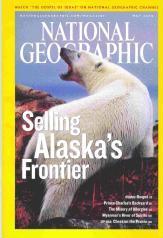
The interests of big oil, wild creatures, and native populations
collide on the largest remaining piece of U.S. wilderness,
Alaska's North Slope.
"The town is so full of anger," says Bernice
Kaigelak, who teaches traditional Inupiat language and
skills at the Nuiqsut village school. "We’re trying to find
a balance between subsistence and the Western way of living.
There are some areas we don’t want them to trash, other
areas we’d like them to use. I’ve come to the point that
regardless of what we say or do, they’re going to come
anyway. If you work with them, you have some
control."
Nuiqsut is a small village that is home to about
one-hundred families on the eastern edge of the National
Petroleum Reserve - Alaska (or NPR-A). One of the strengths of
the thirty-two page article is that, in addition to talking
about the Arctic National Wildlife Refuge, it also looks west
to the rest of America’s Arctic. With gorgeous pictures and
well-written accounts, the article covers federal BLM land,
native lands, the Brooks Range, and Teshekpuk Lake - areas of
ecological and cultural significance that are often
overshadowed by the Arctic Refuge.
Nuiqsut is one of many villages unhappy about recent
developments and the years of fighting. Drillers have forced
them to change their way of life - a price tag has been
applied to a place they consider priceless.
"The caribou herd used to come here. Hardly does
anymore now that this pipeline is here. Oil is a good thing
for the jobs, but it changes things."
-Chester Hopson of Nuiqsut
The article includes an impressive four page map of the
North Slope. It is a startling reminder of just how much of
America’s Arctic has been leased or is eligible for leasing to
oil companies. The red dots, which symbolize where an oil well
is located, are also scattered across the map - the vast
majority in state and native lands. It is hard to miss the
thousands, and in some cases hundreds of thousands, of animals
- shorebirds, raptors, caribou, and whales - that would be
affected or have already been affected by drillers.
Noted biologist George Schaller is quoted in the article,
and his words help summarize the position that we endorse
regarding the Arctic Refuge and all of the other significant
and threatened lands in the Arctic:
"It is the ultimate in patriotism to leave future
generations what the past reveres. Drilling in ANWR is just
ecological vandalism. You have the landscape of 10,000 years
compared with Prudhoe Bay, which has the landscape of New
Jersey. What kind of society do we have that would destroy
that for future generations for a few more gallons of
gas?"
National Geographic should be commended for this piece. Go
ahead and send a thank you email to them ( ngsforum@nationalgeographic.com )
and let them know that they stand on the right side of the
issue and to continue fighting to keep oil companies out of
Alaska. After having read the article, a common question
resurfaced in my mind: weighing all aspects of the issue, how
can anyone continue to argue for drilling in America’s most
cherished wild lands?
BP Oil Spill, Alaska's North Slope, 200,000 gallons 3/8/2006
|
If you no longer wish to receive our NWHS Newsletter,
just email
us and ask to be removed. Make certain to specify the
email address you wish to be removed from the subscription
list, if different from the email used to write us.
Articles not under the National Wildlife Humane Society (NWHS) by-line, do
not necessarily reflect the opinions or policies of NWHS.
Articles not origintating from NWHS, are passed onto
interested recipients as is, and uneditied.
Privacy Policy: Your name, email address, or
any other private info will never be sold, traded, or
furnished to any other parties. Your privacy is assured, and
all info is stored offline. All subscribers' addresses are
hidden from all other subscribers and sent as "blind copies"
(BCC:).
 | | |
